
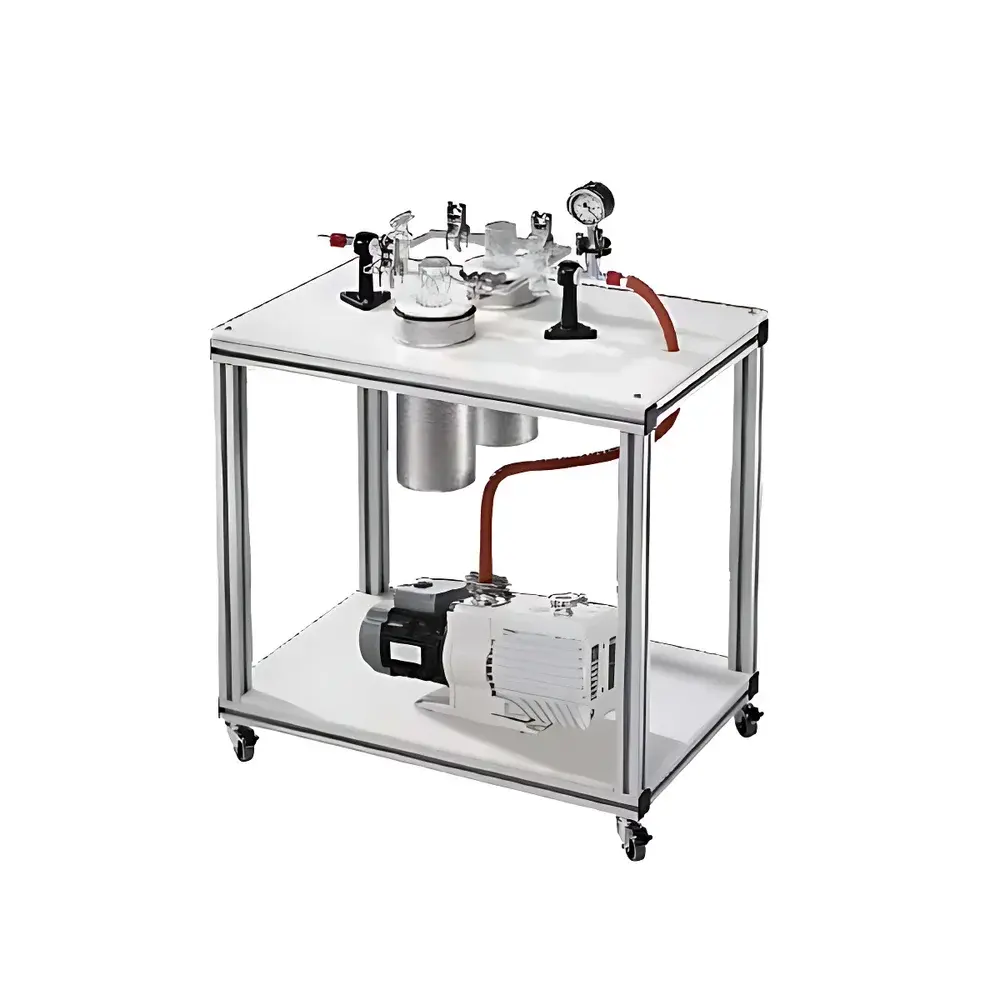
WIGGENS CP1/CP2/GP3 Single-Channel Dual-Cold-Trap Vacuum Systems
| Brand | WIGGENS |
|---|---|
| Origin | Germany |
| Pump Type | Oil-Sealed Rotary Vane Vacuum Pump |
| Models | CP1, CP2, GP3 |
| Construction Materials | Borosilicate 33 Glass, PTFE, PE Work Surface, Aluminum Frame |
| Cold Trap Configuration | Dual Parallel Cold Traps (CP1/CP2) |
| Cold Trap Capacity | 2000 mL Dewar (GP3), 250 mL Condensation Volume |
| Vacuum Interface | KF-NW16 Flanges, GL18 Threaded Connections, PTFE Olive Seals |
| Mobility | Lockable Casters, Modular Benchtop Design |
| Compliance | Designed for GLP-compliant vacuum processes in chemical synthesis and purification labs |
| Software & Control | Analog Vacuum Gauge (CP1/GP3) |
Overview
The WIGGENS CP1, CP2, and GP3 Single-Channel Dual-Cold-Trap Vacuum Systems are engineered for precision-controlled, corrosion-resistant vacuum operations in synthetic organic chemistry, pharmaceutical process development, and analytical sample preparation laboratories. These systems operate on the principle of mechanical vacuum generation using oil-sealed rotary vane pumps—paired with cryogenic condensation via dual-stage cold traps—to protect the pump from solvent vapors, acidic gases, and condensable byproducts generated during distillation, degassing, reflux, and lyophilization workflows. Unlike single-trap configurations, the CP1 and CP2 models integrate two independently operable cold traps in parallel, enabling uninterrupted operation during maintenance or failure of one unit. The GP3 variant extends this architecture with a mobile, integrated manifold platform supporting up to four simultaneous vacuum ports—ideal for multi-vessel reaction setups or parallel sample processing under controlled sub-atmospheric conditions.
Key Features
- Dual cold trap configuration (CP1/CP2): Two borosilicate 33 glass cold traps mounted in parallel with manual three-way valves for seamless switching between units—eliminating process downtime during defrosting or cleaning.
- Chemical resistance: All wetted components—including glass tubing, ball joints, stopcocks, and PTFE-sealed valves—are fabricated from ASTM E438 Type I, Class A borosilicate 33 glass and virgin PTFE, ensuring compatibility with HCl, HF, SO₂, acetone, THF, chlorinated solvents, and other aggressive reagents.
- Modular mobility: Aluminum extrusion frame with lockable polyurethane casters enables stable relocation across lab benches; PE work surface provides non-porous, static-dissipative support for glassware and instrumentation.
- Standardized vacuum interfacing: KF-NW16 flange connections throughout the system ensure leak-tight, repeatable assembly; GL18 threaded ports with 10 mm PTFE olives accommodate standard laboratory glassware without adhesives or O-rings.
- Integrated vacuum monitoring: CP1 and GP3 models include analog Bourdon-tube vacuum gauges calibrated for 0.01–760 Torr (1.33 × 10⁻²–1013 mbar); GP3 allows direct replacement with digital capacitance manometers via its NW16 vacuum port.
- Pump flexibility: Systems are compatible with ChemVak R-series oil-sealed rotary vane pumps (e.g., R-8D, R-17D), selected based on required ultimate vacuum (<4 × 10⁻⁴ mbar for dual-stage models) and pumping speed (180–540 L/min).
Sample Compatibility & Compliance
These vacuum systems are routinely deployed in applications requiring strict adherence to ISO 5832-1 (implant-grade material handling), USP (sterile compounding), and ASTM D1193 (reagent water purity) protocols—where hydrocarbon oil backstreaming must be minimized and condensable vapor capture maximized. The dual cold trap design meets ASTM E2913-13 requirements for solvent recovery efficiency (>98% capture of methanol, ethyl acetate, dichloromethane at −78 °C). All glass components comply with DIN ISO 3585 specifications for borosilicate 3.3, while PTFE components conform to ASTM D4894. The absence of silicone-based lubricants or elastomers ensures compatibility with GC-MS and NMR sample integrity protocols. No internal gaskets or diaphragms contact process streams—eliminating extractables and leachables per ICH Q5C guidelines.
Software & Data Management
While the base CP1/CP2/GP3 systems operate manually via mechanical valves and analog gauges, they support full digital integration through optional upgrades. The NW16 vacuum port on GP3 allows installation of certified digital vacuum transducers (e.g., MKS Baratron 627B) that output RS-485 or 4–20 mA signals compatible with LabVIEW, DeltaV, or Siemens Desigo CCMS platforms. Audit trails, calibration logs, and pressure trend data can be archived in accordance with FDA 21 CFR Part 11 when paired with validated SCADA interfaces. All valve positions are mechanically indexed and labeled—supporting GLP documentation requirements for traceable operational states during regulatory inspections.
Applications
- Reduced-pressure distillation of heat-sensitive compounds (e.g., natural product isolates, polymer precursors)
- Inert atmosphere purging of Schlenk lines and glovebox transfer vessels
- Vacuum-assisted crystallization and recrystallization under controlled vapor pressure gradients
- Removal of low-boiling solvents prior to NMR or mass spectrometry analysis
- Cryogenic trapping of volatile acidic gases (HBr, HCl) during Grignard or lithiation reactions
- Multi-port vacuum filtration of nanoparticle suspensions using parallel Büchner funnels
- Pre-concentration of aqueous extracts prior to LC-MS analysis—minimizing thermal degradation
FAQ
Can the dual cold traps operate simultaneously?
Yes—the CP1 and CP2 systems allow both traps to function in parallel when configured with open three-way valves, increasing total condensation capacity and reducing frost accumulation rate per unit.
Is the GP3 manifold compatible with non-WIGGENS vacuum pumps?
Yes—any pump with NW25 or DN25 KF flange output (e.g., Edwards RV8, Agilent IDP-10) can be coupled using standard ISO-KF adaptors; flow dynamics remain within specification up to 540 L/min.
What is the maximum allowable operating temperature for the PTFE olive seals?
PTFE olives maintain vacuum integrity up to 260 °C continuously; short-term exposure to 300 °C is permissible during autoclave sterilization cycles.
Does the system meet CE and RoHS directives?
Yes—all electrical components (including optional digital gauges and pump controllers) carry CE marking and comply with Directive 2011/65/EU (RoHS2) and 2014/30/EU (EMC).
How often should the vacuum pump oil be changed under continuous operation?
With typical use in chemical synthesis (8 hrs/day, moderate solvent load), ChemVak R-series pump oil requires replacement every 500 hours or quarterly—whichever occurs first—as verified by acid number titration (ASTM D974).



