
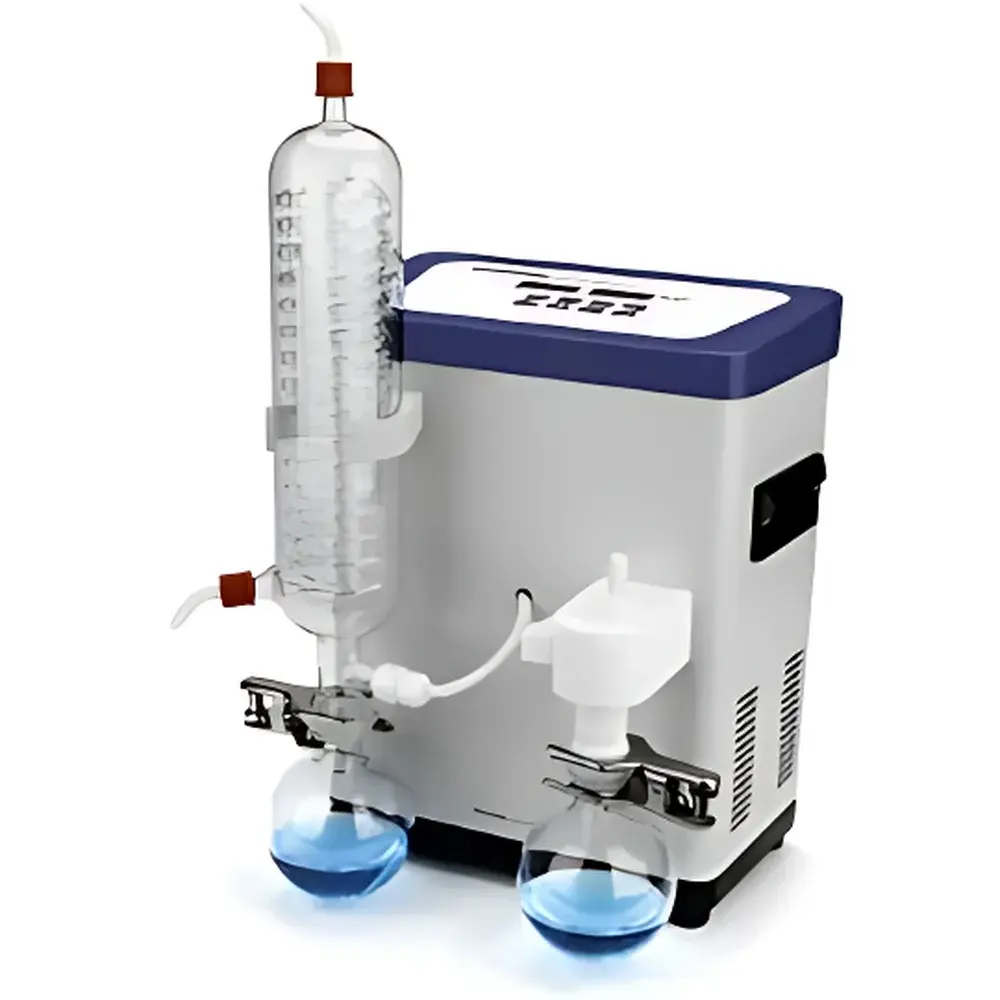
WIGGENS CSC610 Corrosion-Resistant Solvent Recovery Vacuum System
| Brand | WIGGENS |
|---|---|
| Origin | Germany |
| Model | CSC610 |
| Vacuum Pump Type | Oil-Free Diaphragm Pump |
| Ultimate Vacuum | 2–4 mbar |
| Noise Level | 60 dB(A) |
| Power Consumption | 245 W |
| Flow Rate | 37 L/min |
| Inlet/Outlet Port OD | 10 mm |
| Weight | 20.1 kg |
| Standard Configuration Includes | Corrosion-Resistant Diaphragm Pump, DVR380 Digital Vacuum Controller, Separation Trap, Condenser Assembly, Mounting Base with Support Rod, Tubing & Fittings |
Overview
The WIGGENS CSC610 Corrosion-Resistant Solvent Recovery Vacuum System is an integrated, oil-free diaphragm-based vacuum solution engineered for safe and efficient solvent recovery in demanding laboratory environments. Unlike traditional rotary vane (oil-lubricated) pumps, the CSC610 employs a chemically resistant PTFE/NBR diaphragm mechanism—eliminating oil contamination risks and enabling reliable operation with aggressive solvents including acetone, chloroform, methanol, hydrochloric acid vapors, and caustic aqueous streams. Its core function centers on controlled vacuum generation coupled with inline condensation: process vapors are drawn through a separation trap to remove particulates and liquid water, then routed to an integrated air-cooled condenser where volatile solvents are liquefied and collected—reducing emissions, minimizing hazardous waste disposal, and recovering high-purity solvents for reuse. Designed for continuous duty in GLP-compliant labs, the system operates within a stable vacuum range of 2–13 mbar, supporting gentle distillation, rotary evaporation, vacuum drying, fractional crystallization, and inert-atmosphere degassing without thermal degradation or cross-contamination.
Key Features
- Chemically inert wetted path: PTFE-coated diaphragms, stainless steel valves, and EPDM/PTFE seals ensure long-term compatibility with organic solvents, strong acids (e.g., HCl, HNO₃), and alkaline solutions
- Integrated separation trap at inlet prevents solid particulates and condensed water from entering the pump head—significantly extending service life and reducing maintenance frequency
- Digital vacuum control via DVR380 controller: real-time pressure display (mbar, Torr, psi, kPa), programmable setpoints, multi-step vacuum ramps, and analog input/output for external system integration
- Modular architecture: pump, condenser, trap, and controller are pre-aligned on a rigid mounting base—enabling rapid setup, vibration damping, and space-efficient benchtop deployment
- Low-noise operation (≤60 dB[A]) achieved through balanced motor design, acoustic insulation, and non-resonant structural coupling—suitable for shared lab spaces and noise-sensitive facilities
- No oil required: eliminates risk of backstreaming, oil mist emission, or solvent dilution—critical for analytical sample integrity and ISO 17025 traceability requirements
Sample Compatibility & Compliance
The CSC610 is validated for use with low-to-medium volatility solvents (bp: 30–200 °C), including but not limited to ethyl acetate, dichloromethane, tetrahydrofuran, dimethylformamide, and acetonitrile. It is routinely deployed in pharmaceutical QC labs performing USP residual solvent analysis preparation, in academic synthetic chemistry workflows involving acid-catalyzed esterifications, and in semiconductor R&D cleanrooms requiring halogenated solvent recovery under Class 1000 conditions. The system complies with IEC 61000-6-3 (EMC emission limits), IEC 61000-6-2 (immunity), and meets CE marking requirements per Machinery Directive 2006/42/EC. All electrical components conform to IP20 ingress protection; vacuum tubing meets FDA 21 CFR 177.2600 for repeated contact with food-grade solvents.
Software & Data Management
While the CSC610 operates as a standalone instrument, the DVR380 controller supports RS-232 serial communication for bidirectional data exchange with LIMS or ELN platforms. Pressure logs (timestamped, ±0.1 mbar resolution) can be exported as CSV files for audit trails. The controller firmware implements electronic signature-capable user access levels (operator, supervisor, administrator), configurable password policies, and automatic event logging—including vacuum deviation alarms, overtemperature warnings, and runtime counters. These capabilities align with FDA 21 CFR Part 11 requirements for electronic records when deployed in regulated GMP environments, provided local validation protocols are executed per Annex 11 guidelines.
Applications
- Vacuum-assisted rotary evaporation of heat-sensitive natural product extracts under controlled pressure gradients
- Recovery of >92% of dichloromethane from column chromatography fractions prior to lyophilization
- Continuous degassing of polymer precursor solutions in OLED material synthesis
- Acid gas scrubbing during catalytic hydrogenation workups using HCl-saturated ether streams
- High-vacuum filtration of corrosive metal oxide suspensions in battery cathode R&D
- Pre-concentration of environmental water samples containing volatile organic compounds (VOCs) per EPA Method 502.2
FAQ
Is the CSC610 suitable for use with hydrofluoric acid (HF) vapors?
No. While the pump exhibits broad resistance to mineral acids, HF attacks silica-based components and PTFE fillers at elevated temperatures and concentrations. Consult WIGGENS Application Engineering for custom fluoropolymer-lined alternatives.
Can the condenser be upgraded to a chilled recirculating type?
Yes. The standard air-cooled condenser accepts optional retrofit kits with glycol-jacketed coils compatible with external chillers (–20 °C to +10 °C operating range).
What is the recommended maintenance interval under continuous 8-hr/day operation?
Diaphragm replacement is advised every 12,000 operating hours or 24 months—whichever occurs first—based on accelerated life testing per DIN EN 60068-2-64. No routine oil changes or valve cleaning are required.
Does the system support vacuum ramping during fractional distillation?
Yes. The DVR380 controller allows up to 5 programmable vacuum steps with adjustable dwell times and ramp rates (0.1–10 mbar/min), enabling precise boiling point fractionation without manual intervention.
Is the separation trap autoclavable?
The glass separation trap is rated for 121 °C/15 psi steam sterilization; however, PTFE gaskets must be replaced after each cycle due to compression set. Stainless steel variants are available for repeated autoclaving.



