
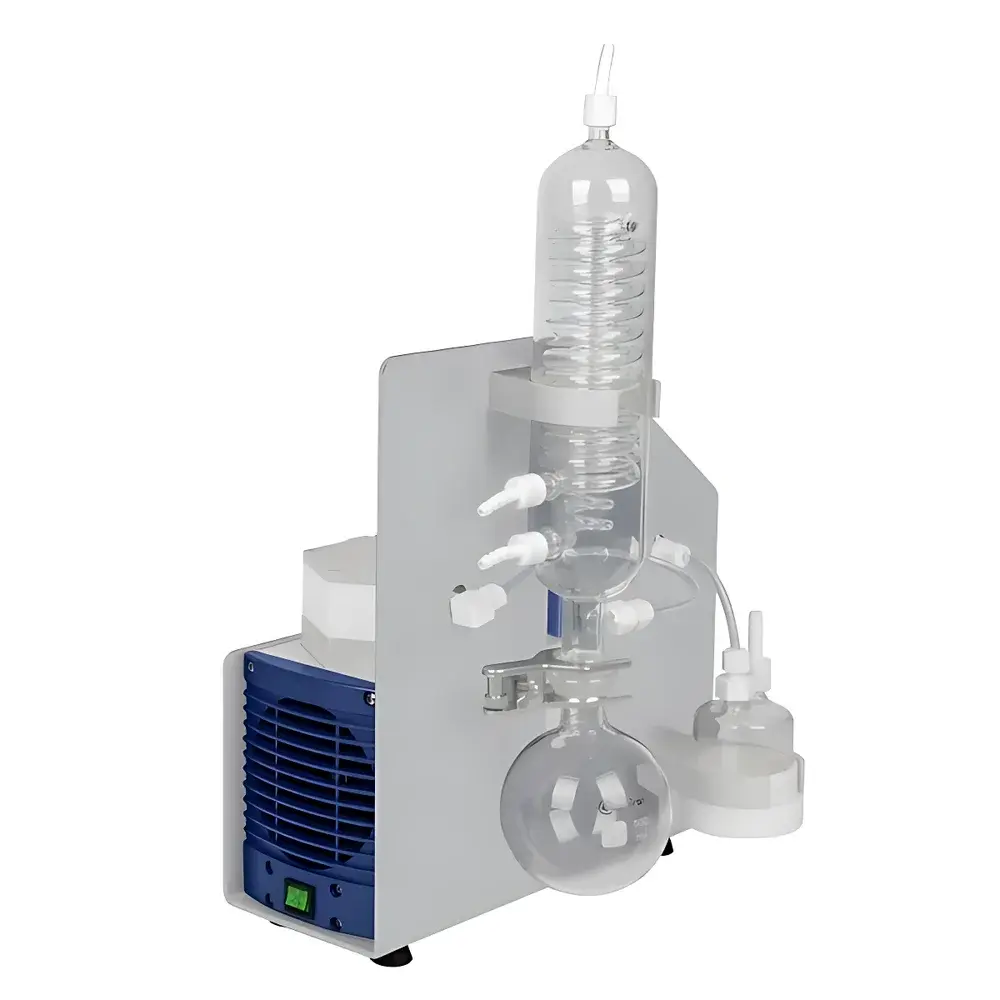
WIGGENS CSH 510 Corrosion-Resistant Solvent Recovery Vacuum System
| Brand | WIGGENS |
|---|---|
| Origin | Germany |
| Pump Type | Diaphragm Vacuum Pump |
| Ultimate Vacuum | 8 mbar |
| Pumping Speed | 34 L/min |
| Motor Power | 245 W |
| Weight | 15.8 kg |
| Inlet/Outlet Port OD | 10 mm |
| Vacuum Range | 2–30 mbar |
| Flow Rate Range | 10–95 L/min |
| Standard Configuration | ChemVak-CSH Integrated System with Corrosion-Resistant Diaphragm Pump (Model C510), Separation Trap, Condenser Assembly, Mounting Base with Support Rod, and Pre-Assembled Tubing & Fittings |
Overview
The WIGGENS CSH 510 is an integrated, corrosion-resistant solvent recovery vacuum system engineered for safe, efficient, and chemically inert operation in demanding laboratory applications. Unlike conventional oil-lubricated rotary vane pumps or water aspirators, the CSH 510 employs a chemically resistant diaphragm pump (model C510) as its core vacuum generation unit—ensuring complete oil-free, maintenance-free operation while delivering stable vacuum performance across aggressive chemical environments. The system operates on the principle of positive displacement via elastomeric diaphragm oscillation, eliminating internal lubricants and minimizing risk of sample contamination or pump degradation during exposure to organic solvents, acids, bases, and halogenated compounds. Its modular architecture integrates vacuum generation, vapor separation, condensation, and digital control into a single compact footprint—optimized for rotary evaporation, fractional distillation, solvent recycling, freeze-drying pre-vacuum stages, and vacuum filtration of corrosive media.
Key Features
- Chemically resistant PTFE/NBR diaphragm and valve assembly—validated for continuous use with acetone, THF, DCM, methanol, HCl (aq), NaOH (aq), and other aggressive solvents.
- Integrated separation trap (bubbler-style inlet buffer) prevents liquid carryover and particulate ingress into the pump head—extending service life and ensuring operational reliability.
- Efficient inline condenser with high-surface-area coiled tubing enables >90% recovery of low-boiling solvents (e.g., ether, pentane, ethyl acetate) at ambient cooling conditions.
- Digitally controlled vacuum regulation with real-time feedback: adjustable setpoint (2–30 mbar), multi-step programmable profiles, and selectable pressure units (mbar, Torr, kPa).
- Quiet operation (<52 dB(A)) and vibration-damped mounting base—suitable for shared lab spaces and sensitive instrumentation environments.
- Modular design allows field reconfiguration: pump-only mode, full solvent recovery mode, or bypass configurations for dedicated filtration or degassing tasks.
Sample Compatibility & Compliance
The CSH 510 is explicitly designed for handling chemically heterogeneous samples in compliance with ISO 8573-1 (compressed air purity classes) and IEC 61000-6-3 (EMC emission standards). Its wetted materials—including PTFE-coated stainless steel housing, fluorocarbon seals, and borosilicate glass condenser—meet USP Class VI biocompatibility requirements and are compatible with GLP/GMP workflows requiring documented material traceability. The system supports ASTM E2654-compliant solvent recovery validation protocols and is routinely deployed in pharmaceutical QC labs performing residual solvent analysis (ICH Q3C) and API purification under cGMP Annex 11-aligned data integrity practices. No external coolant or water supply is required, eliminating cross-contamination risks associated with circulating water pumps.
Software & Data Management
The embedded vacuum controller features non-volatile memory for up to 20 user-defined vacuum programs, each supporting ramp-hold sequences, pressure-triggered event logging, and analog output (0–10 V) for integration with third-party evaporators or PLC-based process controllers. All pressure readings are timestamped and stored internally with ±0.5 mbar repeatability; data export is supported via USB-C interface in CSV format. Audit trail functionality complies with FDA 21 CFR Part 11 requirements when used with validated electronic lab notebook (ELN) systems—enabling full traceability of vacuum setpoints, runtime duration, and deviation alerts during critical purification steps.
Applications
- Solvent recovery from rotary evaporators and short-path distillation setups—reducing hazardous waste disposal costs and improving sustainability metrics.
- Vacuum-assisted crystallization of acid-sensitive APIs where hydrolysis must be minimized under controlled sub-atmospheric conditions.
- Deaeration of polymer precursors and resin formulations prior to casting or injection molding.
- Concentration of biological extracts containing volatile terpenes or labile alkaloids without thermal degradation.
- High-purity vacuum drying of battery electrode slurries and semiconductor precursor films—where metallic contamination from oil-based pumps is strictly prohibited.
- Acid digestion fume management in ICP-MS sample preparation workflows, coupled with scrubber integration via optional exhaust port.
FAQ
Is the CSH 510 suitable for use with hydrofluoric acid (HF) solutions?
No—while the system resists common mineral and organic acids, HF requires specialized nickel-alloy or sapphire-wetted components not included in the standard CSH 510 configuration.
Can the vacuum setpoint be controlled remotely via Ethernet or RS-485?
The standard unit supports only local keypad control and analog voltage output; optional communication modules (Modbus RTU over RS-485) are available under part number OPT-CSH-MB.
What is the expected service interval for the diaphragm assembly under continuous 8-hour daily operation?
Based on accelerated lifetime testing per DIN EN 60068-2-64, the diaphragm exhibits ≥12,000 hours MTBF when operated within the 10–34 L/min flow range and <25 °C ambient temperature.
Does the system include validation documentation for IQ/OQ protocols?
Yes—factory-supplied IQ/OQ templates compliant with ASTM E2500 and EU GMP Annex 15 are provided with each unit, along with calibration certificates traceable to PTB (Physikalisch-Technische Bundesanstalt).
Can the condenser be upgraded to a dry-ice-cooled variant for higher-boiling solvents?
Yes—the standard air-cooled condenser may be replaced with the optional CSH-CR-DC model (dry-ice jacketed, -78 °C operating capability), increasing recovery efficiency for solvents with boiling points up to 120 °C.
Related Products



