
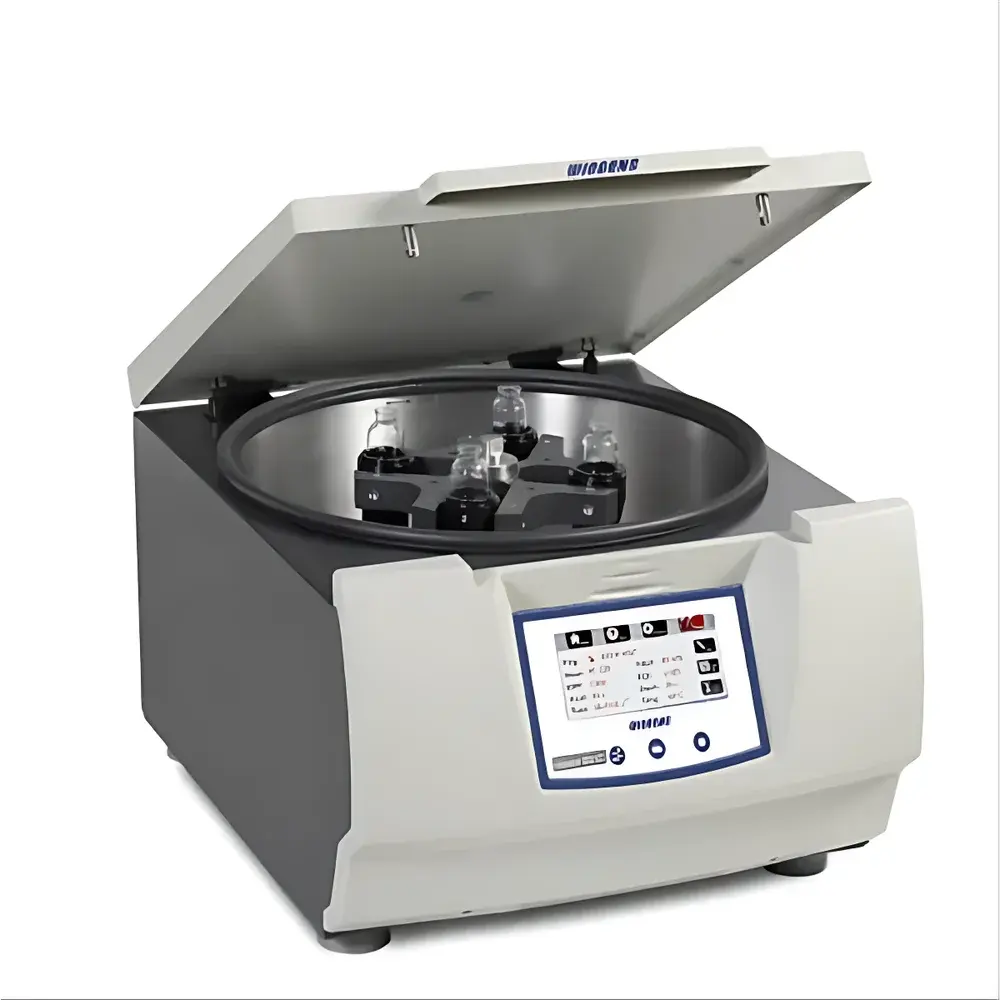
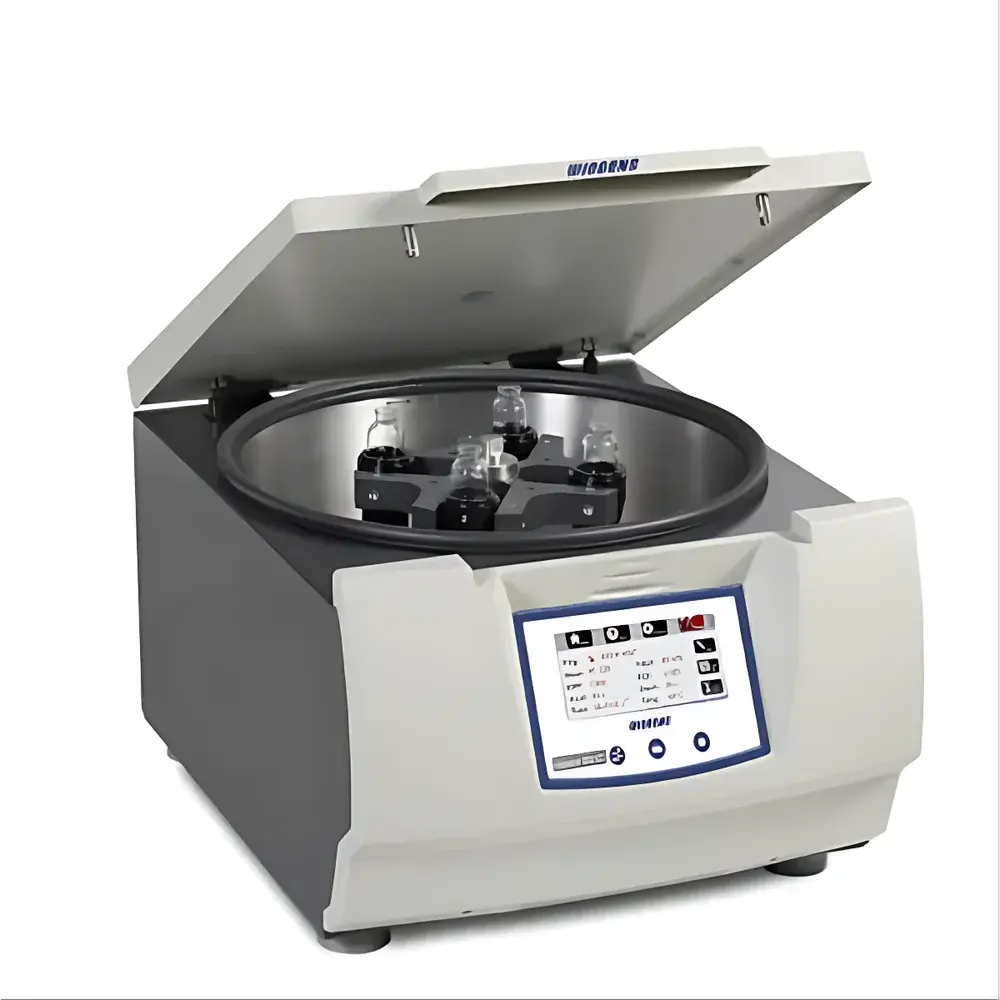
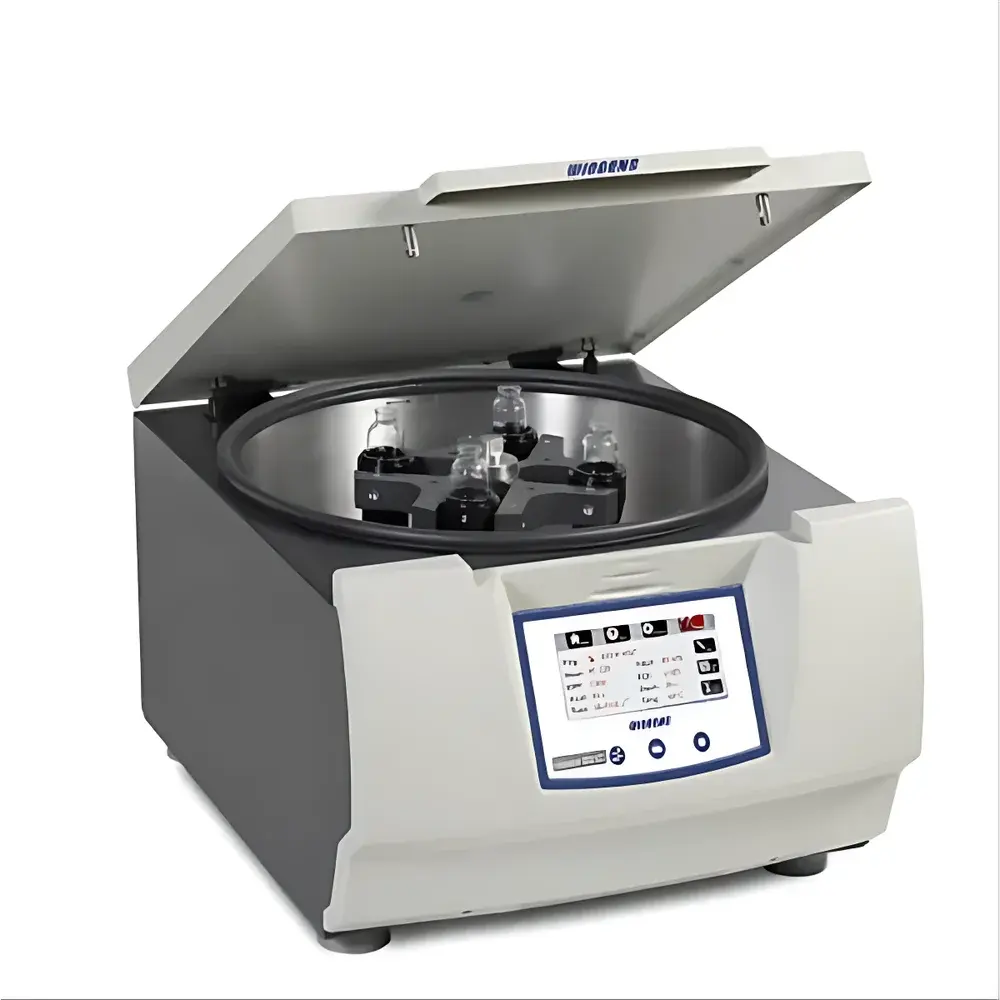
WIGGENS Digtor 22 C Benchtop Centrifuge
| Brand | WIGGENS |
|---|---|
| Origin | Germany |
| Model | Digtor 22 C |
| Instrument Type | Benchtop Centrifuge |
| Max. Speed | 3000 rpm |
| Max. RCF | 2425 × g |
| Max. Capacity | 4 × 100 mL (with 6" or 8" tubes) |
| Temperature Range | RT + 5 °C to 80 °C (1 °C increment, °C/°F selectable) |
| Acceleration/Deceleration | 175 programmable slopes (PCBS) |
| Unbalance Detection | ULS (Unbalance Location System) with positional display |
| Timer Range | 1 s to 99 h (1 s increment) |
| Noise Level | < 60 dB(A) |
| Compliance | EN 61010-1, EN 61010-2-020, EN 61326-1, EN 61326-2-6, EN 61010-2-010 |
| Certifications | 2011/65/EU (RoHS), 2012/19/EU (WEEE), 2014/30/EU (EMC), 2014/35/EU (LVD), 98/79/EC (IVDR) |
Overview
The WIGGENS Digtor 22 C is a precision-engineered benchtop centrifuge designed for routine and standardized separation tasks in petroleum, lubricant, and industrial fluid laboratories. It operates on the principle of sedimentation under controlled gravitational force (RCF), enabling reproducible phase separation of immiscible liquids—particularly oil–water emulsions—and recovery of suspended solids such as sludge, sediments, and precipitates. Unlike high-speed or ultracentrifuges, the Digtor 22 C is optimized for regulated, low-to-moderate speed applications where compliance with international standard test methods takes precedence over extreme rotational performance. Its fixed-angle and horizontal rotor configurations support ASTM, ISO, API, IP, DIN, and BS protocols for fuel and lubricant analysis—including water content, sediment volume, insolubles, and demulsibility evaluation.
Key Features
- TFT color touchscreen interface with >3 m visibility, displaying real-time rpm, RCF, elapsed time, acceleration/deceleration status, and unbalance position (ULS)
- Microprocessor-based control system with 40 user-programmable protocols, password-protected memory, and automatic recall of last-used parameters
- Precise temperature regulation from RT + 5 °C to 80 °C (±0.5 °C accuracy), featuring cavity-mounted Pt100 sensor, overtemperature cut-off, and internal insulation to minimize thermal drift
- Programmable PCBS (Progressive Control Braking System) with 175 selectable acceleration/deceleration ramps to prevent remixing of separated phases
- ULS (Unbalance Location System) identifies and displays the exact rotor position (1–4) where mass imbalance occurs, enabling rapid correction without manual trial-and-error balancing
- Integrated safety architecture: dual mechanical lid lock, motor-driven automatic locking, emergency manual release, anti-drop lid mechanism, and transparent observation window
- Stainless steel centrifuge chamber (AISI 304), autoclavable rotors and adapters, and removable rotor assembly with lid closed
- Brushless DC motor with zero maintenance requirements, silent operation (<60 dB[A]), and built-in overspeed protection
- Optional GRS (Gas Removal System) for volatile sample handling—pre-installed and compatible with inert gas purging
Sample Compatibility & Compliance
The Digtor 22 C accommodates standard laboratory glassware including 6″ (150 mm) and 8″ (200 mm) centrifuge tubes, as well as 28-place microhematocrit capillary racks. Its maximum capacity of 4 × 100 mL supports ASTM D91 (sediment in fuel oils), D96 (water and sediment in petroleum products), D893 (insolubles in lubricating oils), D1796 (emulsion stability in diesel fuels), D2273 (demulsibility of steam turbine oils), D2709 (water in aviation turbine fuels), D2711 (sediment in residual fuel oils), D4007 (water and sediment in crude oil), D5546 (lubricant demulsibility), API RP 2542/2548 (oil–water separation testing), ISO 3734 (petroleum products — determination of water), ISO 9030 (petroleum products — determination of sediment), IP 75/IP 359 (British Standard methods), NF M07-020 (French standard for fuel analysis), and DIN 51793 (determination of water in mineral oils). All operational parameters—including speed, time, temperature, and ramp profiles—are traceable and auditable for GLP/GMP environments.
Software & Data Management
While the Digtor 22 C operates via embedded firmware without external PC dependency, its control logic supports full audit trail functionality required under FDA 21 CFR Part 11 when integrated into validated laboratory workflows. All program executions—including start/stop timestamps, parameter settings, error logs, and ULS events—are stored internally with non-volatile memory retention. Optional RS232 or USB interfaces (available upon request) enable connection to LIMS or ELN systems for automated data export. The device records up to 1000 recent run histories with date/time stamping, accessible via on-screen navigation or exported as CSV files. Password-protected administrator mode allows configuration of user access levels, electronic signature enforcement, and calibration lockout.
Applications
- Determination of water and sediment content in crude oil, diesel, jet fuel, and lubricants per ASTM D96, ISO 9030, and IP 75
- Assessment of emulsion stability and demulsibility in turbine oils and hydraulic fluids (ASTM D1796, D2273, D2711)
- Quantification of insolubles and sludge formation in used engine oils (ASTM D893, D4007)
- Separation of corrosion inhibitors, additives, and particulates prior to elemental analysis (ICP-OES, ICP-MS)
- Preparatory centrifugation for gravimetric analysis of filterable residues (e.g., ASTM D2709, D5546)
- Controlled thermal conditioning of viscous samples during sedimentation (e.g., heated separation at 60–80 °C for heavy fuel oils)
- Quality assurance in refinery QC labs, third-party testing facilities, and OEM lubricant development centers
FAQ
Is the Digtor 22 C compliant with FDA 21 CFR Part 11 for electronic records?
Yes—when configured with optional data logging and connected to a validated LIMS/ELN system, all operational parameters, run logs, and error reports meet ALCOA+ principles and support Part 11 compliance through audit trail, electronic signatures, and secure user authentication.
Can the centrifuge be operated without temperature control enabled?
Yes—the heating function is fully independent and may be disabled; the unit will operate at ambient temperature with no impact on rotational performance or safety systems.
What rotor types are certified for use with the Digtor 22 C?
Factory-certified options include horizontal swing-out rotors for 4 × 100 mL tubes (6″ or 8″), 28-place capillary rotor, and custom adapter kits for conical-bottom tubes and vials—all supplied with individual calibration certificates and autoclave validation documentation.
Does the ULS system require recalibration after rotor replacement?
No—ULS is hardware-integrated and self-calibrating; it automatically detects rotor type and geometry via embedded RFID tags and adjusts sensitivity thresholds accordingly.
Is remote monitoring or network connectivity supported?
Standard configuration includes local touchscreen control only; Ethernet or Wi-Fi modules are not available. However, RS232/USB output enables integration with centralized lab monitoring platforms via serial-to-Ethernet gateways.



