
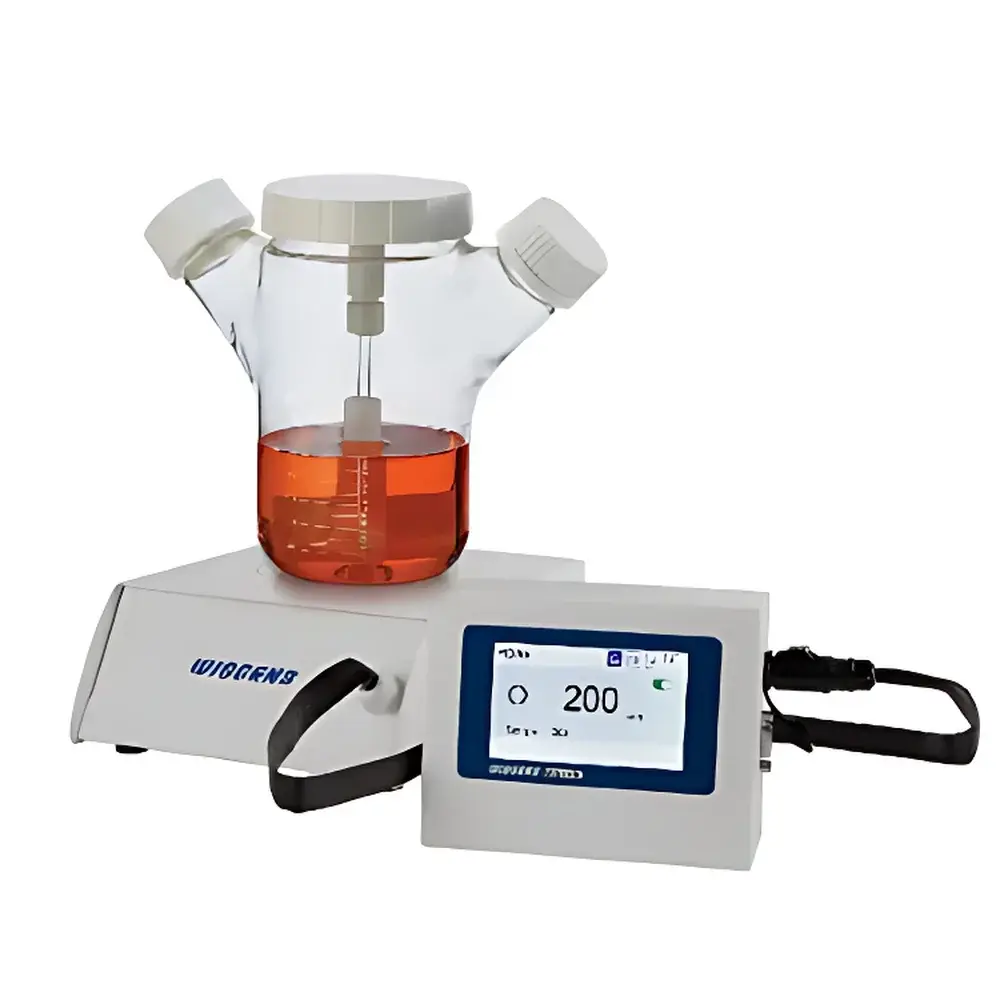
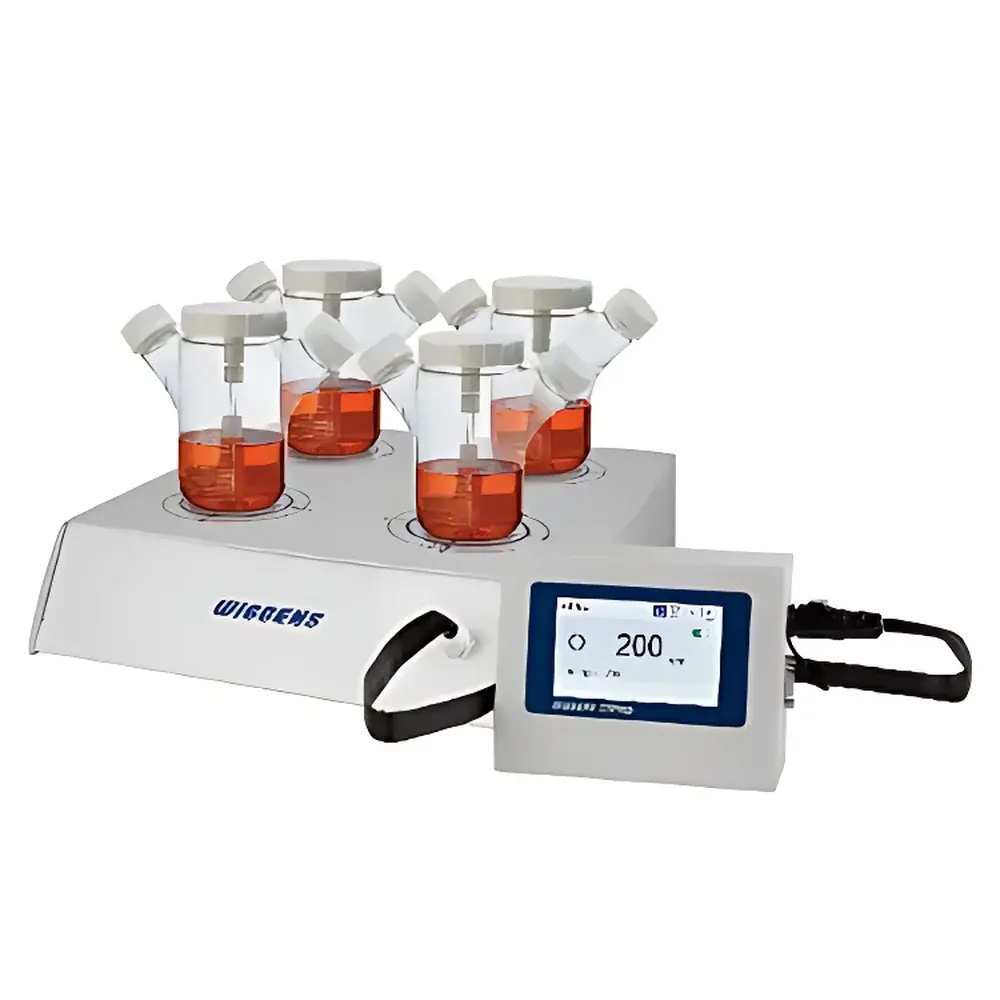
WIGGENS Dual-Arm Magnetic Stirred Cell Culture Bottle
| Brand | WIGGENS |
|---|---|
| Origin | Germany |
| Manufacturer Type | Authorized Distributor |
| Origin Category | Imported |
| Model | Dual-Arm Cell Culture Bottle |
| Price Range | USD 280–1,850 |
| Temperature Range | 0–121 °C |
| Working Volume Range | 20–8000 mL |
| Number of Reactor Vessels | 1 |
| Material | Low-Extractable Borosilicate Glass (Type I, ASTM E438 Class A, USP <661> Type I) |
| Sterilization Method | Autoclavable at 121 °C for 20 min |
Overview
The WIGGENS Dual-Arm Magnetic Stirred Cell Culture Bottle is an engineered solution for scalable suspension and microcarrier-based mammalian, insect, and hybridoma cell culture under sterile, controlled conditions. Designed around Couette-type magnetic stirring principles—where a rotating magnetic field induces gentle, non-invasive rotation of an internal stir bar—the system eliminates mechanical shaft penetration, preserving vessel integrity and sterility. Its dual-arm geometry (comprising a height-adjustable blade-style impeller and a bottom-mounted convex ridge) ensures uniform mixing while minimizing shear stress on sensitive adherent or suspension cells. The 1:1 headspace-to-liquid ratio optimizes O2/CO2 mass transfer, supporting high-density cultures in standard CO2 incubators. Constructed from 3.3 low-extractable borosilicate glass (DIN ISO 3585), the bottle meets USP Type I and ASTM E438 Type I, Class A specifications—ensuring chemical inertness, thermal stability, and compatibility with rigorous sterilization protocols.
Key Features
- Glass construction compliant with USP Type I and ASTM E438 Type I, Class A standards for pharmaceutical-grade bioprocessing
- Dual-arm agitation design: adjustable vertical blade impeller + bottom convex ridge to prevent cell sedimentation and enhance homogeneity
- Integrated magnetic drive system—no shaft seals, no contamination risk, no heat generation during operation
- Autoclavable at 121 °C for 20 minutes; validated for repeated sterilization cycles without dimensional or optical degradation
- Optimized gas exchange via 1:1 headspace-to-volume ratio and wide-diameter neck geometry
- Graduated volume markings: ±50 mL increments (125–1000 mL); ±500 mL increments (3000–8000 mL); ungraduated for 25–50 mL variants
- Standardized threading: 38–430 (small volumes), 51–400/100–400 (mid-to-large volumes), and 45 mm side-port options for sensor integration or gas sparging
Sample Compatibility & Compliance
The Dual-Arm Cell Culture Bottle supports a broad spectrum of biologically relevant systems: suspension-adapted CHO, HEK293, and Sf9 cells; microcarrier-dependent cultures (e.g., Cytodex™, SoloHill™); and anchorage-independent hybridomas. Its inert surface minimizes protein adsorption and leachables—critical for serum-free or chemically defined media formulations. The glass composition complies with ISO 10993–1 (biocompatibility), USP (plastic and glass packaging), and ASTM E438 (borosilicate glass classification). All models are compatible with GLP/GMP-aligned workflows when paired with WIGGENS WH-200C or WH-1200C programmable magnetic stirrers—devices certified per IEC 61000-6-3 (EMC) and IEC 61010-1 (safety), suitable for placement inside CO2 incubators (operating range: 14–40 °C, ≤95% RH at 37 °C).
Software & Data Management
While the bottle itself is a passive vessel, its operational fidelity is enhanced through integration with WIGGENS’ programmable stirrer platforms. The WH-200C and WH-1200C controllers support three validated mixing modes—Constant Speed (for steady-state suspension culture), Intermittent Start (for microcarrier attachment phase: 4–10 cycles of gentle on/off pulsing), and Dual-Speed Ramp (low-speed preconditioning followed by transition to operational rpm). All units feature password-protected parameter logging, real-time rpm monitoring, and alarm-triggered shutdown (e.g., stir bar stall detection). Data export via USB enables traceability aligned with FDA 21 CFR Part 11 requirements when deployed within validated laboratory information management systems (LIMS).
Applications
- Scalable seed train expansion from shake flasks to benchtop bioreactors
- Microcarrier-based production of viral vectors (AAV, lentivirus) and monoclonal antibodies
- Long-term suspension culture of shear-sensitive primary cells and stem cell derivatives
- Process development studies requiring direct comparison between stirred-glass and single-use bioreactor formats
- Media optimization trials where glass surface chemistry must remain unaltered by polymer leachables
- Regulatory submission batches where extractables and leachables profiles must conform to ICH Q5C and Q5D guidelines
FAQ
Can this bottle be used in a CO2 incubator with active humidity control?
Yes—the WH-200C and WH-1200C stirrers are rated for continuous operation inside CO2 incubators at up to 95% relative humidity and 37 °C.
Is the glass compatible with acidic or basic media (e.g., pH 4–10)?
Yes—3.3 borosilicate glass exhibits negligible corrosion or ion leaching across pH 1–13 at temperatures ≤121 °C, per DIN ISO 719 and ISO 720 hydrolytic resistance testing.
What is the maximum recommended working volume for shear-sensitive cells?
For optimal viability in suspension cultures (e.g., dendritic cells), maintain fill level at ≤70% of nominal volume to ensure adequate headspace-driven gas exchange and minimize vortex-induced shear.
Are replacement stir bars available separately?
Yes—WIGGENS offers PTFE-coated, elliptical stir bars (catalog #356874 series) with optimized aspect ratios for 500 mL–8 L bottles; all are autoclavable and certified non-pyrogenic.
Does the bottle support inline pH or DO probe integration?
Yes—models ≥3000 mL include standardized 45 mm side ports compatible with commercially available sterilizable glass or stainless-steel sensor sleeves (e.g., Hamilton, Mettler Toledo).




