
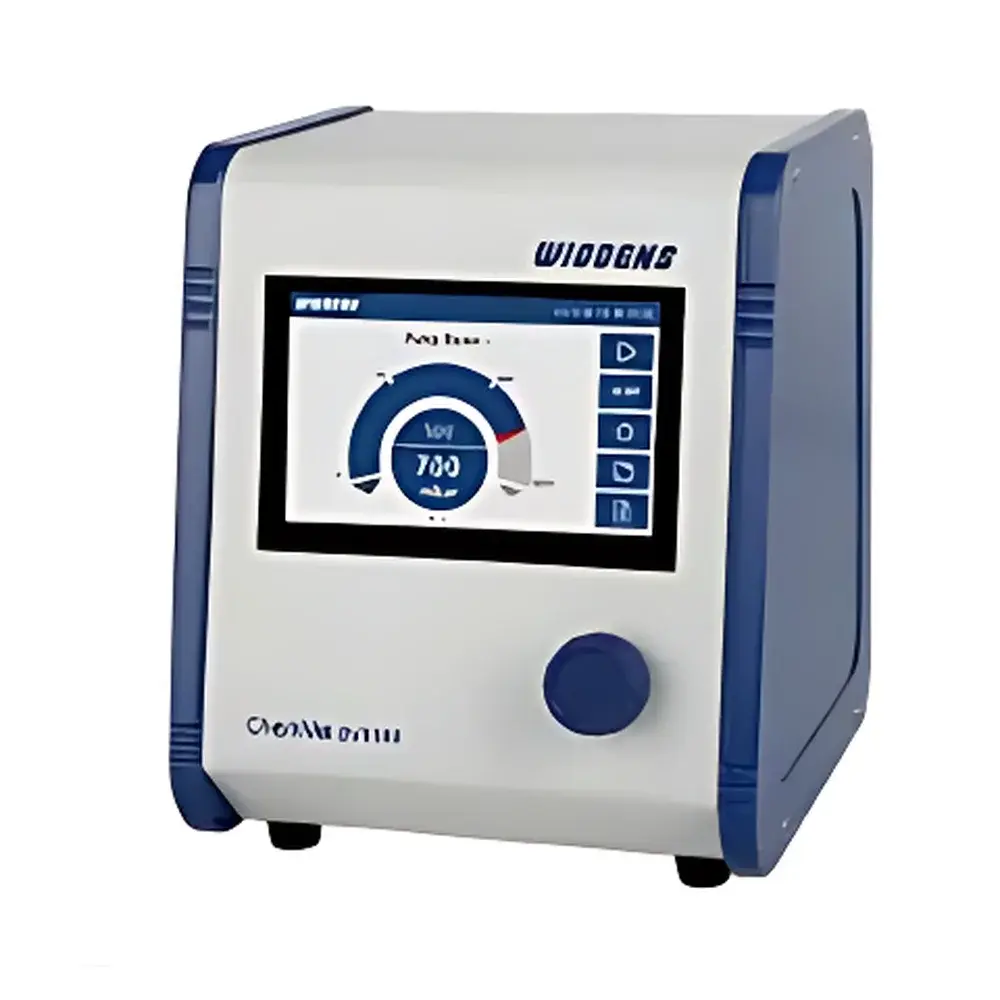
WIGGENS DVR580 Vacuum Controller
| Brand | WIGGENS |
|---|---|
| Origin | Germany |
| Model | DVR580 |
| Vacuum Control Range | 0.1–1010 mbar |
| Display | High-brightness TFT LCD (0.1 mbar resolution) |
| Sensor Accuracy | Class 0.25 |
| Control Interface | Touchscreen + Rotary Navigation Knob |
| Communication Ports | RS232/485, USB |
| Housing Dimensions (W×D×H) | 170 × 220 × 207 mm |
| Power Supply | 100–240 V AC, 50/60 Hz |
| Gas-Contact Materials | PTFE, corrosion-resistant ceramic pressure sensor |
| IP Rating | IP40 |
| Programmability | 6-segment vacuum ramping & hold sequences |
| Pump Integration | Compatible with oil-sealed rotary vane pumps and variable-frequency drive (VFD) vacuum pumps |
| Software Compatibility | WIGGENS LabControl Suite |
| Optional Cloud Module | WIGGENS IoT Remote Monitoring (via mobile app) |
Overview
The WIGGENS DVR580 Vacuum Controller is an intelligent, programmable vacuum regulation system engineered for precision control in demanding laboratory applications—including rotary evaporation, vacuum drying, fractional distillation, and solvent recovery workflows. Unlike passive vacuum gauges or simple on/off valve controllers, the DVR580 implements active closed-loop control using a high-stability ceramic pressure sensor and real-time feedback logic. Its core functionality relies on slope-based vacuum regulation—a proprietary WIGGENS algorithm that modulates vacuum inlet flow to maintain setpoint stability without abrupt pressure transients. This prevents bumping during sensitive distillations, avoids solvent foaming in rotary evaporators, and ensures reproducible endpoint detection in multi-solvent evaporation protocols. Designed for integration into both continuous-running oil pump systems and energy-efficient VFD-controlled vacuum networks, the DVR580 operates independently of pump type while maintaining compatibility with standard KF and NPT vacuum interfaces.
Key Features
- High-contrast 4.3-inch TFT display with intuitive graphical user interface—optimized for glove-compatible operation via dual touch-and-rotary navigation
- Chemically inert gas path: all wetted components constructed from PTFE and high-purity ceramic, certified for long-term exposure to aggressive vapors including HCl, HF, acetone, chloroform, and concentrated organic acids
- Six-stage programmable vacuum profiles supporting complex ramp-hold sequences, dynamic endpoint detection (e.g., boiling point search), and multi-solvent transition logic
- Integrated pressure slope monitoring: detects inflection points in vacuum curves to automatically adjust valve position and stabilize vapor pressure during phase transitions
- VFD pump synchronization module enables motor speed modulation for ultra-smooth vacuum ramping—eliminating mechanical stress on diaphragm or scroll pumps
- One-touch continuous/stepwise venting function with adjustable release rate; optional automatic pump power cutoff upon reaching target vacuum to reduce energy consumption
- Full data traceability: timestamped process logs, method versioning, and secure parameter encryption compliant with GLP audit requirements
Sample Compatibility & Compliance
The DVR580 is validated for use with volatile, corrosive, and condensable vapors across pharmaceutical, chemical synthesis, and materials science laboratories. Its PTFE/ceramic sensor assembly meets ISO 8573-1 Class 2 purity requirements for compressed gas measurement and conforms to ASTM D2879 (vacuum distillation of organic liquids). All electrical components comply with IEC 61010-1:2010 for laboratory equipment safety. The controller supports 21 CFR Part 11-compliant electronic signatures when used with WIGGENS LabControl Suite v3.2+, enabling full audit trail generation—including operator ID, parameter changes, and execution timestamps—for regulated environments. No internal motor or moving parts are present; the unit functions solely as a smart valve actuator and sensor hub.
Software & Data Management
The DVR580 communicates natively with WIGGENS LabControl Suite via USB or RS485, enabling remote configuration, real-time graphing of vacuum trajectories, and batch export of CSV-formatted process data. Method files (.wvm) are encrypted and portable between DVR580 units—facilitating SOP harmonization across multi-site labs. Optional WIGGENS IoT Cloud Gateway (Model WG-IoT-VM1) provides TLS 1.2-secured MQTT telemetry to mobile devices running the official WIGGENS LabApp (iOS/Android), allowing push notifications for alarm conditions (e.g., overpressure, sensor timeout, communication loss). Data retention complies with GDPR Article 32 technical safeguards, with local storage limited to 32 MB of cyclic process history unless externally archived.
Applications
- Rotary evaporation of heat-sensitive compounds under controlled vacuum gradients to prevent thermal degradation
- Multi-step solvent removal from peptide synthesis reaction mixtures where sequential pressure reduction improves yield
- Accelerated vacuum drying of hygroscopic polymers and battery electrode slurries with endpoint detection via pressure slope analysis
- Automated fractional distillation of azeotropic mixtures requiring precise pressure-dependent boiling point tracking
- Integration into GMP-compliant API purification lines where vacuum stability directly impacts crystallization kinetics and particle size distribution
- Environmental testing chambers requiring repeatable low-pressure conditioning cycles per ISO 16750-4
FAQ
Does the DVR580 include a built-in vacuum pump?
No—the DVR580 is a standalone controller and requires external vacuum source connection (e.g., oil-sealed rotary vane pump, diaphragm pump, or central vacuum system).
Can it control non-WIGGENS vacuum pumps?
Yes—compatible with any pump featuring dry-contact relay output or analog 0–10 V / 4–20 mA control input; VFD integration requires compatible frequency command interface.
What is the maximum allowable temperature of gases entering the sensor port?
Ambient operating range: 5–40 °C; inlet gas temperature must not exceed 60 °C continuously to preserve ceramic sensor integrity.
Is calibration traceable to national standards?
Factory calibration is performed against NIST-traceable barometric references; optional annual recalibration service includes ISO/IEC 17025-accredited certificate.
How many user-defined methods can be stored internally?
Up to 100 fully parameterized vacuum programs, each supporting up to six independent pressure/time segments with conditional branching logic.



