
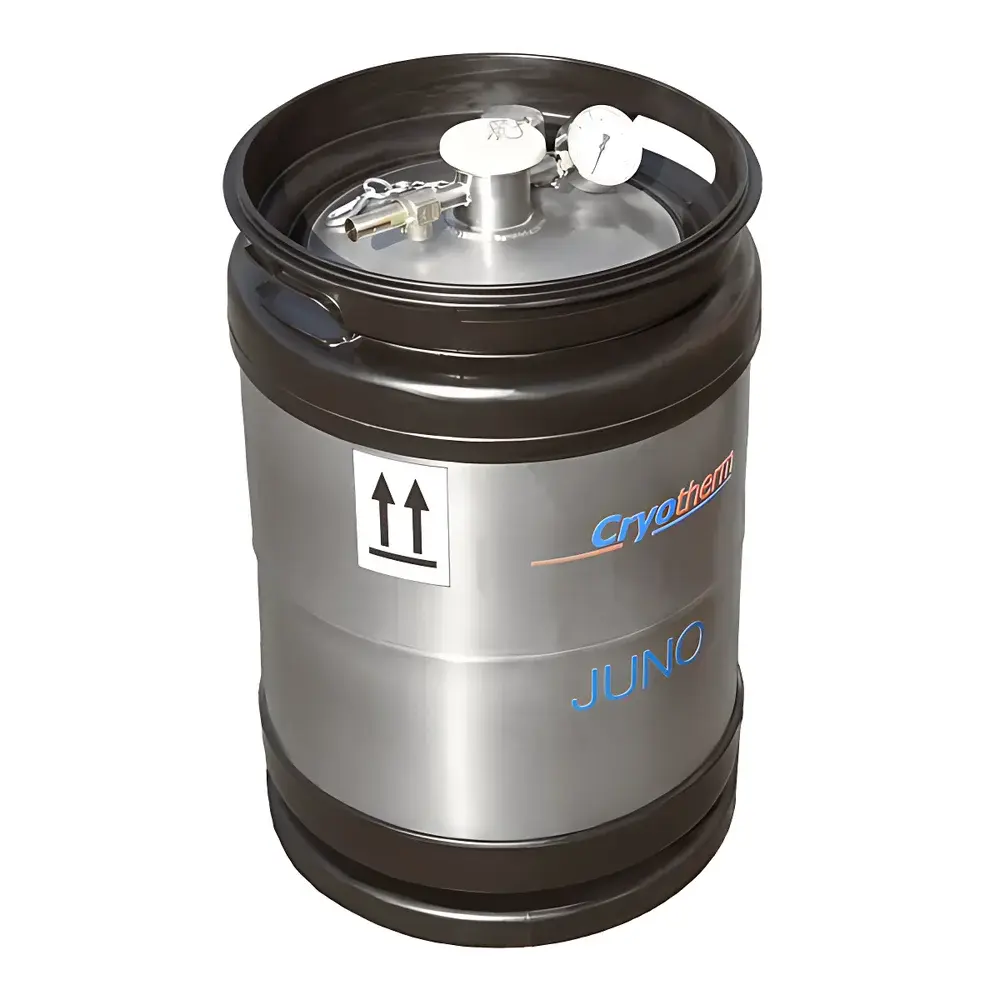
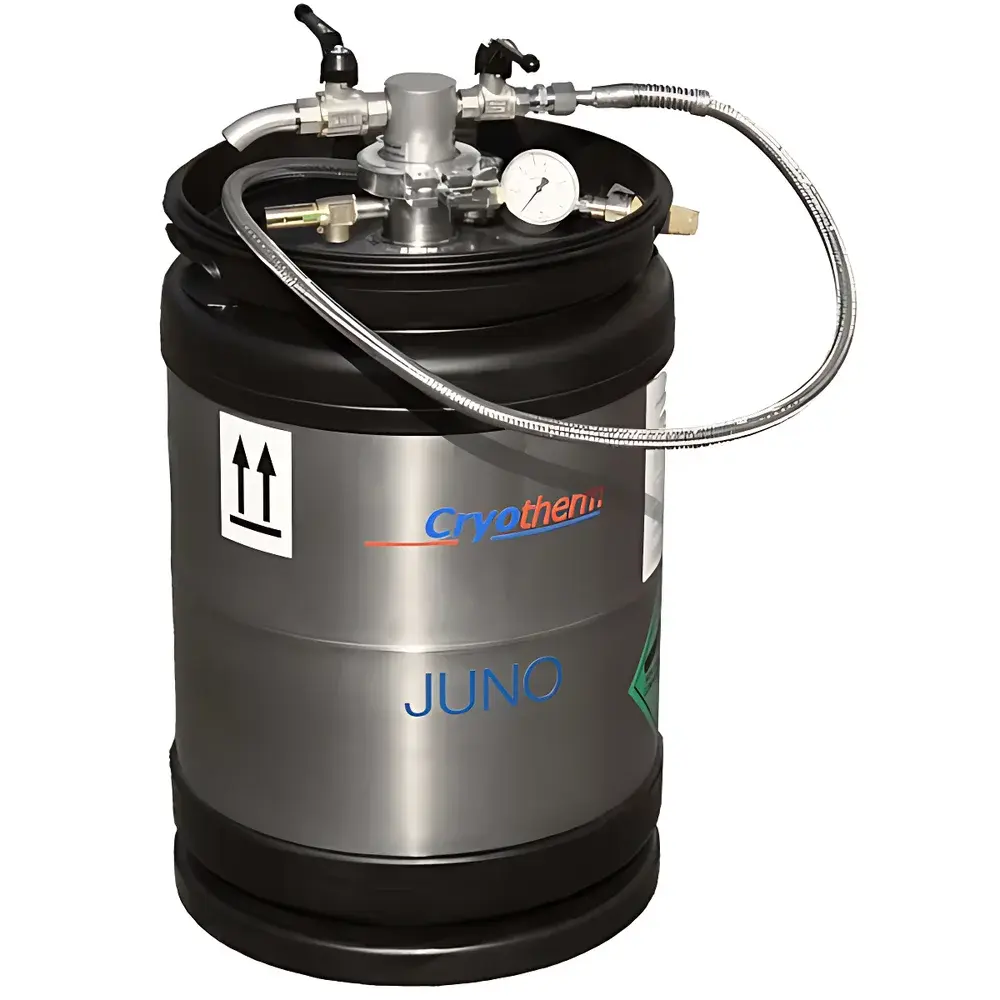
WIGGENS JUNO 30 Stainless Steel Liquid Nitrogen Dewar
| Brand | WIGGENS |
|---|---|
| Origin | Germany |
| Model | JUNO 30 |
| Capacity | 30 L |
| Operating Pressure | ≤1.3 bar |
| Height | 660 mm |
| Diameter | 407 mm |
| Static LN₂ Hold Time | 32 days |
| LN₂ Evaporation Rate | 0.8 L/day (at 20°C, 1013 mbar, lid closed, no transfer line) |
| Empty Weight | 18 kg |
| Full Weight | 41 kg |
| Temperature Range | –196°C |
| Optional Accessories | Stainless Steel Transfer Siphon (with pressure regulator), Cryogenic Transfer Hose, Insulated Connecting Tubing, Threaded Adapters, Quick-Release Clamps with O-Rings |
Overview
The WIGGENS JUNO 30 is a compact, vacuum-insulated stainless steel liquid nitrogen (LN₂) dewar engineered for reliable, low-evaporation cryogenic storage in research laboratories, biobanking facilities, and pharmaceutical quality control environments. Designed according to fundamental principles of cryostatic containment, the JUNO 30 employs a double-walled austenitic stainless steel construction with high-vacuum interstitial space (<10⁻³ mbar) to minimize conductive and convective heat ingress. This architecture ensures thermal stability at –196°C while maintaining structural integrity under sustained cryogenic thermal cycling. Unlike pressurized storage systems, the JUNO 30 operates as a non-pressurized, vented dewar—its maximum allowable working pressure (MAWP) is limited to 1.3 bar, enabling passive vapor-phase equilibrium and eliminating risks associated with over-pressurization during routine handling. Its 30-liter internal volume supports medium-term storage of biological specimens—including vials, straws, and cryoboxes—while its ergonomic footprint (407 mm diameter × 660 mm height) facilitates integration into standard laboratory cabinetry and cleanroom pass-throughs.
Key Features
- Vacuum-insulated double-wall stainless steel vessel with helium leak-tested integrity and verified residual gas analysis (RGA) performance
- KF NW 50 ISO-KF flange mounted on the neck for secure, standardized connection of LN₂ siphon lines and transfer hardware
- Integrated mechanical pressure gauge (0–2 bar range) and certified spring-loaded safety relief valve (set point: 1.3 bar ±0.05 bar) compliant with PED 2014/68/EU
- Low thermal mass design contributes to measured evaporation rate of 0.8 L/day under ISO 21028-1 reference conditions (20°C ambient, sealed lid, static operation)
- Reinforced base with integrated leveling feet; optional bottom-mounted casters (order code 2640-CD) enable controlled mobility without compromising vacuum seal integrity
- Surface-finished interior (Ra ≤ 0.8 µm) and electropolished exterior to support ISO 14644-1 Class 5 cleanroom compatibility and ease of decontamination
Sample Compatibility & Compliance
The JUNO 30 accommodates standard cryogenic sample carriers including 1.2–2.0 mL external-thread vials (e.g., Nunc™, Corning®), 0.5 mL straws (equine/avian IVF formats), and 10×10 cryoboxes (up to 4 layers vertically). Its vapor-phase storage configuration maintains specimen temperatures between –150°C and –190°C—within the recommended range for long-term genomic DNA, primary cell lines, and stem cell preservation per ISO 20387:2018 (Biobanking) and AABB Standards. The dewar conforms to European Pressure Equipment Directive (PED 2014/68/EU) Annex I essential safety requirements and carries CE marking. All materials comply with EU Regulation (EC) No 1935/2004 for food-contact equivalence and USP for extractables profiling. Documentation includes Declaration of Conformity, material traceability certificates (3.1 EN 10204), and vacuum decay test reports.
Software & Data Management
While the JUNO 30 is a manually operated passive dewar, its design integrates seamlessly with digital cold chain monitoring ecosystems. The KF NW 50 port supports retrofitting of calibrated Pt100 temperature probes (e.g., WIKA TR20 series) and wireless vapor-phase sensors (e.g., Sensirion SHT45-based loggers). When paired with validated environmental monitoring platforms (e.g., Vaisala viewLinc, DicksonOne), users achieve full 21 CFR Part 11-compliant audit trails—including timestamped temperature excursions, door-open events (via magnetic switch add-on), and LN₂ level trending via ultrasonic fill-level transducers. Calibration certificates for all third-party sensors are supplied with NIST-traceable documentation.
Applications
- Cryopreservation of peripheral blood mononuclear cells (PBMCs), induced pluripotent stem cells (iPSCs), and hybridoma cultures in academic and contract research organizations (CROs)
- Stabilization of thermolabile reagents—including restriction enzymes, reverse transcriptases, and CRISPR-Cas9 ribonucleoprotein complexes—during QC release testing
- Transport of clinical trial biospecimens under IATA Packing Instruction 206 (PI206) and ADR Chapter 3.3 provisions for Class 2.2 non-pressurized cryogens
- Backup storage for ultra-low temperature (ULT) freezers during maintenance cycles or power outages, providing ≥72-hour thermal buffer for critical inventory
- On-site LN₂ supply for cryo-microtomes, SEM cryo-stages, and laser ablation systems requiring localized coolant delivery
FAQ
What is the expected service life of the vacuum insulation under normal laboratory use?
Vacuum integrity is guaranteed for 10 years from date of manufacture, supported by annual residual gas analysis (RGA) verification per ISO 21028-2. Typical field lifetime exceeds 15 years with proper handling and avoidance of mechanical shock to the neck region.
Can the JUNO 30 be used for liquid-phase storage of samples?
Yes—though vapor-phase operation is recommended for biospecimen integrity, direct immersion is permissible when using cryovial racks with elevated bases to prevent contact with pooled LN₂. Users must validate thawing kinetics and ice nucleation behavior for their specific sample matrix.
Is the KF NW 50 flange compatible with ISO-KF standards from other manufacturers?
Yes—the flange meets ISO 2861-1:2015 dimensional specifications and utilizes standard Viton® O-rings (ISO 3601-1, Class N). Interchangeability with Edwards, VAT, and Pfeiffer components has been verified in third-party fit-testing.
Does WIGGENS provide validation protocols for IQ/OQ/PQ?
Standardized IQ/OQ templates aligned with ISO/IEC 17025 and GAMP 5 are available upon request. PQ execution requires site-specific mapping per ASTM E2876-22 (thermal uniformity) and ISO 21028-1 (evaporation rate verification).
Related Products




