
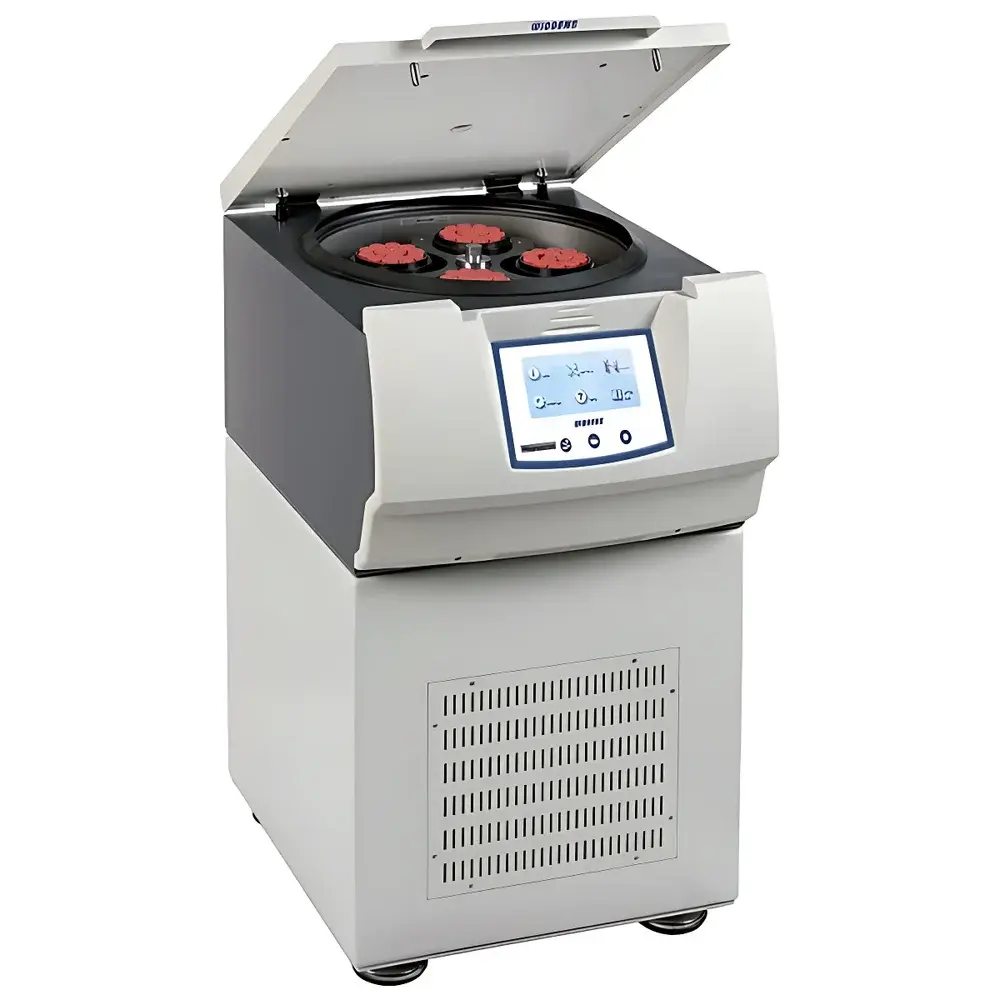
WIGGENS MAGNUS 22/22R High-Capacity Floor-Standing Centrifuge
| Brand | WIGGENS |
|---|---|
| Origin | Germany |
| Model | MAGNUS 22/22R |
| Instrument Type | Floor-standing centrifuge |
| Speed Range | 100–14,300 rpm |
| Max RCF | 21,948 × g |
| Max Capacity | 4 × 750 mL |
| Temperature Range (MAGNUS 22R) | −20 °C to +40 °C |
| Refrigerant | R449A |
| Compliance | EN 61010-1, EN 61010-2-020, EN 61326-1, EN 61326-2-6, EU Directives 2011/65/EU, 2012/19/EU, 2014/30/EU, 2014/35/EU, 98/79/EC, (EC) No 1005/2009, (EU) No 517/2014 |
Overview
The WIGGENS MAGNUS 22 and MAGNUS 22R are high-capacity, floor-standing centrifuges engineered for reproducible, high-throughput separation in demanding laboratory environments. Designed for applications requiring large-volume processing—such as cell harvesting, plasma fractionation, microbial pelletization, and biopolymer isolation—the MAGNUS platform operates on the principle of sedimentation under controlled rotational acceleration. The MAGNUS 22 delivers non-refrigerated operation with precise speed and RCF control, while the MAGNUS 22R integrates a high-efficiency refrigeration system using environmentally compliant R449A refrigerant, enabling temperature-stable operation from −20 °C to +40 °C. Both models feature a robust stainless-steel centrifuge chamber, dual mechanical and electronic lid interlocks, and real-time unbalance detection with positional identification—ensuring operational safety and compliance with ISO/IEC 17025-aligned quality workflows.
Key Features
- High-resolution TFT color touchscreen (visible at >3 m), supporting intuitive programming and real-time parameter monitoring (RPM, RCF, time, acceleration/deceleration profiles)
- Precision speed control in 10 rpm increments; RCF displayed dynamically based on selected rotor geometry and actual rotational speed
- 175 programmable acceleration/deceleration ramp profiles (PCBS technology) to minimize sample resuspension and preserve delicate pellet integrity
- Unbalance Location System (ULS): automatically identifies and displays the angular position of imbalance (e.g., “Position 3”) for rapid correction
- 40 user-programmable protocols with password protection and audit-trail-capable execution logging
- Automatic rotor recognition and overspeed protection prevent incompatible or unsafe configurations
- Noise emission <60 dB(A) at 1 m distance, achieved via vibration-damped base design and brushless DC motor architecture
- Integrated energy-saving mode with auto-power-off after idle timeout, compliant with EU Ecodesign Directive 2009/125/EC
Sample Compatibility & Compliance
The MAGNUS 22/22R accommodates a wide range of primary sample containers—including 750 mL bottles, microplates (96-/384-well), cell culture plates, conical tubes (15–50 mL), and custom adapters for specialized vessels—enabling seamless transition between clinical, bioprocess, and research workflows. All rotors and adapters are autoclavable (121 °C, 20 min), supporting GLP/GMP-compliant decontamination protocols. The centrifuge meets essential safety and electromagnetic compatibility requirements per EN 61010-1 (Safety of Electrical Equipment for Laboratory Use) and EN 61010-2-020 (Particular Requirements for Centrifuges), and conforms to IVD Directive 98/79/EC for in vitro diagnostic applications. Refrigerated operation of the MAGNUS 22R complies with Regulation (EU) No 517/2014 on fluorinated greenhouse gases and Regulation (EC) No 1005/2009 on ozone-depleting substances—verified through third-party CE certification.
Software & Data Management
Operation is governed by an embedded microprocessor-based control system supporting fully traceable, parameter-locked procedures. Each run logs timestamped data—including setpoints, actual RPM/RCF, chamber temperature (22R), acceleration profile, and fault events—stored internally for ≥1,000 cycles. Optional USB export enables integration with LIMS or ELN platforms. Programmable timers support durations from 1 second to 99 hours, with stepwise sequencing (e.g., hold at 3,000 rpm for 10 min → accelerate to 12,000 rpm → decelerate with ramp 42). Real-time deviation alerts (e.g., temperature drift >±1.5 °C, unbalance >5 g) trigger automatic shutdown and event flagging—facilitating FDA 21 CFR Part 11–aligned audit readiness when paired with validated networked data capture.
Applications
- Biopharmaceutical manufacturing: Clarification of mammalian cell culture harvests (CHO, HEK293), viral vector pelleting, and plasmid DNA concentration
- Clinical diagnostics: High-volume serum/plasma separation for automated immunoassay platforms
- Academic research: Subcellular fractionation (nuclei, mitochondria), exosome isolation from conditioned media, and polymerase chain reaction (PCR) cleanup
- Food & environmental testing: Microbial enumeration (E. coli, Salmonella), sediment analysis, and fat extraction from homogenized samples
- Quality control labs: Stability testing of suspensions, emulsions, and colloidal formulations per USP and ASTM D6986
FAQ
What is the maximum permissible imbalance tolerance before automatic shutdown?
The MAGNUS 22/22R detects imbalances ≥5 g at maximum speed and halts rotation within ≤0.8 s, displaying the exact rotor position (1–4) of the imbalance.
Can the MAGNUS 22R maintain 4 °C during a 14,300 rpm run with full 4 × 750 mL load?
Yes—thermal management is validated for continuous operation at rated speed and capacity, with chamber temperature held within ±0.8 °C of setpoint across the full −20 °C to +40 °C range.
Are rotor calibration certificates provided with each unit?
Each rotor ships with a factory-verified calibration report traceable to PTB (Physikalisch-Technische Bundesanstalt), including RCF deviation curves at 10%, 50%, and 100% of max speed.
Is remote monitoring or Ethernet connectivity supported?
Standard configuration includes USB host port for firmware updates and data export; optional RS-485 interface (Modbus RTU) is available for SCADA integration under OEM agreement.
Does the centrifuge comply with IEC 61000-4 immunity standards for electromagnetic environments in shared lab spaces?
Yes—EN 61326-1 and EN 61326-2-6 certification confirms immunity to electrostatic discharge (±8 kV contact), radiated RF fields (10 V/m, 80 MHz–2.7 GHz), and fast transients (±2 kV), meeting Class A industrial emission limits.



