
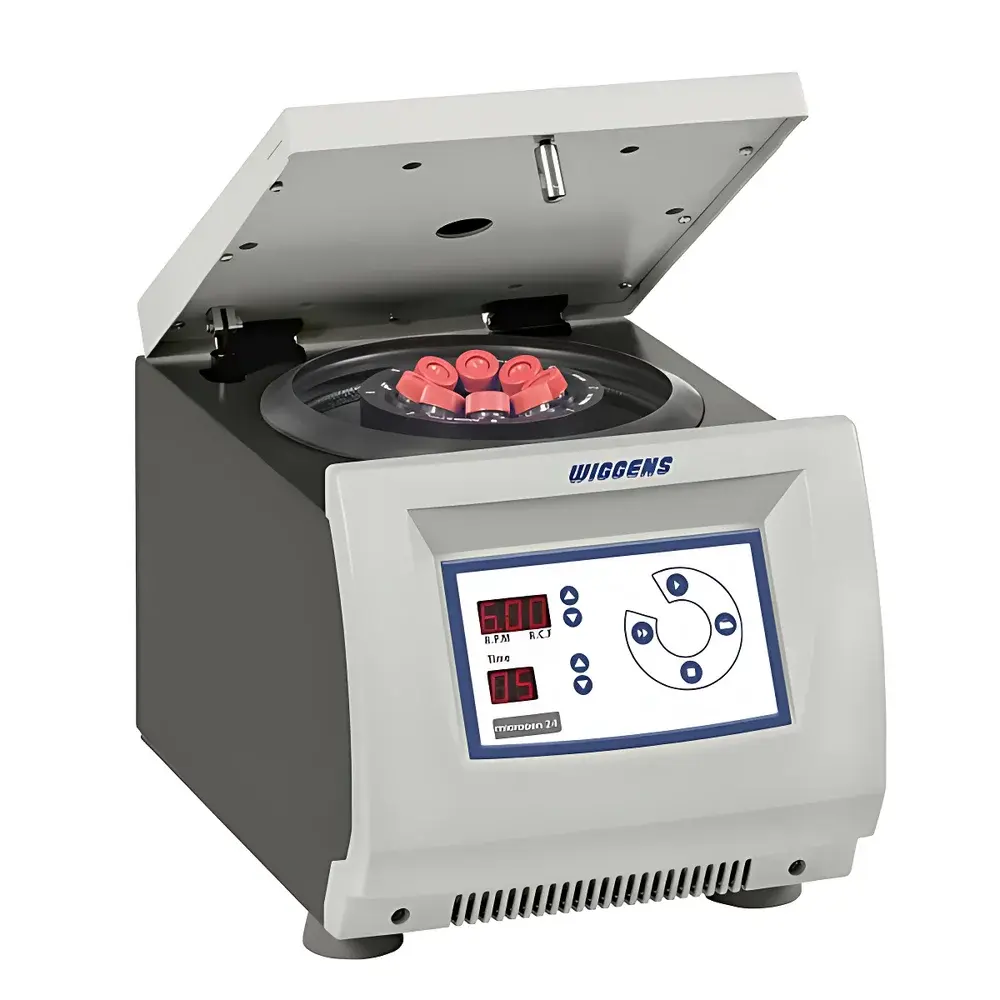
WIGGENS MICROCEN 24 Benchtop Microcentrifuge
| Brand | WIGGENS |
|---|---|
| Origin | Germany |
| Model | MICROCEN 24 |
| Instrument Type | Benchtop Centrifuge |
| Max Speed | 8000 rpm |
| Max RCF | 6368 × g |
| Max Capacity | 10 × 15 mL |
| Temperature Control | None (Non-refrigerated) |
| Rotor Type | Fixed-angle (30°) |
| Compliance | EN 61010-1, EN 61010-2-020, EN 61326-1, EN 61326-2-6 |
| Certifications | 2011/65/EU (RoHS), 2012/19/EU (WEEE), 2014/30/EU (EMC), 2014/35/EU (LVD), 98/79/EC (IVDR) |
Overview
The WIGGENS MICROCEN 24 is a compact, high-performance benchtop microcentrifuge engineered for routine separation tasks in life science laboratories, clinical diagnostics, and quality control environments. Designed around a robust brushless DC motor architecture, it delivers precise, reproducible centrifugal force generation without the thermal drift or maintenance burden associated with brushed motors. Operating at a maximum speed of 8,000 rpm and generating up to 6,368 × g, the MICROCEN 24 is optimized for applications requiring rapid pelleting of cellular debris, precipitated nucleic acids, proteins, and particulates from small-volume samples—particularly in workflows where space efficiency, operational simplicity, and regulatory traceability are critical. Unlike ultra-high-speed or refrigerated centrifuges, the MICROCEN 24 is a non-cooled, ambient-temperature instrument, making it ideal for short-duration spins (<30 min), room-temperature-sensitive protocols (e.g., certain enzyme assays), and labs prioritizing energy efficiency and minimal heat load in shared workspaces.
Key Features
- Microprocessor-controlled operation with dual-display LED interface showing real-time RPM and RCF values
- Stepwise speed adjustment in 50 rpm increments (or 10 × g steps) during active run—enabling dynamic optimization without stopping
- Programmable timer (1–999 minutes, 1-minute resolution) with both forward and reverse countdown modes
- Three-stage acceleration/deceleration profiles: fast, medium, and inertia-based—minimizing sample resuspension and rotor stress
- Automatic rotor memory function: recalls last-used parameters (speed, time, acceleration profile) on power-up
- Acoustic and visual status alerts—including end-of-run signal, imbalance detection, and lid-open confirmation
- Noise emission <60 dB(A) at 1 m distance, compliant with ISO 3744 acoustic testing methodology
- Instant spin (short-pulse) mode for quick sedimentation checks without full parameter setup
Sample Compatibility & Compliance
The MICROCEN 24 supports standardized microcentrifuge tubes across common volumes: 0.2–0.4 mL, 0.5–0.6 mL, 1.5–2.0 mL, 5 mL, 7–10 mL, and 15 mL conical or round-bottom formats. Three interchangeable fixed-angle rotors (RT 246, RT 247, RT 248) provide flexibility in throughput and tube geometry—each rated for full-speed operation at 8,000 rpm. All rotors and adapters are autoclavable (121°C, 20 min, saturated steam), ensuring compliance with GLP/GMP requirements for reusable components in regulated environments. The stainless-steel centrifuge chamber facilitates decontamination and resists corrosion from common reagents (e.g., ethanol, isopropanol, dilute acids/bases). Safety mechanisms include mechanical lid interlock with emergency manual release, automatic imbalance shutdown (±5% mass deviation per rotor half), lid-drop prevention latch, and transparent viewing window for visual process verification. Full electromagnetic compatibility (EMC) and low-voltage directive (LVD) conformity are verified per EN 61326-1 and EN 61010-1, supporting integration into ISO 17025-accredited laboratories.
Software & Data Management
While the MICROCEN 24 operates as a standalone instrument without external PC connectivity, its embedded firmware implements audit-trail-capable parameter logging. Each run records timestamp, set speed (RPM/RCF), duration, acceleration profile, and final status (normal stop, imbalance abort, lid-open interrupt). These entries persist across power cycles and are accessible via on-screen history scroll. Though not FDA 21 CFR Part 11-compliant out-of-the-box, the device’s deterministic behavior, non-volatile parameter memory, and hardware-enforced safety interlocks align with ALCOA+ principles (Attributable, Legible, Contemporaneous, Original, Accurate, Complete, Consistent, Enduring, Available) when used within documented SOPs. Optional third-party lab information management systems (LIMS) may integrate via RS-232 or analog pulse output (available on request)—subject to local validation protocols.
Applications
- Routine pelleting of bacterial cells, yeast, and mammalian cell lysates prior to supernatant harvesting
- Clarification of PCR master mixes, restriction digests, and ligase reactions
- Concentration and recovery of plasmid DNA, genomic DNA, RNA, and synthetic oligonucleotides
- Separation of serum/plasma from whole blood in point-of-care or satellite lab settings
- Preparative centrifugation of nanoparticles, liposomes, and extracellular vesicles (within size/mass limits of 6,368 × g)
- Quality control of reagent kits, including buffer clarity checks and precipitate removal
FAQ
Is the MICROCEN 24 suitable for biosafety level 2 (BSL-2) applications?
Yes—its sealed stainless-steel chamber, autoclavable rotors, and optional biocontainment lids (sold separately) support BSL-2 workflows when combined with appropriate PPE and procedural controls.
Can I use this centrifuge for density gradient separations?
No—the MICROCEN 24 lacks variable-speed ramping during run and gradient-compatible swing-out rotors; it is intended for fixed-angle, single-step pelleting only.
Does the device meet IEC 61000-4 electromagnetic immunity standards?
Yes—compliance with EN 61326-1 confirms immunity to electrostatic discharge (IEC 61000-4-2), radiated RF fields (IEC 61000-4-3), and fast transients (IEC 61000-4-4), as validated in certified test laboratories.
What is the expected service life of the brushless motor?
Rated for ≥20,000 hours of operation under nominal load conditions, with no scheduled brush replacement required—consistent with ISO 13374-1 condition monitoring guidelines for rotating equipment.
Are rotor balancing tools included with purchase?
No—balancing is achieved by symmetrical tube placement per manufacturer’s loading diagram; dedicated balancing weights or tools are unnecessary for standard configurations.



