
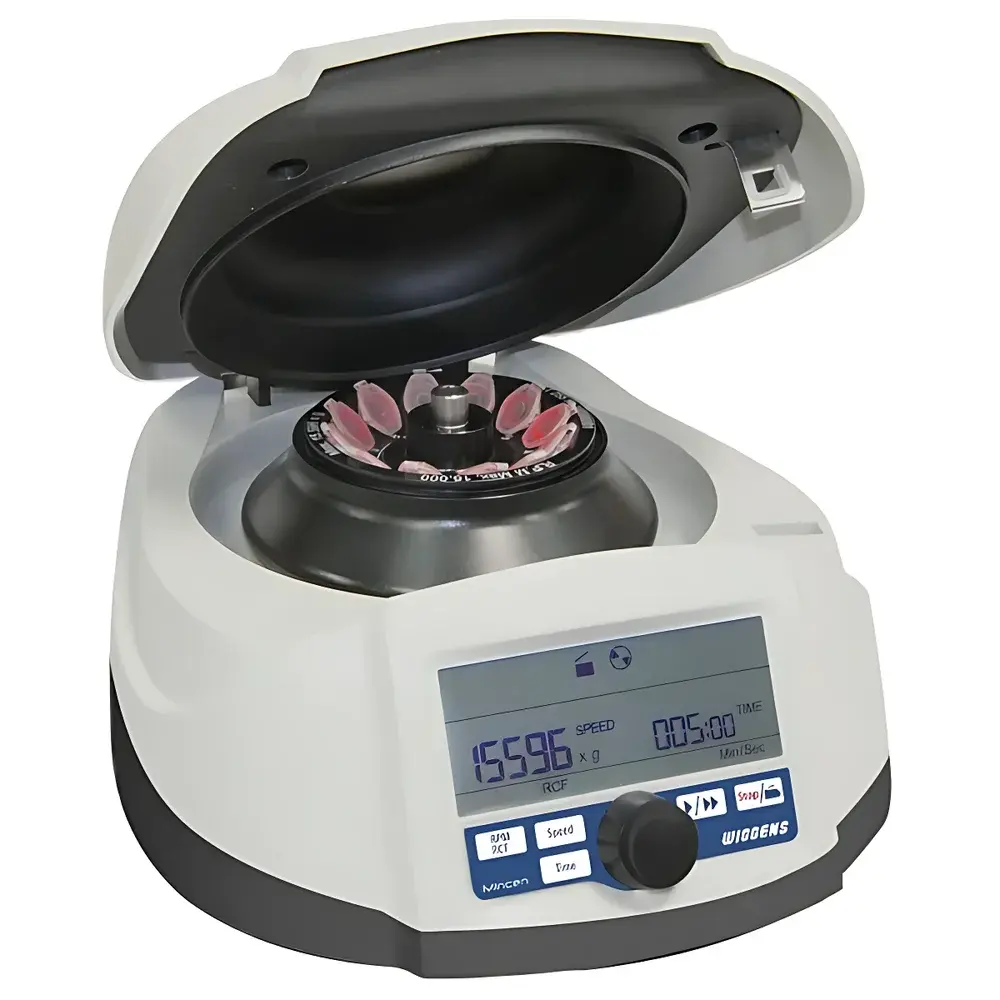
WIGGENS MINICEN 20 Benchtop Microcentrifuge
| Brand | WIGGENS |
|---|---|
| Origin | Germany |
| Model | MINICEN 20 |
| Instrument Type | Benchtop Centrifuge |
| Category | High-Speed Microcentrifuge (10,000–30,000 rpm) |
| Cooling | Refrigerated |
| Rotor Configuration | Fixed-Angle Rotor |
| Maximum Capacity | 12 × 1.5–2.0 mL |
| Max Speed | 15,000 rpm |
| Max RCF | 15,596 × g |
| Dimensions (W×D×H) | 260 × 230 × 130 mm |
| Net Weight | 4 kg |
| Noise Level | <60 dB(A) |
| Power Supply | 230 V / 110 V, 50–60 Hz |
| Compliance | EN 61010-1, EN 61010-2-020, EN 61326-1, EN 61326-2-6 |
Overview
The WIGGENS MINICEN 20 is a compact, refrigerated benchtop microcentrifuge engineered for precision separation of biological samples in resource-constrained or high-throughput laboratory environments. Operating on fixed-angle rotor dynamics, it delivers consistent sedimentation forces up to 15,596 × g at 15,000 rpm—sufficient for pelleting bacteria, mammalian cells, subcellular organelles, and nucleic acid complexes from volumes between 0.2 mL and 2.0 mL. Its thermally managed architecture incorporates forced-air cooling to minimize temperature drift during extended runs, ensuring sample integrity—particularly critical for heat-sensitive proteins, enzymes, or RNA preparations. Designed and manufactured under German engineering standards, the MINICEN 20 meets the functional and safety requirements of ISO/IEC 17025-accredited laboratories and complies with key regulatory frameworks including IEC 61010-1 (safety of electrical equipment for laboratory use) and IEC 61326-1 (EMC for laboratory instrumentation).
Key Features
- Compact footprint (260 × 230 × 130 mm) and lightweight design (4 kg), ideal for crowded biosafety cabinets, cold rooms, or mobile lab setups.
- High-resolution LCD display showing real-time RPM, RCF, countdown timer, rotor rotation status, and lid position—enabling full operational transparency without opening the chamber.
- Precise speed control in 100 rpm / 100 × g increments, with manual override capability during active runs for dynamic protocol optimization.
- Programmable timer ranging from 30 seconds to 999 minutes (1-second resolution), supporting multi-step protocols with pause functionality and automatic deceleration profiles.
- Brushless DC motor ensures maintenance-free operation, low vibration, and long service life—validated for >10,000 hours MTBF under continuous use conditions.
- Acoustic feedback system with distinct tones indicating lid closure, acceleration, steady-state operation, and completion—enhancing situational awareness in shared lab spaces.
- Integrated mechanical lid lock with emergency release, anti-drop safety latch, and transparent viewing window for visual confirmation of rotor integrity and sample loading.
- Automatic imbalance detection halts operation immediately upon detecting ≥0.5 g mass asymmetry—preventing rotor damage and safeguarding operator safety.
Sample Compatibility & Compliance
The MINICEN 20 accommodates standard microcentrifuge tubes across three volume tiers: 1.5–2.0 mL (RT255 rotor), 0.5–0.6 mL (RE 509 adapter), and 0.2–0.4 mL (RE 510 adapter). All rotors and adapters are autoclavable (121 °C, 20 min, 1 bar), enabling strict adherence to GLP/GMP sample handling workflows. The device conforms to EN 61010-2-020 (particular safety requirements for centrifuges) and supports audit-ready documentation through its parameter memory function, which retains the last-used settings—including speed, time, and acceleration/deceleration profiles—for traceability and SOP consistency. Its electromagnetic compatibility (EN 61326-2-6) and low-noise design (<60 dB[A]) meet ISO 14040 environmental criteria for installation in open-plan research facilities.
Software & Data Management
While the MINICEN 20 operates as a standalone instrument, its USB interface enables direct connection to Windows- or macOS-based PCs for firmware updates and optional data logging via WIGGENS’ proprietary configuration utility (v2.1+). The software supports export of run logs—including timestamp, set parameters, actual RCF achieved, and fault codes—in CSV format for integration into LIMS or ELN systems. Though not FDA 21 CFR Part 11 compliant out-of-the-box, the device’s deterministic behavior, non-volatile parameter storage, and hardware-enforced safety interlocks facilitate validation under internal QA protocols aligned with Annex 11 and ALCOA+ principles.
Applications
- Routine pelleting of bacterial cultures (E. coli, Bacillus spp.) and yeast suspensions prior to lysis or genomic DNA extraction.
- Clarification of cell lysates and supernatant recovery in protein purification workflows (e.g., His-tagged protein isolation).
- Concentration and cleanup of PCR products, plasmid preps, and oligonucleotides using spin-column or ethanol precipitation methods.
- Separation of exosomes and extracellular vesicles from conditioned media in cell biology and biomarker discovery studies.
- Micro-volume sample preparation for MALDI-TOF MS, HPLC injection, or capillary electrophoresis analysis.
FAQ
Is the MINICEN 20 suitable for continuous operation at maximum speed?
Yes—the brushless motor and forced-air thermal management system are rated for uninterrupted runs up to 999 minutes at 15,000 rpm, provided ambient temperature remains ≤25 °C and ventilation grilles are unobstructed.
Can the rotor be sterilized using ethylene oxide (EtO)?
No—only autoclaving (121 °C, 20 min) is validated for rotor and adapter sterilization. EtO exposure may degrade polymer components and compromise mechanical tolerances.
Does the device support programmable acceleration and deceleration ramps?
No—acceleration and deceleration are fixed to ensure mechanical stability and reproducible braking performance. However, the “soft stop” mode minimizes resuspension of pellets during deceleration.
What happens if power is interrupted mid-run?
The unit does not retain run state after power loss. Upon restoration, it defaults to standby mode and requires manual re-initiation of the protocol.
Is rotor imbalance detection calibrated per run or only at startup?
Imbalance sensing occurs continuously throughout operation, with immediate shutdown triggered by any detected deviation exceeding the certified tolerance threshold (±0.5 g).



