
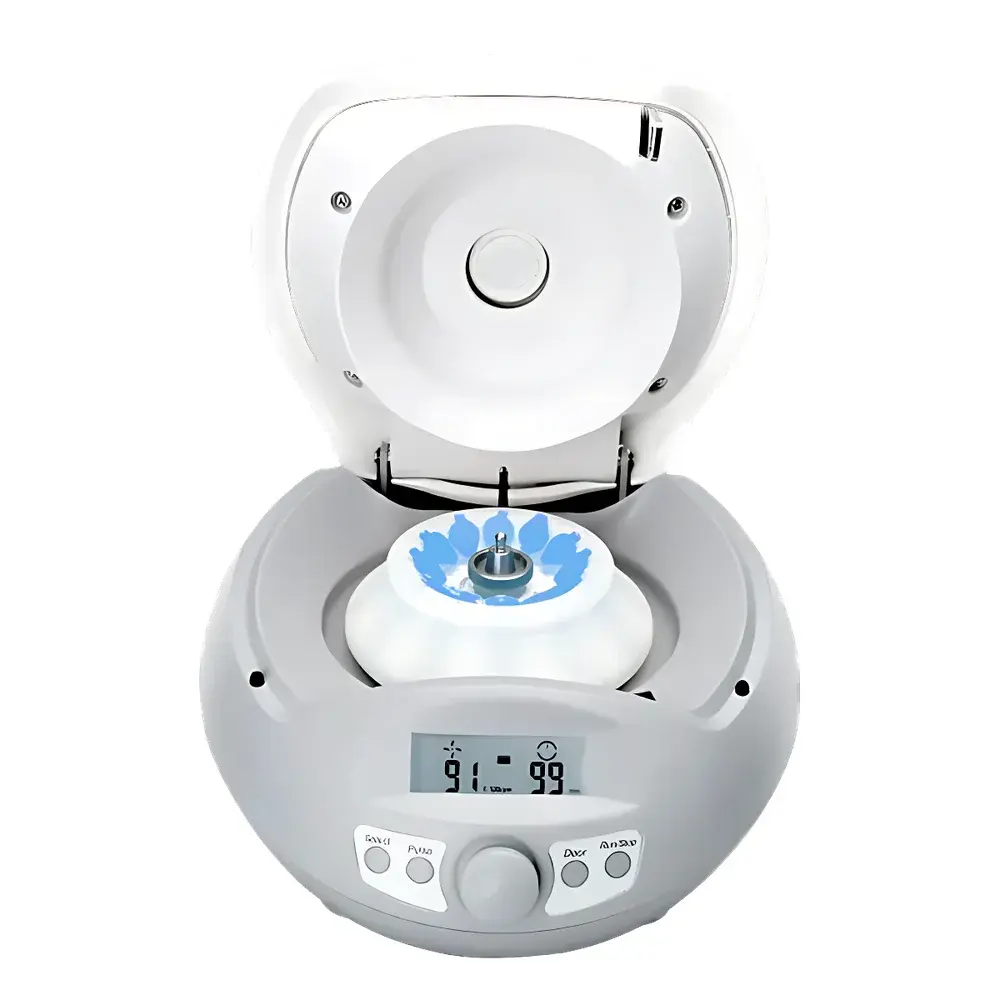
WIGGENS Minicen22 High-Speed Microcentrifuge
| Brand | WIGGENS |
|---|---|
| Origin | Germany |
| Model | Minicen22 |
| Centrifuge Type | Benchtop Microcentrifuge |
| Speed Range | 500–15,000 rpm (adjustable in 100-rpm increments) |
| Max RCF | 15,100 ×g (adjustable in 100 ×g increments) |
| Speed Accuracy | ±20 rpm |
| Rotor Capacity | 12 × 0.2 mL / 0.5 mL / 1.5 mL / 2.0 mL tubes |
| Timer Range | 30 s – 99 min or continuous mode |
| Acceleration/Deceleration | 11 s / 9 s |
| Noise Level | 54 dB(A) |
| Power Supply | AC 110–240 V, 50/60 Hz, 3 A, 100 W |
| Dimensions (L×W×H) | 255 × 245 × 140 mm |
| Weight | 6 kg |
| Motor | Brushless DC motor |
| Safety Features | Lid interlock, overspeed protection, overtemperature monitoring, real-time status diagnostics |
| Display | Backlit LCD with simultaneous rpm/RCF toggle |
| Additional Functions | PULSE mode, auto-lid opening post-run, audible end-of-run alert, run progress bar, error code reporting |
| Compliance | Designed for GLP-compliant environments |
Overview
The WIGGENS Minicen22 High-Speed Microcentrifuge is a compact, precision-engineered benchtop centrifuge optimized for rapid, reproducible separation of microliter-scale biological and chemical samples. Operating on the principle of sedimentation under controlled centrifugal force, it delivers consistent RCF (Relative Centrifugal Force) up to 15,100 ×g at a maximum rotational speed of 15,000 rpm—sufficient for pelleting bacteria, mammalian cells, subcellular organelles, and macromolecular complexes including nucleic acids, proteins, and lipids. Its low-profile footprint (255 × 245 × 140 mm) and lightweight construction (6 kg) make it ideal for crowded fume hoods, biosafety cabinets, and mobile lab setups without compromising mechanical stability. The unit employs a brushless DC motor architecture—eliminating carbon brushes, reducing thermal drift, and ensuring long-term torque consistency across voltage fluctuations (110–240 V, 50/60 Hz). Cast-iron base design lowers center of gravity, while integrated vacuum suction feet provide dual mechanical anchoring during high-speed operation—critical for vibration-sensitive applications such as RNA isolation or pre-PCR sample preparation.
Key Features
- Brushless DC motor with maintenance-free operation, delivering rapid acceleration (0–15,000 rpm in ≤11 s) and precise deceleration (≤9 s), minimizing run-to-run variability
- High-accuracy speed control (±20 rpm tolerance) and RCF calculation engine compliant with IEC 61010-2-020 safety standards
- Intuitive backlit LCD interface supporting real-time rpm/RCF toggling, dynamic parameter adjustment after rotor stabilization, and visual run-progress tracking
- Dual-mode timer: programmable duration from 30 seconds to 99 minutes, plus continuous operation mode for density gradient equilibration or overnight protocols
- PULSE function enabling transient high-force spins (user-defined rpm) for quick pellet re-suspension or brief clarification steps
- Comprehensive safety suite: lid interlock with force-sensing latch, electronic overspeed cutoff, thermistor-based overtemperature shutdown, and self-diagnostic error logging (e.g., E01 = imbalance, E03 = motor fault)
- Auto-lid release and audible alert upon completion—reducing manual intervention and enhancing workflow continuity in high-throughput labs
Sample Compatibility & Compliance
The Minicen22 accommodates standard microcentrifuge tube formats—including 0.2 mL PCR strips, 0.5 mL snap-cap tubes, and 1.5/2.0 mL conical tubes—via a single fixed-angle aluminum rotor compatible with universal adapters. No rotor exchange is required to switch between tube volumes, eliminating cross-contamination risk and setup time. All rotor components are autoclavable (121 °C, 20 min) and chemically resistant to common solvents (ethanol, isopropanol, dilute acids/bases). The instrument meets electromagnetic compatibility (EMC) requirements per EN 61326-1 and electrical safety standards per EN 61010-1. It is validated for use in clinical laboratories adhering to CLIA, CAP, and ISO 15189 frameworks, and supports traceable operation under GLP/GMP conditions through timestamped run logs and non-volatile error memory.
Software & Data Management
While the Minicen22 operates as a standalone instrument, its embedded firmware stores up to 20 recent run records—including date/time stamp, set parameters (rpm, RCF, duration), actual runtime, and fault codes—in non-volatile memory. These logs are accessible via the LCD interface for immediate review and support root-cause analysis during QA audits. The system supports 21 CFR Part 11–aligned operational integrity: all parameter changes post-stabilization are logged with timestamps, and no user-modifiable settings affect calibration constants. For integration into LIMS or ELN ecosystems, optional RS-232 or USB-to-serial adapters enable ASCII-formatted data export (e.g., “RUN_20240517_1422|14800|14920|600|OK”) compatible with common laboratory informatics platforms.
Applications
- Routine pelleting of bacterial cultures (E. coli, Bacillus spp.) and yeast for plasmid DNA extraction or protein expression workflows
- Clarification of cell lysates prior to column-based purification of genomic DNA, total RNA, or recombinant proteins
- Isolation of mitochondria, nuclei, and synaptic vesicles via differential centrifugation protocols (e.g., 1,000 ×g → 10,000 ×g → 15,000 ×g sequential spins)
- Concentration of viral particles from supernatants or exosome-enriched fractions in virology and extracellular vesicle research
- Micro-volume precipitation of synthetic oligonucleotides, dNTPs, or radiolabeled probes in radiochemistry and molecular probe development
- Pre-analytical processing in blood banks and transfusion medicine labs—including platelet-poor plasma (PPP) preparation and buffy coat harvesting
FAQ
What tube formats does the Minicen22 support without rotor modification?
It accepts 0.2 mL, 0.5 mL, 1.5 mL, and 2.0 mL microcentrifuge tubes using the same fixed-angle rotor and supplied adapters—no tooling or rotor swaps required.
Is the rotor autoclavable?
Yes—the aluminum rotor and plastic adapters are rated for autoclaving at 121 °C for 20 minutes; however, repeated sterilization may affect adapter longevity and should be monitored per institutional SOPs.
Can the Minicen22 be used in cold rooms or refrigerated environments?
It is rated for ambient operation between 5 °C and 40 °C and relative humidity ≤80% non-condensing; condensation on internal electronics must be avoided.
Does the instrument meet FDA 21 CFR Part 11 requirements?
While not a regulated software system itself, its firmware enforces Part 11–compatible practices—including immutable audit trails, electronic signatures via password-protected access (optional firmware upgrade), and secure parameter logging.
What maintenance is required beyond routine cleaning?
None—brushless DC motor design eliminates scheduled brush replacement; periodic inspection of suction feet adhesion and rotor thread integrity is recommended every 6 months.



