
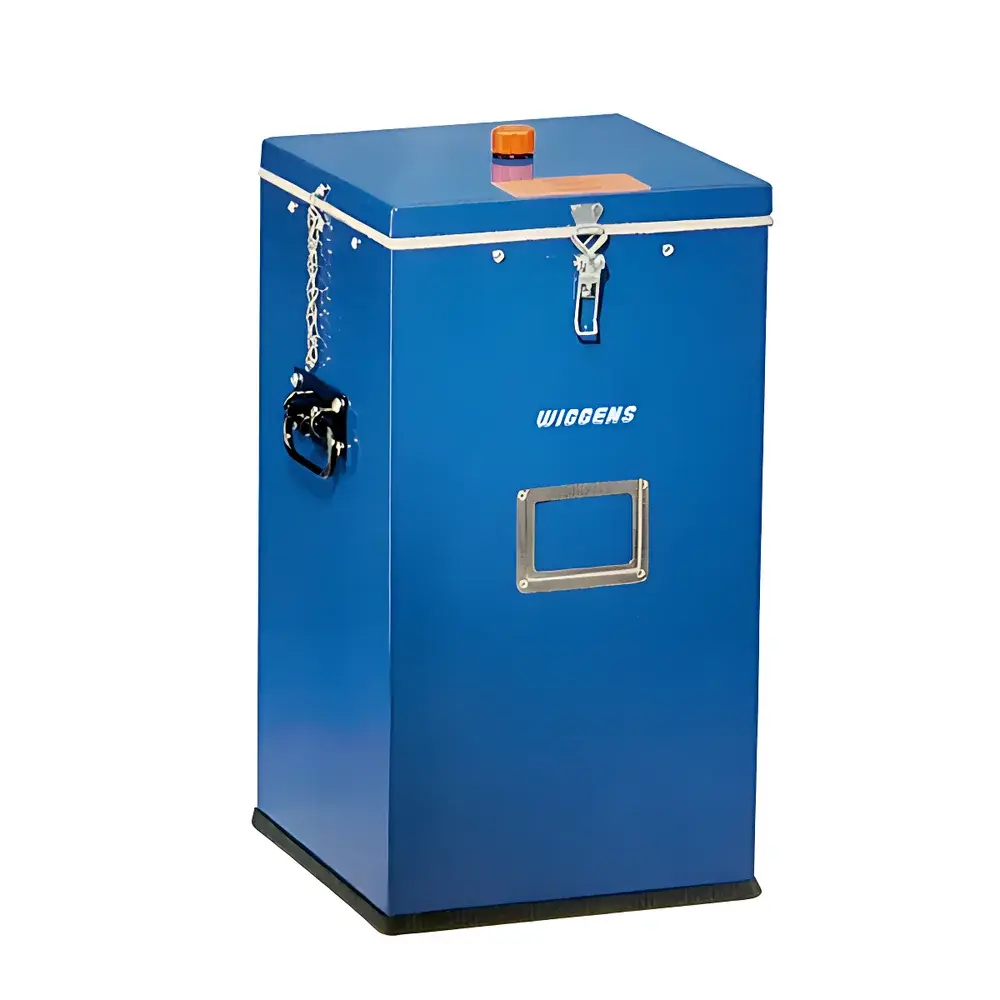
WIGGENS Model 131–135 Square Dewar Flasks
| Brand | WIGGENS |
|---|---|
| Origin | Germany |
| Model | 131–135 |
| Capacity Range | 10–40 L |
| Dimensions (L×W×H) | 200–280 mm × 230–330 mm × 290–800 mm |
| Weight | 17–35 kg |
| LN₂ Evaporation Rate | 0.4–0.9 L/day |
| Inner Vessel Material | Borosilicate Glass 3.3 (DIN ISO 3585) |
| Outer Shell | Powder-Coated Steel |
| Insulation | Vacuum Gap + Reflective Multi-Layer Foil |
| Lid Type | Spring-Clamped Insulated Cap |
| Accessories | Optional Viewing Window, Linen Dry-Ice Bag (Cat. No. 1234–1238), Insulating Tray (Cat. No. 1632–1646), Castor Base with Locking Wheels (Cat. No. 1268–133 to 1268–135) |
Overview
The WIGGENS Model 131–135 series comprises vacuum-insulated square dewar flasks engineered for high-integrity, low-temperature sample containment and transport in life science laboratories. These flasks operate on the principle of high-vacuum thermal isolation between concentric walls, augmented by multi-layer reflective foil shielding to minimize radiative heat transfer. Designed specifically for cryogenic storage at –196 °C (liquid nitrogen) or –78 °C (dry ice), they maintain stable thermal environments over extended periods—critical for preserving nucleic acid integrity, primary cell viability, enzyme activity, and cryopreserved tissue architecture. Unlike cylindrical dewars, the square geometry maximizes benchtop and rack space utilization while enabling secure stacking and alignment within controlled-access cold rooms or transport carts. The borosilicate glass 3.3 inner vessel complies with DIN ISO 3585 for hydrolytic resistance and thermal shock tolerance (ΔT ≥ 100 K), ensuring long-term chemical inertness toward biological buffers, ethanol-based cryoprotectants, and liquid-phase solvents.
Key Features
- Vacuum-jacketed square construction with integrated reflective multilayer insulation (MLI) for optimized thermal efficiency and minimal boil-off
- Borosilicate glass 3.3 inner liner certified to DIN ISO 3585—resistant to thermal shock, alkali leaching, and autoclave-compatible cleaning protocols
- Powder-coated steel outer shell in WIGGENS-standard blue finish, providing mechanical robustness and corrosion resistance under routine lab handling
- Spring-clamped insulated lid with silicone gasket seal, designed to limit vapor loss and prevent accidental dislodgement during transport
- Integrated anti-tip geometry with reinforced base corners and dual ergonomic side handles for safe manual lifting and relocation
- Optional viewing window (custom-order) enables visual verification of fill level and sample positioning without lid removal or thermal interruption
Sample Compatibility & Compliance
These dewars are validated for long-term storage of cryopreserved mammalian cells (including iPSCs and PBMCs), viral vectors, RNA-seq libraries, and frozen tissue sections. They meet material compatibility requirements per ISO 13485 for medical device-related biobanking workflows and support GLP-compliant documentation when used with traceable accessories (e.g., calibrated temperature loggers placed inside the inner vessel). While not classified as pressure vessels under PED 2014/68/EU, their design adheres to EN 13445-3 Annex C for non-pressurized cryogenic containers. The vacuum integrity is factory-tested to ≤1×10⁻³ mbar residual pressure, verified via helium leak detection (ASTM E499-17). All models comply with EU RoHS Directive 2011/65/EU and REACH Regulation (EC) No. 1907/2006 regarding restricted substances.
Software & Data Management
As passive cryogenic storage devices, the 131–135 series does not incorporate embedded electronics or firmware. However, they are fully compatible with third-party monitoring ecosystems: wireless temperature loggers (e.g., DeltaTRAK FlashLink, LogTag TRIX-8) can be mounted inside the inner vessel or secured beneath the lid gasket. When deployed in GxP-regulated environments, integration with validated data acquisition platforms (e.g., LabVantage LIMS, Thermo Fisher SampleManager) supports audit-trail generation for temperature excursions, maintenance logs, and calibration records—fully compliant with FDA 21 CFR Part 11 requirements for electronic records and signatures.
Applications
- Cryogenic transport of clinical specimens between satellite collection sites and central biorepositories
- Short-term holding of LN₂-cooled NMR probe inserts and superconducting magnet shims
- Controlled-rate freezing support for oocyte and embryo banking programs
- On-bench stabilization of thermolabile reagents (e.g., restriction enzymes, Taq polymerases, CRISPR RNP complexes)
- Field-deployable cold chain units for environmental microbiome sampling in remote locations
- Backup storage for ultra-low temperature freezers during maintenance cycles or power outages
FAQ
Can these dewars be used for liquid helium storage?
No. The thermal design and vacuum specifications are optimized for liquid nitrogen (–196 °C) and dry ice (–78 °C) applications only. Liquid helium (–269 °C) requires specialized double-vacuum, superinsulated systems with active cooling compensation.
Is the borosilicate glass liner autoclavable?
Yes—the inner vessel is rated for steam sterilization at 121 °C, 2 bar for 20 minutes, provided the outer steel shell is protected from condensation and direct exposure to saturated steam.
What is the recommended maximum fill level for optimal evaporation control?
For minimum LN₂ boil-off, maintain liquid level between 70% and 90% of inner vessel capacity. Overfilling increases surface area convection and compromises lid seal integrity.
Are replacement lids available separately?
Yes. Insulated spring-clamp lids (Cat. No. 1231–1233) and custom-viewing-window lids (Cat. No. 1240–1245) are stocked and supplied with full dimensional certification reports.
Do these dewars require periodic vacuum reconditioning?
Under normal laboratory use and proper handling, the vacuum integrity remains stable for ≥8 years. Annual visual inspection of the outer shell for dents or coating damage is advised; vacuum decay testing is recommended every 36 months in GMP environments.



