
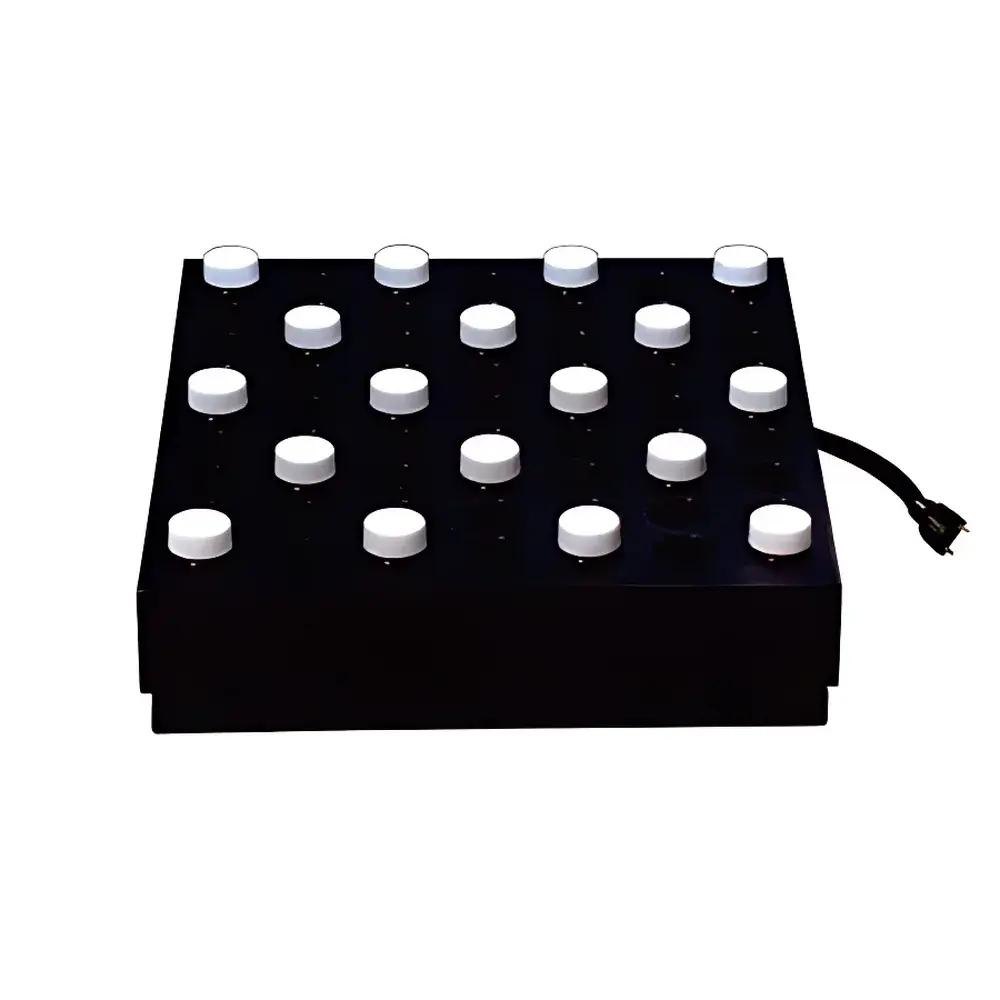
WIGGENS RB/RBC/RBR Series High-Performance Thermo-Regulated Metal Block Modules
| Brand | WIGGENS |
|---|---|
| Origin | Germany |
| Model | RB/RBC/RBR |
| Temperature Range | –80 °C to +130 °C |
| Temperature Uniformity | ±1 °C |
| Max. Sample Capacity | >60 positions |
| Module Types | Heating-only (RB), Heating/Refrigeration (RBC), Reflux-capable Heating/Refrigeration (RBR) |
Overview
The WIGGENS RB/RBC/RBR Series Thermo-Regulated Metal Block Modules are precision-engineered thermal platforms designed for high-throughput, reproducible sample conditioning in analytical, pharmaceutical, and life science laboratories. These modules operate on solid-state conductive heat transfer principles—leveraging machined aluminum alloy blocks with integrated resistive heating elements and, in RBC and RBR variants, annular coolant channels conforming to each well geometry. Unlike fluid-bath systems, metal block modules eliminate cross-contamination risk, reduce evaporation losses, and deliver rapid thermal response (typical heating/cooling rates of 2–4 °C/s depending on load and chiller performance). The RB series supports standalone heating applications from ambient to +130 °C; the RBC series extends functionality to –80 °C using externally coupled recirculating chillers (e.g., WIGGENS WB-350 or equivalent); the RBR series adds a dedicated condensation layer for reflux-coupled reactions, enabling controlled volatile retention during heated incubations—a capability critical for derivatization, enzymatic assays, and solvent-based extractions under GLP-compliant workflows.
Key Features
- Three modular architectures: RB (heating-only), RBC (heating/refrigeration), and RBR (reflux-integrated heating/refrigeration)
- Machined anodized aluminum blocks ensuring high thermal conductivity, chemical resistance, and long-term dimensional stability
- Well-specific coolant channel geometry in RBC/RBR models enables uniform sub-zero cooling across all positions without thermal bridging
- Triple-layer RBR design: bottom heating zone, middle insulating barrier, top condensation zone—each independently thermally managed
- Standard well configurations support common vial formats (2 mL, 4 mL, 8 mL, 20 mL) with precise depth and diameter tolerances per ISO 8573 and ASTM D471 standards
- Optional nitrogen-assisted evaporation kits (RBV-96, RBV-63) integrate seamlessly with WIGGENS orbital shakers for parallel sample concentration under inert atmosphere
- Compatible with WIGGENS PID-controlled temperature units (e.g., WB-350) supporting 10-program memory, multi-step ramp/soak profiles, and dual timing modes (start-on-setpoint or start-on-timer)
Sample Compatibility & Compliance
These modules accommodate standard screw-cap and crimp-top vials—including those compliant with USP , ISO 8317, and DIN 16538 specifications—without requiring adapters. Well dimensions are certified traceable to NIST-traceable calipers, and block flatness is maintained within ±5 µm across operational temperature ranges. For regulated environments, the system supports 21 CFR Part 11-compliant data logging when paired with validated WIGGENS controllers featuring audit trail, electronic signature, and user-access-level management. All aluminum components meet RoHS Directive 2011/65/EU and REACH Annex XIV criteria. The polypropylene-compatible construction of associated accessories (e.g., RBV kits) ensures compatibility with common organic solvents used in QC testing per ICH Q2(R2) method validation guidelines.
Software & Data Management
While the modules themselves are hardware platforms, full traceability and process control are achieved via integration with WIGGENS’ WB-350 controller firmware (v3.2+), which provides encrypted local storage of temperature logs, program execution records, and fault diagnostics. Data export is supported in CSV and PDF formats compatible with LIMS integration (e.g., LabWare, STARLIMS) through USB 2.0 or optional RS-485 interface. Firmware updates maintain backward compatibility with legacy RB-series modules and include enhanced alarm thresholds for out-of-specification thermal drift detection—aligned with ISO/IEC 17025:2017 clause 7.7 on equipment monitoring.
Applications
- High-throughput sample equilibration prior to GC, HPLC, or LC-MS injection
- Enzyme kinetic studies requiring precise sub-zero stabilization of reaction mixtures
- Controlled derivatization reactions (e.g., dansylation, silylation) where reflux prevents reagent loss
- Stability-indicating assays per ICH Q1A(R2) under accelerated temperature-humidity conditions
- Nucleic acid hybridization and restriction digestion protocols demanding tight thermal homogeneity
- Residual solvent analysis per USP using headspace-GC with temperature-programmed incubation
- Parallel synthesis in medicinal chemistry with real-time thermal profiling across 96-position arrays
FAQ
What external chiller is required for RBC and RBR modules?
A recirculating chiller capable of sustaining –80 °C at ≥1.5 L/min flow rate and ≥3 bar pressure is mandatory. WIGGENS WB-350 (J5015K) is validated for direct coupling; alternative units must meet DIN EN 61000-6-3 EMC and IEC 61010-1 safety standards.
Can RB modules be retrofitted with refrigeration capability?
No. RB modules lack internal coolant channels and structural reinforcement for cryogenic operation. Only RBC and RBR variants are engineered for bidirectional thermal control.
Is calibration documentation provided with each module?
Yes—each unit ships with a factory calibration certificate (traceable to PTB, Germany) covering temperature uniformity (±1 °C at 37 °C, 60 °C, and 100 °C) and thermal stability (±0.3 °C over 2 h at setpoint).
Are custom well geometries available?
Yes. WIGGENS offers OEM machining services for non-standard vial diameters, depths, or array layouts—subject to minimum order quantities and mechanical feasibility review.
Does the nitrogen evaporation kit affect temperature uniformity?
Independent validation per ASTM E2876 confirms no measurable deviation (>±0.2 °C) in block uniformity when RBV-96 or RBV-63 kits are installed and operated at ≤15 psi N₂ flow.



