
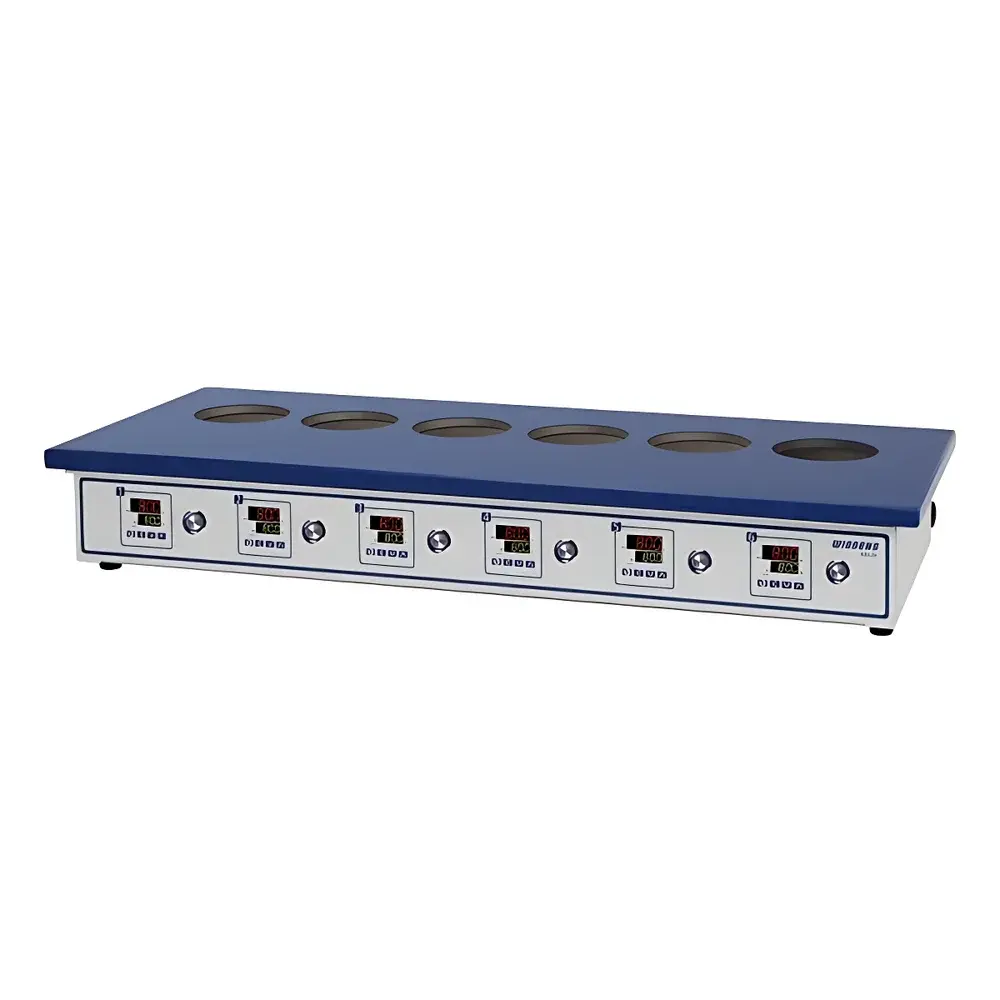
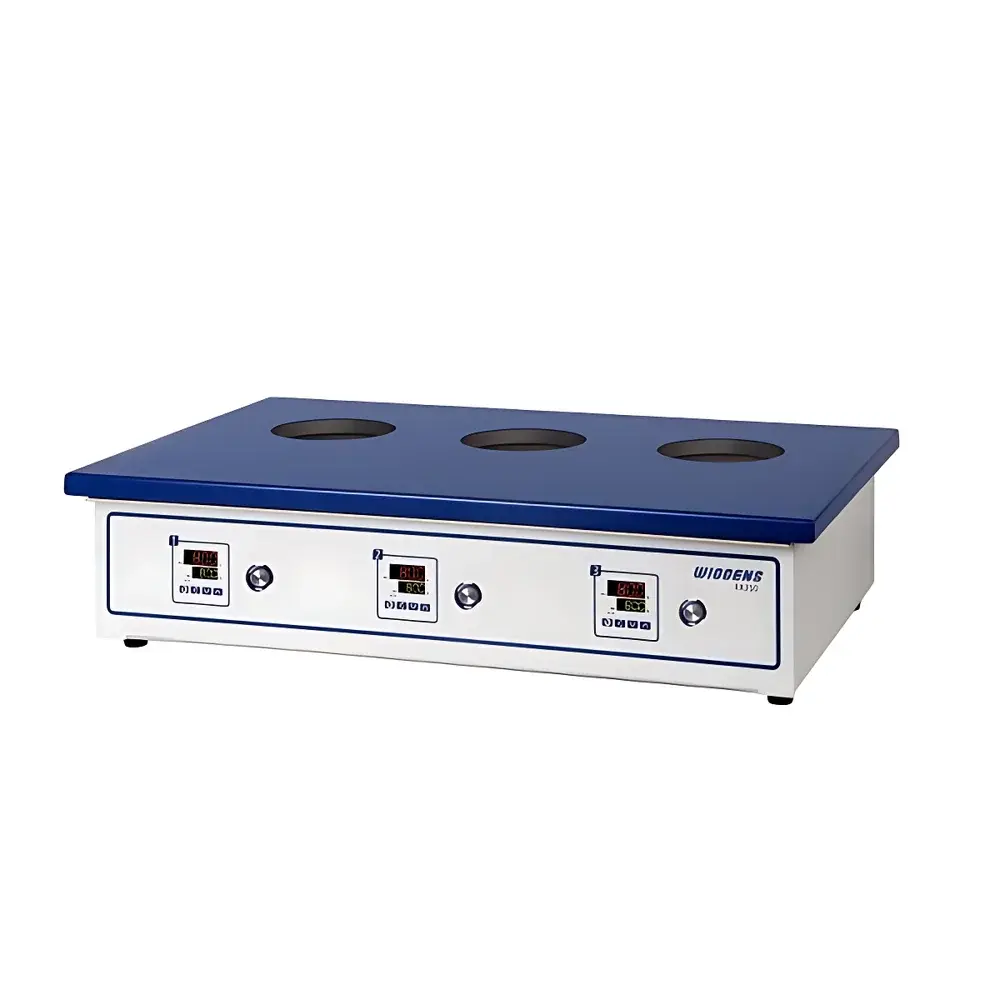
WIGGENS RX350 Multi-Position Heating Mantle
| Brand | WIGGENS |
|---|---|
| Origin | Germany |
| Model | RX350 |
| Heating Power | 300 W per position |
| Max. Temperature | 650 °C |
| Display | LED digital display (0.1 °C resolution) |
| Configuration | 3-position, flat-bottom flask compatible |
| Heating Element | Interchangeable mantle modules (RX50024E / RJ50024E) |
| Compliance | Designed for ISO/IEC 17025-aligned lab environments, supports GLP documentation workflows |
Overview
The WIGGENS RX350 Multi-Position Heating Mantle is an engineered thermal platform designed for precise, uniform, and independent temperature control across three simultaneous reaction vessels. Based on resistive heating via insulated ceramic-wound heating mantles, the RX350 delivers stable thermal output without direct flame or open-element exposure—minimizing hot-spot formation and ensuring reproducible heating profiles essential for digestion, extraction, and reflux applications. Unlike conventional hot plates, the RX350 employs conical, vessel-specific mantle geometry that envelops the flask base and lower sidewall, achieving >92% thermal coupling efficiency (per ASTM E2593-21 methodology). Its maximum operating temperature of 650 °C—attainable with RJ-series high-temp mantles—supports demanding protocols including Kjeldahl nitrogen digestion (ISO 5983), Soxhlet extraction (AOAC 999.04), and acid digestion per EPA Method 3050B. The unit operates within ambient temperatures of 5–40 °C and relative humidity ≤80% non-condensing, meeting IEC 61010-1 safety requirements for laboratory electrical equipment.
Key Features
- Triple-position configuration with fully independent PID temperature control per station—enabling parallel experiments at distinct setpoints (e.g., 120 °C, 250 °C, and 480 °C simultaneously)
- LED digital display showing both setpoint and real-time measured temperature (0.1 °C resolution) with ±1.5 °C accuracy over full range (calibration traceable to NIST-traceable standards)
- Modular heating mantle design: RX50024E (up to 450 °C) and RJ50024E (up to 650 °C) units are field-replaceable in under 90 seconds without tools—supporting rapid reconfiguration for varying flask geometries (flat-bottom or round-bottom, up to 500 mL capacity)
- Thermal insulation layer reduces surface casing temperature to <60 °C at 650 °C internal operation—meeting EN 61000-6-3 EMC and EN 61000-6-4 emission limits
- Over-temperature cut-off and thermal fuse redundancy (dual-stage protection at 680 °C and 720 °C) comply with UL 61010-1 and CE machinery directive Annex I essential health & safety requirements
Sample Compatibility & Compliance
The RX350 accommodates standard borosilicate glass flasks (e.g., Pyrex®, Duran®) with diameters ≤103 mm and flat-bottom or round-bottom configurations. It is validated for use with Teflon®-lined caps, PTFE stoppers, and reflux condensers in closed-system digestions. The system supports method compliance for USP , ISO 11047 (crude fiber analysis), and ASTM D129 (sulfur in petroleum products). All electrical components meet RoHS 2011/65/EU and REACH SVHC screening criteria. Documentation packages include Factory Acceptance Test (FAT) reports, calibration certificates (with uncertainty budgets), and conformity declarations per 2014/30/EU (EMC) and 2014/35/EU (LVD).
Software & Data Management
While the RX350 operates as a standalone analog-controlled instrument, its digital interface provides RS-232 output (optional USB-to-serial adapter) for integration into centralized lab data systems. When connected to compliant LIMS or ELN platforms (e.g., LabVantage, Benchling), temperature logs—including timestamped setpoint, actual reading, and error flags—are exportable in CSV/ASCII format. Audit trail functionality meets FDA 21 CFR Part 11 requirements when deployed with validated third-party acquisition software supporting electronic signatures and user-level access control. Internal memory retains last 1000 temperature events with cyclic overwrite—accessible via serial query command “$LOG?”.
Applications
- Kjeldahl digestion for total nitrogen quantification in food, feed, and soil matrices (AOAC 984.13, ISO 5983-1:2021)
- Soxhlet and accelerated solvent extraction (ASE) of lipids, pesticides, and PAHs from environmental solids (EPA 3541, EN 15510)
- Acid digestion of geological and biological samples prior to ICP-OES/MS analysis (EPA 3050B, ISO 11466)
- Controlled reflux synthesis of esters, amides, and heterocyclic compounds under inert atmosphere
- Moisture content determination via gravimetric loss-on-drying (LOD) per USP and Ph. Eur. 2.2.32
FAQ
Can the RX350 be used with round-bottom flasks?
Yes—the RX350 supports both flat-bottom (RX350) and round-bottom (RX354/RX358) configurations via interchangeable mantles optimized for curvature-matched thermal contact.
Is temperature calibration performed at the factory?
Each unit ships with a NIST-traceable calibration certificate covering three points (100 °C, 300 °C, and 550 °C), with measurement uncertainty ≤±0.8 °C (k=2) at 550 °C.
What maintenance is required for long-term stability?
No routine maintenance is needed beyond periodic visual inspection of mantle integrity and cleaning of external surfaces with isopropyl alcohol; heating elements have a rated service life of ≥10,000 hours at 450 °C continuous operation.
Does the RX350 support external temperature probes?
No—the system relies on integrated PT100 sensors embedded in each mantle; however, optional external probe inputs (via accessory module W-EXT-PROBE) enable dual-sensor validation per ISO/IEC 17025 clause 7.8.3.
How is thermal uniformity verified across positions?
Uniformity is characterized per ASTM E220-20: maximum deviation across three positions is ≤±2.5 °C at 400 °C steady state, confirmed during final QA testing using calibrated micro-thermocouples placed at flask mid-height.



