
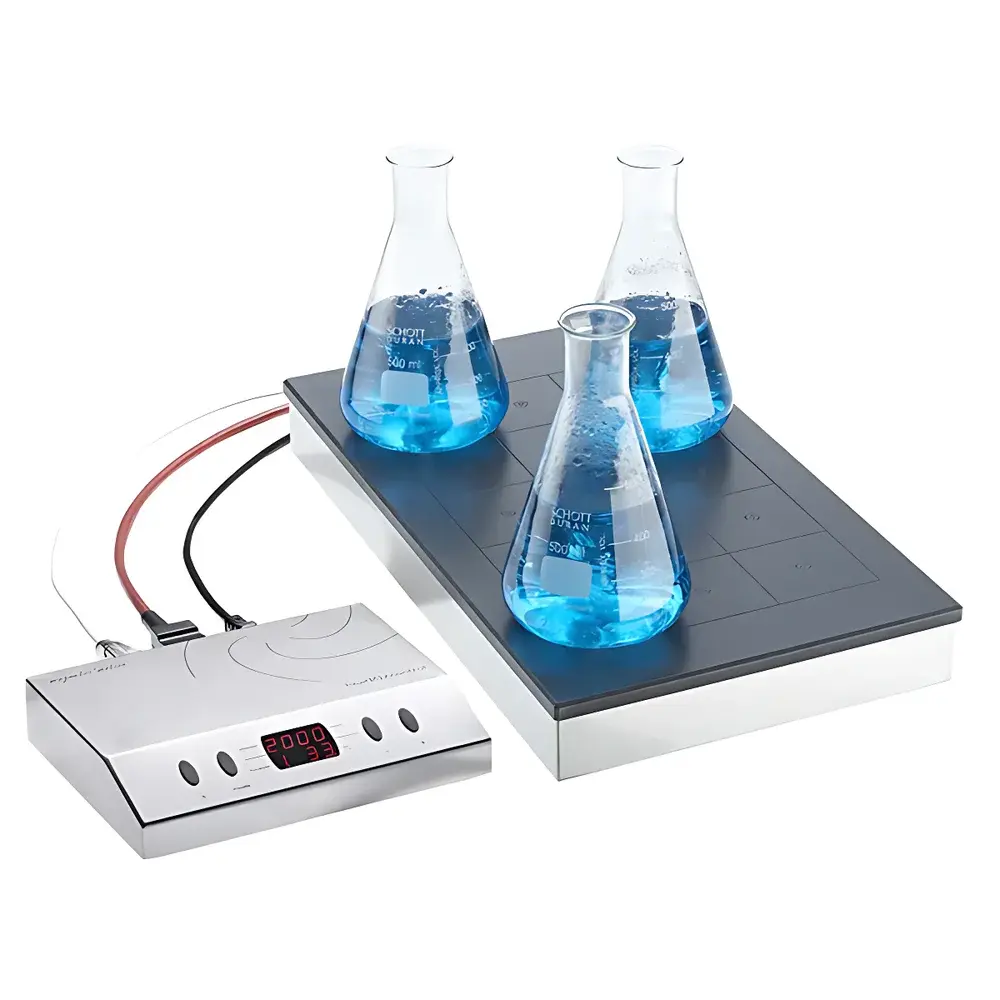
WIGGENS SH15 Inductive Magnetic Drive Multi-Position Hotplate Stirrer
| Brand | WIGGENS |
|---|---|
| Origin | Germany |
| Model | SH15 |
| Instrument Type | Magnetic Stirrer |
| Max. Stirring Volume per Position | 1000 mL |
| Speed Range | 100–2000 rpm |
| Heating Temperature Range | RT to +200 °C |
| Power Settings | 4-step (25/50/75/100%) |
| Heating Plate Material | PTFE-coated Aluminum |
| Control Interface | LED Display with RS232 Port |
| External Temperature Sensing | Pt100 Input Supported |
| Over-Temperature Protection | Yes |
| Dimensions (W×D×H) | 250 × 430 × 75 mm |
| Weight | ~15 kg |
| Power Supply | 230 V, 1200 W |
Overview
The WIGGENS SH15 Inductive Magnetic Drive Multi-Position Hotplate Stirrer is an engineered solution for laboratories requiring simultaneous, precise, and maintenance-free stirring and heating across up to 15 independent positions. Unlike conventional direct-drive magnetic stirrers, the SH15 employs inductive magnetic coupling—eliminating physical contact between the drive motor and the stirring element. This architecture ensures zero mechanical wear, no heat generation in the drive unit, and long-term operational stability even under continuous duty cycles. Each position operates at identical speed and torque characteristics, enabling true parallel processing of multiple samples without cross-position variability. Designed for reproducible thermal and mixing conditions, the SH15 integrates a uniform-heating PTFE-coated aluminum hotplate capable of reaching +200 °C with ±1 °C thermal homogeneity across the surface—critical for kinetic studies, dissolution testing, and multi-vial synthesis workflows.
Key Features
- Inductive magnetic drive system: No brushes, no gears, no lubrication—ensuring silent, maintenance-free operation over extended service life.
- 15-position configuration with standardized 65 mm center-to-center spacing—optimized for compatibility with standard round-bottom flasks, beakers, and vials (1–1000 mL per position).
- Four-level power adjustment (25%/50%/75%/100%) allows dynamic torque modulation: high-power mode supports viscous media (e.g., polymer solutions, cell culture matrices), while low-power mode enables unattended overnight stirring without thermal drift or motor saturation.
- Soft-start acceleration algorithm prevents abrupt motion of stir bars—reducing splashing, vortex instability, and premature bar ejection during initiation.
- PTFE-coated aluminum heating plate offers exceptional chemical resistance to acids, bases, and organic solvents; surface is non-porous and easily decontaminated between runs.
- Dual independent control channels: one for stirring parameters (speed, power level), another for thermal regulation—each with dedicated LED display and tactile keypad input.
- Built-in over-temperature cut-off and optional external Pt100 probe integration enable closed-loop sample temperature control—meeting requirements for GLP-compliant thermal validation protocols.
Sample Compatibility & Compliance
The SH15 accommodates a broad range of vessel geometries—including cylindrical glassware (25–1000 mL), square-section reaction blocks, and custom multi-well plates—without requiring repositioning or adapter kits. Its low-profile design (75 mm height) facilitates integration into fume hoods and under laminar flow cabinets. The device complies with IEC 61010-1:2010 for electrical safety in laboratory equipment and meets EMC directive 2014/30/EU. While not intrinsically rated for hazardous environments, its sealed electronics and chemical-resistant surface support use in ISO Class 5–8 cleanrooms when operated with appropriate containment. For regulated environments, the RS232 interface supports audit-trail-capable data logging when paired with validated third-party software compliant with FDA 21 CFR Part 11 requirements.
Software & Data Management
The SH15 does not include embedded firmware-based data storage; instead, it provides real-time parameter streaming via RS232 serial output (ASCII protocol). This interface enables seamless integration with laboratory information management systems (LIMS), electronic lab notebooks (ELN), or custom SCADA platforms. Users may log speed, setpoint temperature, actual plate temperature (via internal sensor), and external Pt100 readings at user-defined intervals (e.g., every 5 seconds). All communication is timestamped and checksum-verified to ensure data integrity. No proprietary drivers are required—standard terminal emulators or Python/Node.js serial libraries suffice for implementation. Configuration files and calibration records remain under full user control, supporting traceability in GMP and ISO/IEC 17025 workflows.
Applications
- Parallel dissolution testing in pharmaceutical QA/QC labs—maintaining consistent agitation intensity and bath temperature across 15 USP Apparatus II vessels.
- Multi-channel buffer equilibration for HPLC and LC-MS system preparation, where pH-sensitive reagents require stable, non-oxidizing mixing conditions.
- High-throughput enzymatic assay setup, including temperature-controlled pre-incubation of substrate–enzyme mixtures prior to kinetic readout.
- Synthesis screening in medicinal chemistry: simultaneous stirring/heating of reaction vials under inert atmosphere (when used with glovebox-compatible enclosures).
- Environmental sample digestion protocols (e.g., EPA Method 3050B), where uniform heating and controlled agitation prevent localized boiling or precipitate formation.
FAQ
Does the SH15 support individual speed control per position?
No—the SH15 maintains synchronized speed across all 15 positions. This design prioritizes inter-vial reproducibility over positional flexibility, aligning with regulatory expectations for comparative analytical workflows.
Can the SH15 be used with metal-containing solutions?
Yes, provided the stir bars are chemically compatible (e.g., PTFE- or glass-coated). The inductive drive is unaffected by solution conductivity or paramagnetic content, unlike eddy-current-based systems.
Is calibration documentation available for the Pt100 input channel?
WIGGENS supplies factory calibration certificates (traceable to DKD/DAkkS standards) upon request; users must perform periodic verification using NIST-traceable reference thermometers per ISO/IEC 17025 Clause 6.5.
What is the maximum ambient operating temperature for continuous use?
The unit is rated for ambient temperatures up to +35 °C. Above this, derating of heating power and reduced duty cycle are recommended to maintain thermal stability and longevity of the PTFE coating.
How is over-temperature protection implemented?
A redundant dual-sensor architecture monitors both plate surface temperature and internal electronics housing. If either exceeds preset thresholds (+220 °C plate, +90 °C electronics), power is immediately cut and a visual alarm is triggered on the LED display.



