
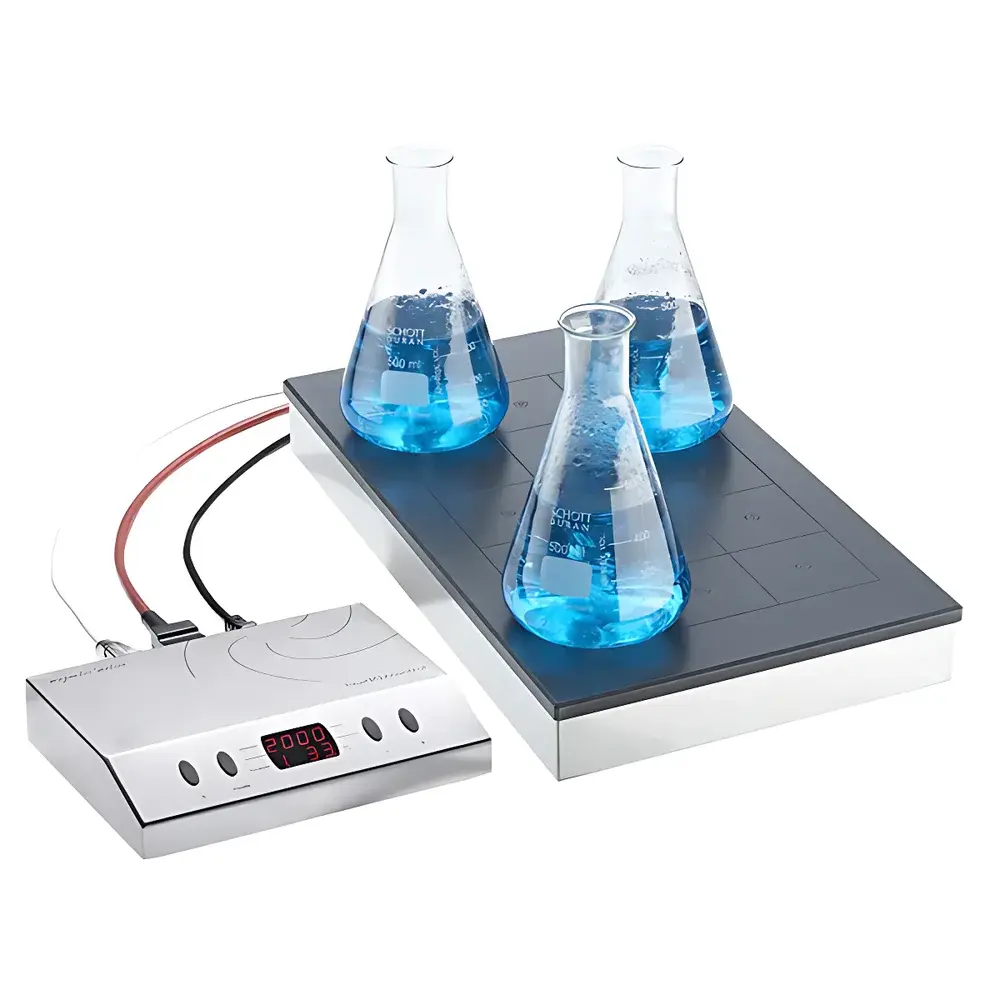
WIGGENS SH6 Induction-Driven Multi-Position Magnetic Hotplate Stirrer
| Brand | WIGGENS |
|---|---|
| Origin | Germany |
| Type | Induction-driven magnetic hotplate stirrer |
| Model | SH6 |
| Number of Positions | 6 |
| Max. Stirring Volume per Position | 1500 mL |
| Speed Range | 100–2000 rpm |
| Heating Temperature Range | Ambient to +200 °C |
| Power Setting Levels | 4 (25/50/75/100%) |
| Heating Plate Material | PTFE-coated aluminum alloy |
| Control Interface | Independent LED display for speed, power level, and temperature |
| Temperature Monitoring | External Pt100 probe input |
| Communication | RS232 interface |
| Protection Rating | IP20 |
| Power Supply | 230 V, 1200 W |
| Dimensions (W×D×H) | 250 × 430 × 75 mm |
| Weight | ~15 kg |
| Safety Features | Auto overtemperature cutoff, soft-start function |
Overview
The WIGGENS SH6 Induction-Driven Multi-Position Magnetic Hotplate Stirrer is an engineered solution for laboratories requiring simultaneous, precise, and maintenance-free stirring and heating across up to six independent positions. Unlike conventional electromagnetic coil-based stirrers, the SH6 employs contactless induction drive technology—generating rotational torque via alternating magnetic fields without physical coupling between the drive unit and the stir bar. This eliminates mechanical wear, brush arcing, heat generation in the motor housing, and vibration-induced instability—especially critical at low speeds (100–300 rpm) where conventional systems often exhibit jitter or stalling. Each position operates with synchronized speed control, ensuring uniform mixing kinetics across parallel experiments. Integrated PTFE-coated aluminum heating plates deliver rapid thermal response and homogeneous surface temperature distribution (±2 °C across active area), validated per ASTM E2209 for hotplate uniformity testing. Designed for continuous-duty operation under GLP-compliant workflows, the SH6 meets IEC 61010-1 safety standards for laboratory electrical equipment.
Key Features
- Contactless induction drive system: No moving parts in the drive mechanism; zero maintenance, no heat buildup in the base unit, and silent operation.
- Six independently accessible stirring positions with 130 mm center-to-center spacing—optimized for compatibility with standard Erlenmeyer flasks (up to 1000 mL), beakers (up to 1500 mL), and round-bottom flasks.
- Four-step power regulation (25%, 50%, 75%, 100%) enables adaptive torque delivery: high-power mode supports viscous media (e.g., polymer solutions, cell culture matrices); low-power mode sustains extended incubation without thermal drift.
- Soft-start acceleration algorithm prevents sudden jerk on stir bars, reducing risk of splashing, vortex collapse, or bar ejection—particularly beneficial for low-density or volatile solvents.
- PTFE-coated aluminum heating plate: Chemically inert, non-porous, and easily decontaminated—resistant to acids, bases, and organic solvents per ISO 15223-1 biocompatibility guidelines.
- Dual-control architecture: Separate digital LED interfaces for stirring parameters (speed + power level) and thermal parameters (setpoint + real-time probe reading).
- RS232 serial interface supports integration into LIMS or automated lab platforms for audit-trail-capable parameter logging (compliant with FDA 21 CFR Part 11 when paired with validated software).
Sample Compatibility & Compliance
The SH6 accommodates vessels ranging from 1 mL microcentrifuge tubes (with appropriate small-diameter stir bars) to 1500 mL tall-form beakers. Its flat, low-profile design ensures stable placement of conical flasks up to 1000 mL without tipping risk. The induction drive maintains consistent torque regardless of vessel wall thickness or material (glass, PP, PC, or borosilicate)—a key advantage over permanent-magnet-coupled systems that suffer efficiency loss through thick or ferromagnetic containers. The unit complies with CE marking requirements under Directive 2014/30/EU (EMC) and 2014/35/EU (LVD), carries UL recognition for North American markets (E350184), and conforms to ISO/IEC 17025 clause 5.5.2 for equipment suitability in accredited testing laboratories. Overtemperature protection activates at +210 °C (hardware-limited), independent of user-set values.
Software & Data Management
While the SH6 operates as a standalone instrument, its RS232 port enables bidirectional communication with third-party control software (e.g., LabVIEW, MATLAB, or custom Python scripts via pySerial). Users may log timestamped records of setpoints, actual speeds (via internal tachometer feedback), and Pt100-measured sample temperatures. When deployed in regulated environments, data export supports CSV or ASCII formats compatible with electronic lab notebooks (ELNs) satisfying ALCOA+ principles (Attributable, Legible, Contemporaneous, Original, Accurate). Firmware updates are performed offline via USB-to-serial adapter; no cloud connectivity or remote access functionality is implemented—ensuring full data sovereignty.
Applications
- Parallel synthesis screening in medicinal chemistry: Simultaneous optimization of reaction conditions (temperature, agitation intensity) across six variants.
- QC/QA testing in food and beverage labs: Homogenization of viscosity-standardized emulsions prior to rheological analysis per ISO 1183-2.
- Environmental water analysis: Digestion of EPA Method 3015A samples under controlled heating/stirring to ensure complete acid dissolution of trace metals.
- Biopharmaceutical process development: Gentle, oxygen-stable mixing of monoclonal antibody formulations during accelerated stability studies (ICH Q5C).
- Materials science: Dispersion of nanomaterials (e.g., graphene oxide, TiO₂ nanoparticles) in polymer precursors without introducing metallic contamination from worn drive components.
FAQ
Does the SH6 support external temperature feedback control using a Pt100 probe?
Yes—the instrument accepts a standard 2-wire or 3-wire Pt100 sensor connected via the rear-panel DIN connector. Temperature regulation switches from heater-surface mode to sample-temperature mode upon probe insertion, with PID tuning optimized for aqueous and organic media.
Can the SH6 operate continuously for 72+ hours without performance degradation?
Yes—its induction drive architecture has no consumable components, and thermal management is validated for uninterrupted operation at 100% power and +200 °C for ≥168 hours per IEC 60068-2-2 test protocol.
Is the RS232 interface galvanically isolated?
No—it is TTL-level RS232 compliant but not opto-isolated; use of an industrial-grade USB-RS232 converter with surge protection is recommended in electrically noisy environments.
What stir bar dimensions are recommended for optimal coupling at 100 rpm?
For 1500 mL beakers, use 40 mm × 8 mm PTFE-coated elliptical stir bars; for 250 mL flasks, 25 mm × 5 mm bars provide maximum torque transfer efficiency at low speeds.
Does the SH6 meet IP rating requirements for wet-lab environments?
It carries IP20 classification—suitable for dry, indoor laboratory use only; it is not rated for splash resistance or cleaning with liquid disinfectants. For higher ingress protection, consider the WHMIX series (IP64).



