
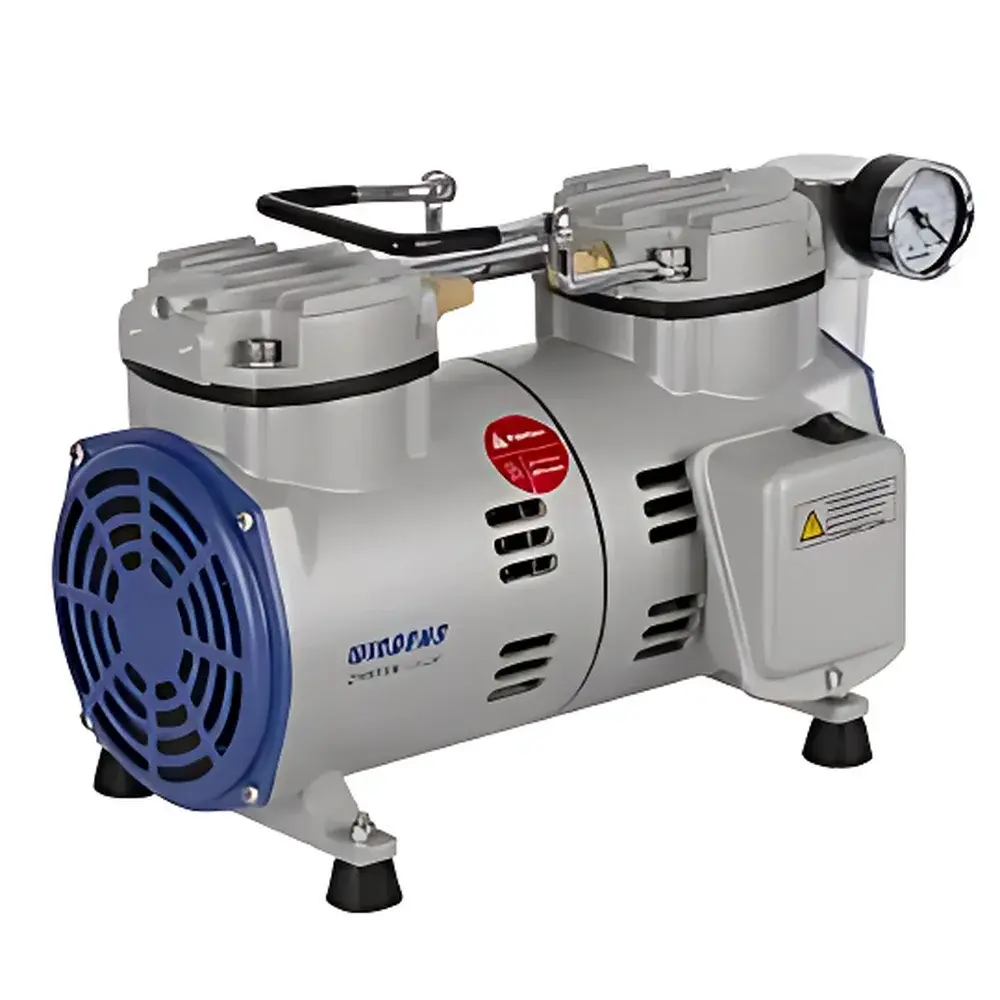
WIGGENS V600 Oil-Free Vacuum Pump
| Brand | WIGGENS |
|---|---|
| Origin | Germany |
| Model | V600 |
| Pump Type | Oil-Free Piston Vacuum Pump |
| Ultimate Vacuum | 120 mbar |
| Pumping Speed | 60 L/min |
| Motor Power | 190 W |
| Dimensions (W×D×H) | 340 × 155 × 195 mm |
| Weight | 8.6 kg |
| Noise Level | ≤65 dB(A) |
| Input Voltage | 220–240 V / 50 Hz |
| Motor Speed | 1450 rpm |
| Inlet Port Diameter | 9 mm |
| Thermal Overload Protection | Integrated |
| Inlet Filter | Standard Sintered Metal Cartridge |
| Compliance | CE, RoHS |
Overview
The WIGGENS V600 Oil-Free Vacuum Pump is an engineered solution for laboratories requiring reliable, contamination-free vacuum generation in non-corrosive applications. Based on a precision-machined reciprocating piston mechanism, this pump operates without lubricating oil—eliminating oil carryover, vapor backstreaming, and hydrocarbon contamination. Its dry-running architecture ensures consistent performance across repeated duty cycles while maintaining compliance with stringent hygiene requirements in life science, food safety, and environmental testing workflows. Designed and manufactured to German engineering standards, the V600 delivers stable ultimate vacuum down to 120 mbar with a nominal pumping speed of 60 L/min at atmospheric intake conditions. The unit is optimized for intermittent and medium-duty operation, making it suitable for benchtop vacuum filtration, sample concentration, vacuum drying ovens, microbial vacuum aspiration, and air sampling protocols where clean, repeatable vacuum levels are critical.
Key Features
- Oil-free piston technology ensures zero hydrocarbon contamination—essential for sensitive biological, pharmaceutical, and food-grade applications.
- Integrated thermal overload protection automatically interrupts motor operation when internal temperature exceeds safe thresholds, then resumes function upon passive cooling—enhancing operational safety and longevity.
- Standard sintered metal inlet filter captures particulates and moisture-laden aerosols, protecting the cylinder and piston assembly from abrasion and condensation-induced wear.
- Acoustically optimized housing and vibration-dampened mounting reduce operational noise to ≤65 dB(A), supporting quiet laboratory environments compliant with ISO 11201 occupational noise guidelines.
- Reversible configuration capability: With optional adapter kits (sold separately), the V600 can be converted from vacuum mode to positive-pressure mode—enabling dual-use functionality for tasks such as gas purging or membrane pressurization.
- Compact footprint (340 × 155 × 195 mm) and lightweight design (8.6 kg) facilitate integration into crowded fume hoods, biosafety cabinets, or mobile analytical platforms.
Sample Compatibility & Compliance
The V600 is validated for use with non-aggressive, non-condensable, and non-corrosive gases and vapors—including ambient air, nitrogen, and carbon dioxide. It is not rated for solvents, halogenated compounds, acidic or alkaline vapors, or high-humidity streams exceeding dew point limits of the inlet filter. As a CE-marked device conforming to EN 61000-6-3 (EMC) and EN 61000-6-2 (immunity), it meets EU regulatory requirements for laboratory equipment. While not intrinsically safe, its construction supports GLP-aligned documentation practices, including traceable serial-number logging and maintenance records compatible with ISO/IEC 17025 quality management systems.
Software & Data Management
The V600 operates as a standalone analog device with no embedded digital interface or firmware. All control is manual via front-panel power switch; vacuum level and flow rate are monitored externally using calibrated gauges or flowmeters. For laboratories implementing electronic lab notebooks (ELNs) or LIMS integration, vacuum event logs may be captured manually or via external pressure transducers connected to data acquisition systems. No proprietary software or drivers are required—ensuring compatibility with legacy infrastructure and minimizing cybersecurity surface area. Audit trails for maintenance (e.g., filter replacement intervals) must be maintained per institutional SOPs.
Applications
- Microbiological analysis: Vacuum-assisted membrane filtration for coliform, E. coli, and total viable count (TVC) assays per ISO 9308-1 and EPA Method 1603.
- Liquid vacuum filtration: Rapid clarification of aqueous samples prior to HPLC, ICP-MS, or spectrophotometric analysis.
- Vacuum drying: Controlled dehydration of heat-sensitive biological specimens in benchtop vacuum ovens (e.g., Binder VD series).
- Air and water sampling: Low-flow aspiration for PM10/PM2.5 collection per ISO 23293 and EPA TO-15 protocols.
- Suspended solids determination: Gravimetric analysis of TSS in wastewater effluent following APHA Standard Methods 2540G.
- Inert gas blanketing: When reconfigured as a pressure source, supports nitrogen purging of reaction vessels or storage containers.
FAQ
Can the V600 handle solvent vapors or acidic gases?
No. This pump is strictly intended for non-corrosive, non-condensable, and non-flammable media. Exposure to organic solvents, HCl, NH3, or high-humidity air will compromise seal integrity and accelerate wear.
Is routine oil maintenance required?
None. The oil-free piston design eliminates the need for lubricant replenishment, oil changes, or associated disposal procedures.
What is the recommended service interval for the inlet filter?
Under typical laboratory use (≤4 hr/day, low-dust environment), inspect the sintered metal cartridge every 6 months; replace if visibly clogged or after exposure to high-particulate streams.
Does the V600 comply with FDA 21 CFR Part 11?
As a non-computerized, non-data-logging device, it falls outside the scope of Part 11 requirements. However, its mechanical reliability supports ALCOA+ data integrity principles when paired with validated external measurement tools.
Can multiple V600 units be manifolded for higher throughput?
Yes—provided all branch lines include individual isolation valves and pressure-relief safeguards. Consult WIGGENS Application Engineering for piping schematics and flow-balancing recommendations.



