
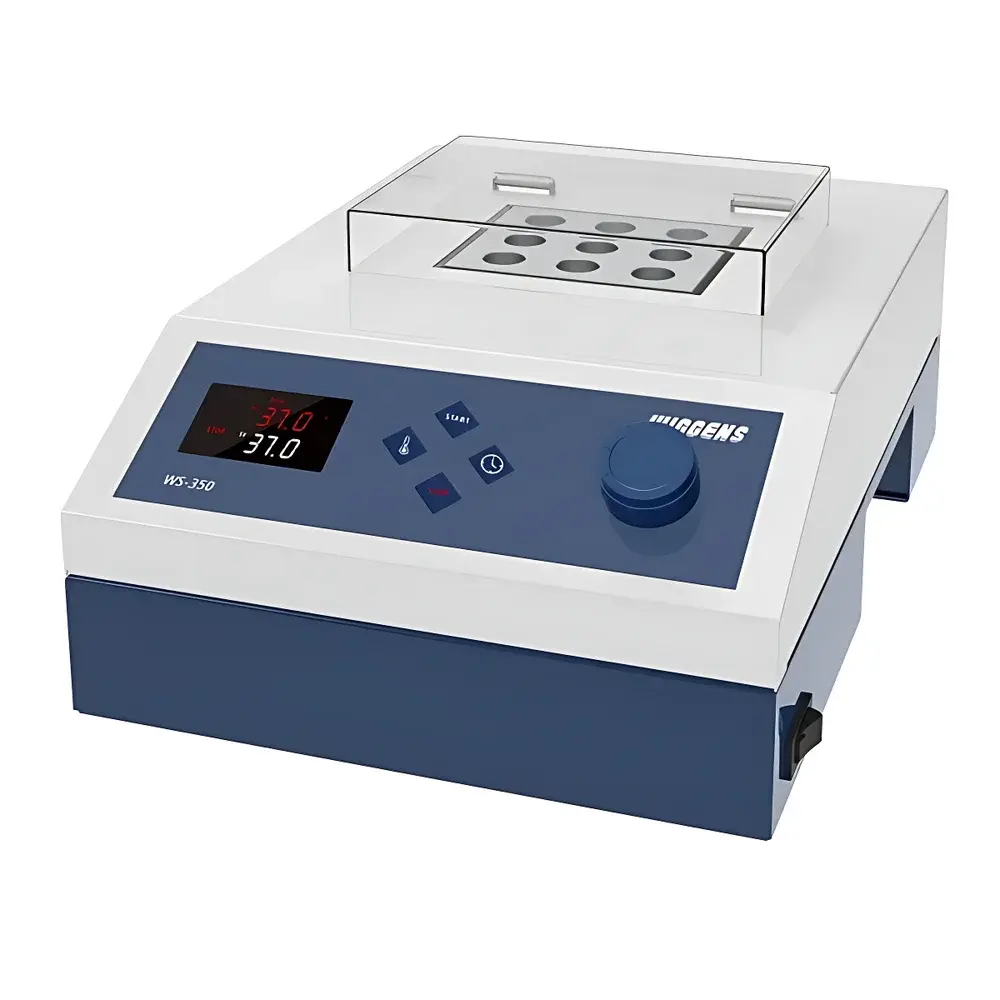
WIGGENS WB-350 Semiconductor-Based Peltier Heated & Cooled Dry Bath Incubator
| Brand | WIGGENS |
|---|---|
| Origin | Germany |
| Model | WB-350 |
| Temperature Range | +4 to 95°C |
| Temperature Accuracy | ±0.1°C at 37°C |
| Temperature Uniformity (Fluctuation) | ±0.1°C at 37°C |
| Temperature Ramp Rate | Rapid heating and cooling |
| Control System | PID microprocessor feedback control |
| Display | High-brightness VFD screen with touch keypad |
| Housing Material | Chemical-resistant polypropylene |
| Heating/Cooling Module | Anodized aluminum block with optimized thermal coupling |
| Lid | Transparent polycarbonate for real-time sample observation |
| Programmability | 10 user-defined programs, each with up to 10 steps |
| Timer Modes | Two independent timing functions — immediate start or delay start upon reaching setpoint |
| Safety Features | Overtemperature cutoff, PCB current limiting, thermal fuse protection |
| External Dimensions (W×D×H) | 276 × 334 × 165 mm |
| Internal Chamber Dimensions (W×D×H) | 99 × 77.5 × 36 mm |
| Net Weight | 5.0 kg |
| Power Supply | 230 V, 50/60 Hz, 2 A |
Overview
The WIGGENS WB-350 is a compact, semiconductor-based dry bath incubator engineered for precise temperature control across a broad operational range of +4°C to 95°C. Unlike traditional resistive-heating-only units, the WB-350 integrates thermoelectric (Peltier) technology to deliver both active heating and active cooling—enabling rapid thermal equilibration without external chillers or cryogenic media. Its core architecture relies on closed-loop PID feedback control, continuously monitoring block temperature via high-stability platinum RTD sensors and dynamically adjusting power delivery to maintain stability within ±0.1°C at 37°C—a performance benchmark aligned with ISO/IEC 17025–compliant calibration protocols for laboratory thermal instrumentation. Designed for benchtop integration in QC labs, molecular biology workflows, and clinical sample preparation, the WB-350 eliminates liquid bath contamination risks while ensuring reproducible thermal conditioning of tubes, vials, and microplates.
Key Features
- Thermoelectric (Peltier) dual-mode operation: simultaneous heating and cooling without compressors or refrigerants
- VFD display with intuitive touch-key interface for real-time parameter visualization and adjustment
- Chemically inert polypropylene housing resistant to common solvents, acids, and bases—validated per ASTM D543 for corrosion resistance
- Anodized aluminum heating/cooling module with high thermal conductivity and uniform surface emissivity for consistent heat transfer (tested per ASTM E2847)
- Optically transparent polycarbonate lid enabling non-invasive visual monitoring of sample integrity and condensation behavior
- Integrated module extractor tool for rapid, glove-compatible exchange of interchangeable blocks (e.g., 0.2 mL, 0.5 mL, 1.5 mL, 2.0 mL tube formats)
- Dual-timer logic: configurable “start-on-setpoint” or “start-on-delay” scheduling for protocol synchronization with downstream assays
- Comprehensive safety architecture including overtemperature cutoff (>120°C), current-limiting circuitry, and self-diagnostic PCB fault detection
Sample Compatibility & Compliance
The WB-350 accommodates standard microcentrifuge tubes (0.2–2.0 mL), PCR strips, and small-volume vials via interchangeable aluminum blocks—each precision-machined to nominal tolerances of ±0.05 mm. Its sealed chamber design prevents cross-contamination between runs and supports GLP-compliant documentation when paired with external data loggers (e.g., compliant with FDA 21 CFR Part 11 audit trail requirements). The unit meets IEC 61010-1:2010 safety standards for laboratory electrical equipment and carries CE marking under the EU Low Voltage Directive. Temperature accuracy and stability are verified traceably to NIST-traceable references during factory calibration; users may perform field verification using certified reference thermometers per ISO/IEC 17025 Clause 6.5.2.
Software & Data Management
While the WB-350 operates as a standalone instrument, its programmable architecture supports full experimental traceability. Ten stored protocols—each comprising up to ten sequential steps with independent temperature, dwell time, and ramp rate assignments—can be recalled and executed without PC connectivity. All settings are retained during power interruption due to non-volatile EEPROM memory. For laboratories requiring electronic records, optional RS-232 or USB-to-serial adapters enable integration with LIMS or custom Python/Matlab scripts for automated logging. Calibration history, error codes, and runtime statistics are accessible via service mode—supporting internal quality audits and regulatory readiness per ISO 9001 and ISO 13485 frameworks.
Applications
- Enzyme reaction incubation (e.g., restriction digests, ligations, kinase assays) requiring tight thermal control at physiological or sub-physiological temperatures
- Sample pre-warming or chilling prior to HPLC injection, mass spectrometry analysis, or flow cytometry staining
- Controlled denaturation/renaturation studies in protein biochemistry
- Stability testing of biologics and pharmaceutical intermediates per ICH Q5C guidelines
- Environmental microbiology: temperature-controlled enrichment of thermotolerant or psychrotolerant strains
- Forensic toxicology: controlled hydrolysis of glucuronide-conjugated analytes prior to GC-MS quantification
FAQ
Does the WB-350 require external cooling water or refrigerant gas?
No—the unit uses solid-state Peltier elements for both heating and cooling; no auxiliary fluids or ventilation ducts are needed.
Can the WB-350 maintain temperature stability during ambient fluctuations?
Yes—its adaptive PID algorithm compensates for ambient shifts between 10°C and 35°C, maintaining ±0.1°C stability at 37°C per ISO 8573-1 Annex B test conditions.
Is the aluminum block compatible with organic solvents such as acetone or chloroform?
The anodized surface provides moderate resistance; however, prolonged direct exposure to strong halogenated solvents is not recommended—use tube caps and secondary containment per CLSI GP26-A4.
How often should temperature calibration be performed?
Annual verification is advised for ISO/IEC 17025-accredited labs; more frequent checks (e.g., daily startup verification) are recommended for GMP environments per USP .
Are replacement modules available for non-standard tube formats?
Yes—WIGGENS offers OEM-machined blocks for 96-well plates, PCR frames, and custom geometries; lead time is typically 4–6 weeks from order confirmation.



