
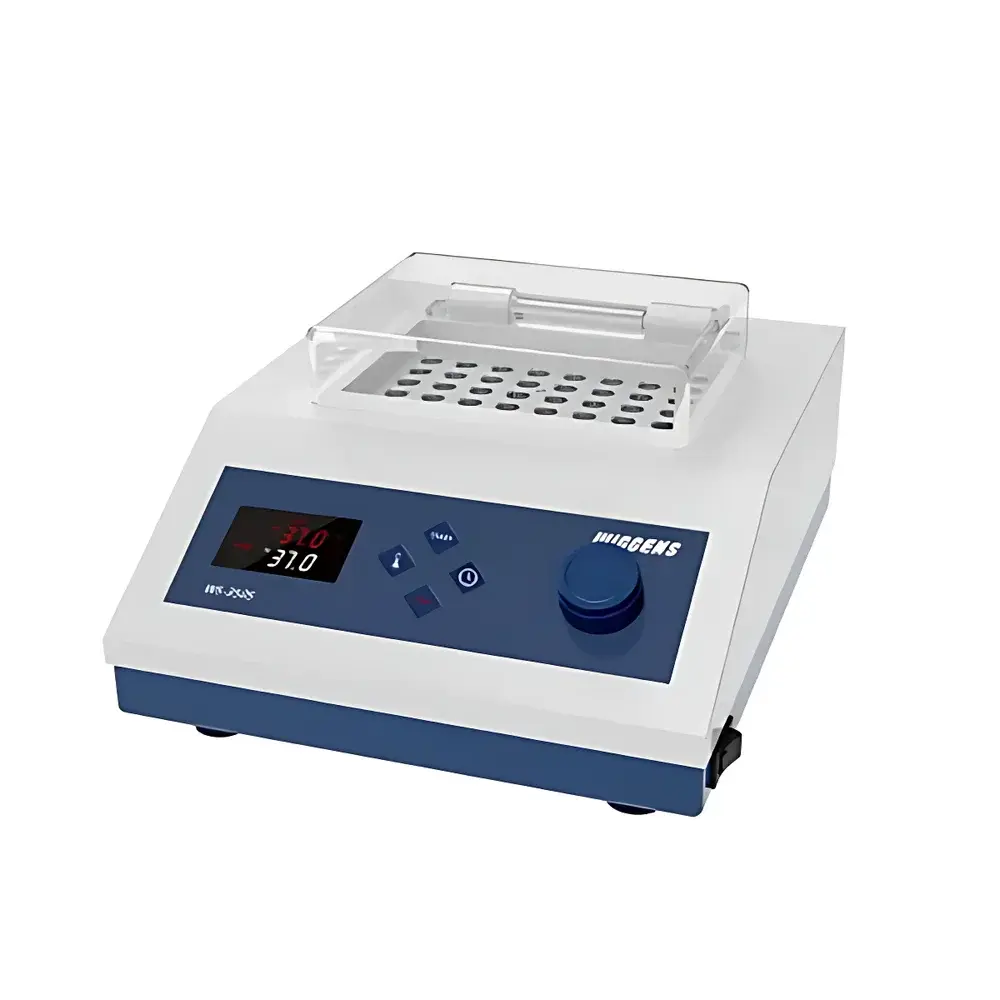
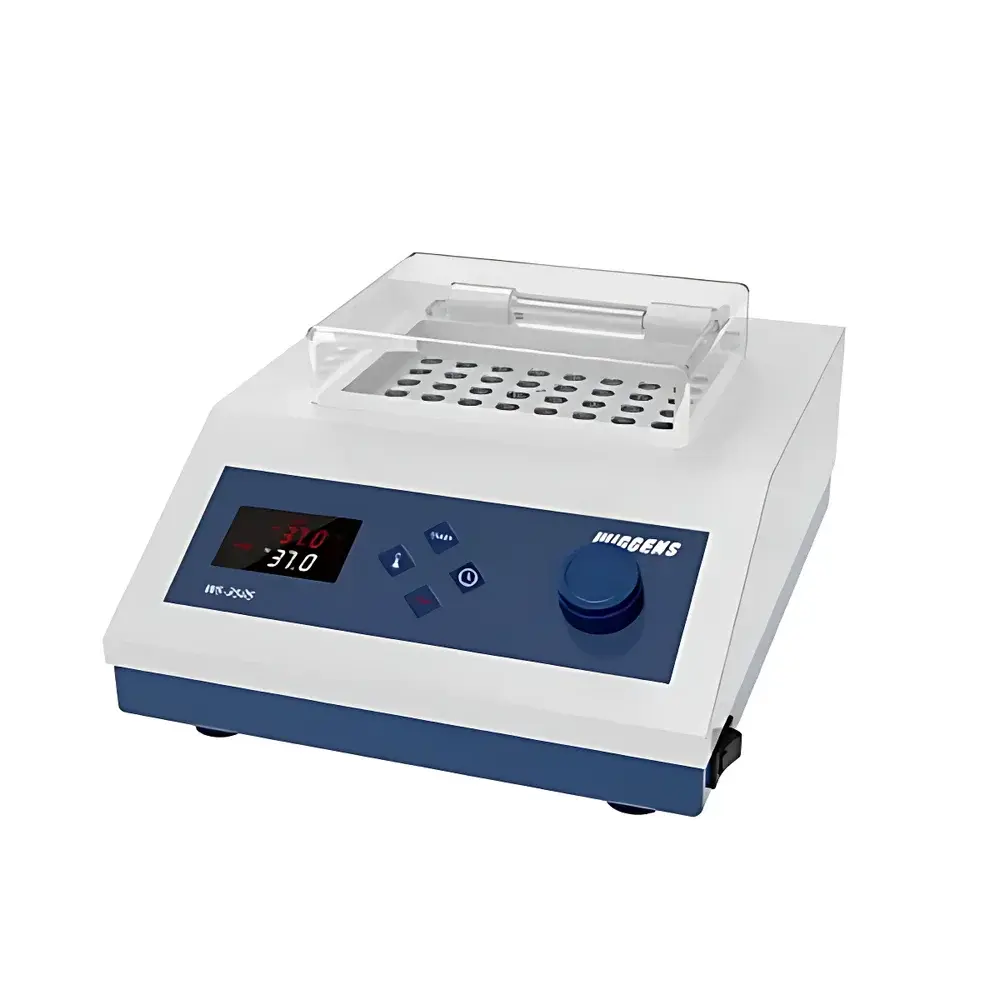
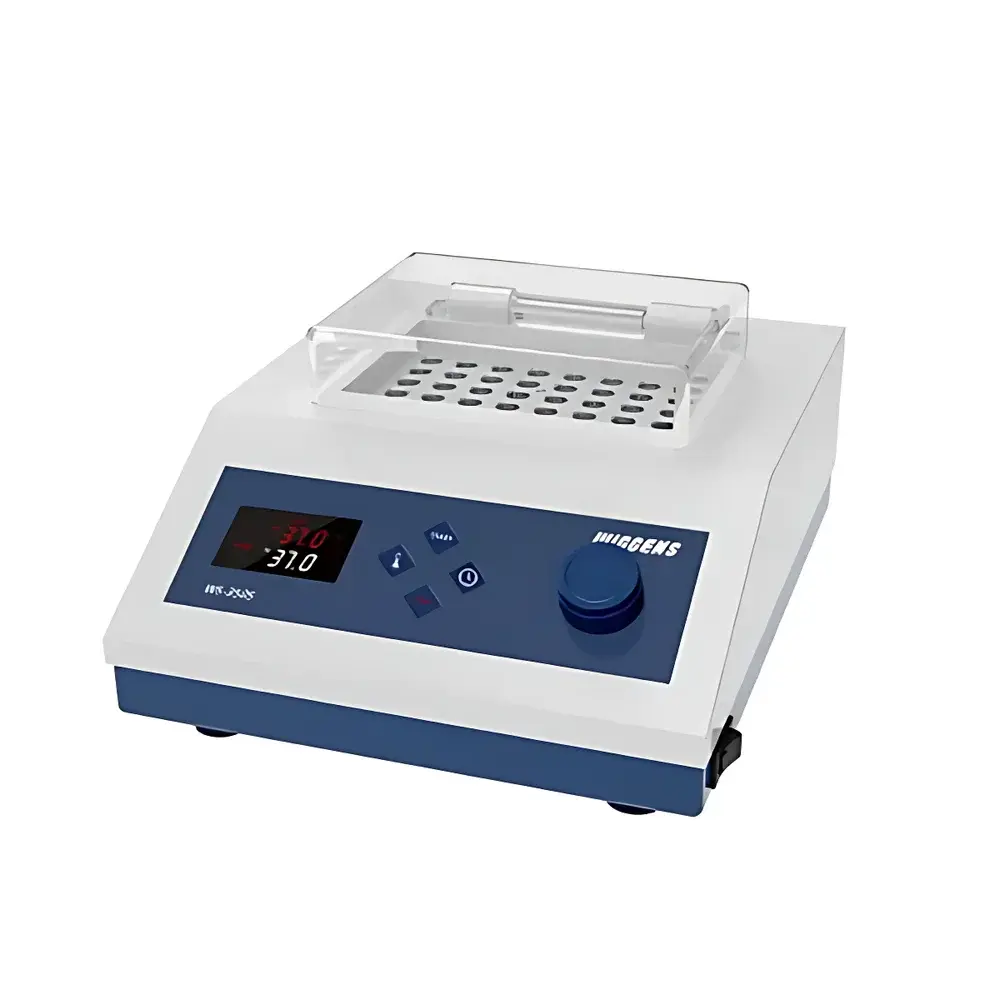
WIGGENS WB-350S Digital Dry Bath Incubator
| Brand | WIGGENS |
|---|---|
| Origin | Germany |
| Model | WB-350S |
| Temperature Range | Ambient +5 to 130 °C |
| Accuracy | ±0.1 °C (at setpoint) |
| Temperature Uniformity (at 80 °C) | ±0.1 °C (stability), ±0.5 °C (gradient across block) |
| Control System | PID feedback with overshoot suppression |
| Display | VFD (dual-channel: setpoint & real-time temperature) |
| Timer Modes | Two independent modes — delay start or dwell time after reaching setpoint |
| Safety Features | Dual thermal cutoffs (heating plate >150 °C, PCB overtemperature), current limiting, auto power-off, visual high-temp warning (red LED) |
| External Dimensions (W×D×H) | 276 × 334 × 120 mm |
| Internal Chamber (W×D×H) | 154 × 99 × 37 mm |
| Net Weight | 3.9 kg |
| Power Supply | 230 V, 50/60 Hz, 2.8 A |
| Operating Environment | 2–60 °C, ≤80% RH (non-condensing) |
| Standard Accessories | Main unit, protective lid |
| Heating blocks | Optional, application-specific |
Overview
The WIGGENS WB-350S Digital Dry Bath Incubator is a precision-engineered thermal platform designed for consistent, contact-based heating of multiple small-volume samples in tubes, vials, or microplates. Unlike water baths, it employs solid-state conductive heating via interchangeable aluminum or stainless-steel heating blocks—eliminating contamination risks, evaporation artifacts, and maintenance overhead associated with liquid media. Its core operational principle relies on closed-loop PID feedback control, where thermistor-based sensing continuously modulates power delivery to maintain target temperature with minimal overshoot and high spatial uniformity. The device operates across a usable range from ambient +5 °C to 130 °C, making it suitable for enzyme activation, DNA denaturation, sample thawing, cell culture pre-warming, and reagent equilibration protocols common in molecular biology, clinical diagnostics, and pharmaceutical QC labs.
Key Features
- PID-controlled thermal regulation ensures stable setpoint maintenance with ±0.1 °C accuracy at 80 °C and <±0.5 °C intra-chamber gradient—validated per ISO 17025 traceable calibration practices.
- Dual-mode digital timer: Mode 1 initiates countdown upon temperature stabilization; Mode 2 triggers immediately at power-on—enabling reproducible incubation timing regardless of ramp dynamics.
- Vacuum Fluorescent Display (VFD) provides simultaneous, high-contrast readout of setpoint and real-time block temperature—optimized for visibility under laboratory lighting and glove use.
- Integrated dual-stage safety architecture: hardware-level thermal fuses cut power if heating surface exceeds 150 °C or internal PCB temperature rises beyond safe thresholds; current-limiting circuitry prevents overload during cold-start conditions.
- Compact footprint (276 × 334 × 120 mm) and lightweight design (3.9 kg) support benchtop deployment in regulated environments—including ISO Class 5 cleanrooms and GLP-compliant analytical suites.
- Front-panel touch-sensitive controls minimize mechanical wear and improve long-term reliability compared to rotary encoders or membrane switches.
Sample Compatibility & Compliance
The WB-350S accepts user-selectable heating blocks (sold separately), including configurations for 0.2 mL PCR tubes, 0.5 mL microtubes, 1.5/2.0 mL Eppendorf-style tubes, 15 mL and 50 mL conical tubes, and 96-well plates. All blocks are CNC-machined from anodized aluminum or electropolished stainless steel to ensure dimensional repeatability and thermal homogeneity. The system complies with IEC 61010-1:2010 for electrical safety in laboratory equipment and meets EMC requirements per EN 61326-1:2013. While not certified for sterile processing, its sealed housing and absence of fluid reservoirs facilitate decontamination using 70% ethanol or hydrogen peroxide vapor—supporting routine cleaning validation per FDA Guidance for Industry: Sterile Drug Products Produced by Aseptic Processing (2004).
Software & Data Management
The WB-350S operates as a standalone instrument without proprietary software dependencies. All configuration and monitoring occur via the front-panel interface, ensuring compatibility with air-gapped networks and eliminating cybersecurity concerns associated with USB-connected controllers. Audit trails are maintained manually through lab notebook entries, as the unit does not feature electronic recordkeeping or 21 CFR Part 11 compliance. For laboratories requiring data capture, optional external thermocouple loggers (e.g., Omega OM-DAQPRO-5300) may be used to record block temperature profiles synchronized with timer events—supporting SOP-driven documentation workflows aligned with ISO/IEC 17025 Clause 7.7.
Applications
- Molecular biology: Denaturation of DNA templates prior to PCR setup; heat inactivation of restriction enzymes or phosphatases.
- Clinical microbiology: Pre-warming of blood culture bottles and transport media to reduce incubation lag time.
- Pharmaceutical QA/QC: Controlled heating of reference standards during dissolution method development or viscosity testing of semi-solids.
- Environmental testing: Conditioning of soil or water extracts before extraction or derivatization steps in EPA Method 8270D workflows.
- Industrial R&D: Accelerated stability studies of adhesives, coatings, or polymer dispersions under defined thermal stress profiles.
FAQ
Is the WB-350S suitable for use in GMP-regulated environments?
Yes—its robust construction, deterministic thermal response, and absence of moving parts or consumables make it appropriate for GMP Annex 11-aligned applications where instrument qualification (IQ/OQ/PQ) is required. Calibration certificates for individual heating blocks can be obtained from accredited third-party providers.
Can the unit be operated without a heating block installed?
No—the internal sensor is embedded within the heating plate assembly; operation without a properly seated block may result in inaccurate readings or thermal runaway. The system includes mechanical interlocks to prevent unintended activation.
What is the maximum recommended load per heating block?
Load capacity depends on block geometry and material. Aluminum blocks dissipate heat more rapidly than stainless steel variants; users should consult WIGGENS’ technical datasheets for each block model to determine optimal tube fill volumes and spacing to preserve uniformity.
Does the WB-350S support remote monitoring or network connectivity?
No—it lacks Ethernet, Wi-Fi, or RS-232 interfaces. Remote supervision requires integration with external data loggers or PLC systems via analog voltage output (if equipped with optional I/O module—available separately under part number W3033353).
How frequently should the unit undergo preventive maintenance?
Annual verification of temperature accuracy using NIST-traceable reference thermometers is recommended. Visual inspection of the protective lid seal, vent openings, and touch-panel responsiveness should occur quarterly per laboratory maintenance SOPs.



