
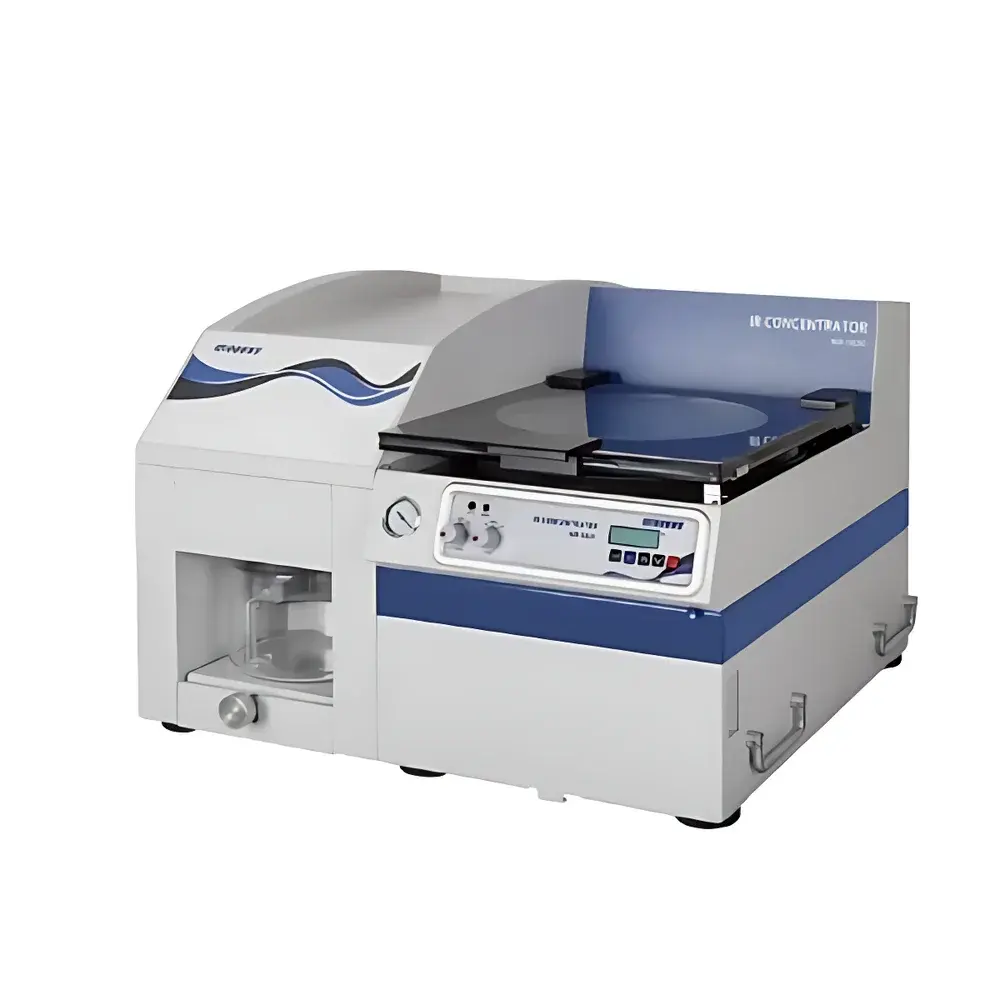
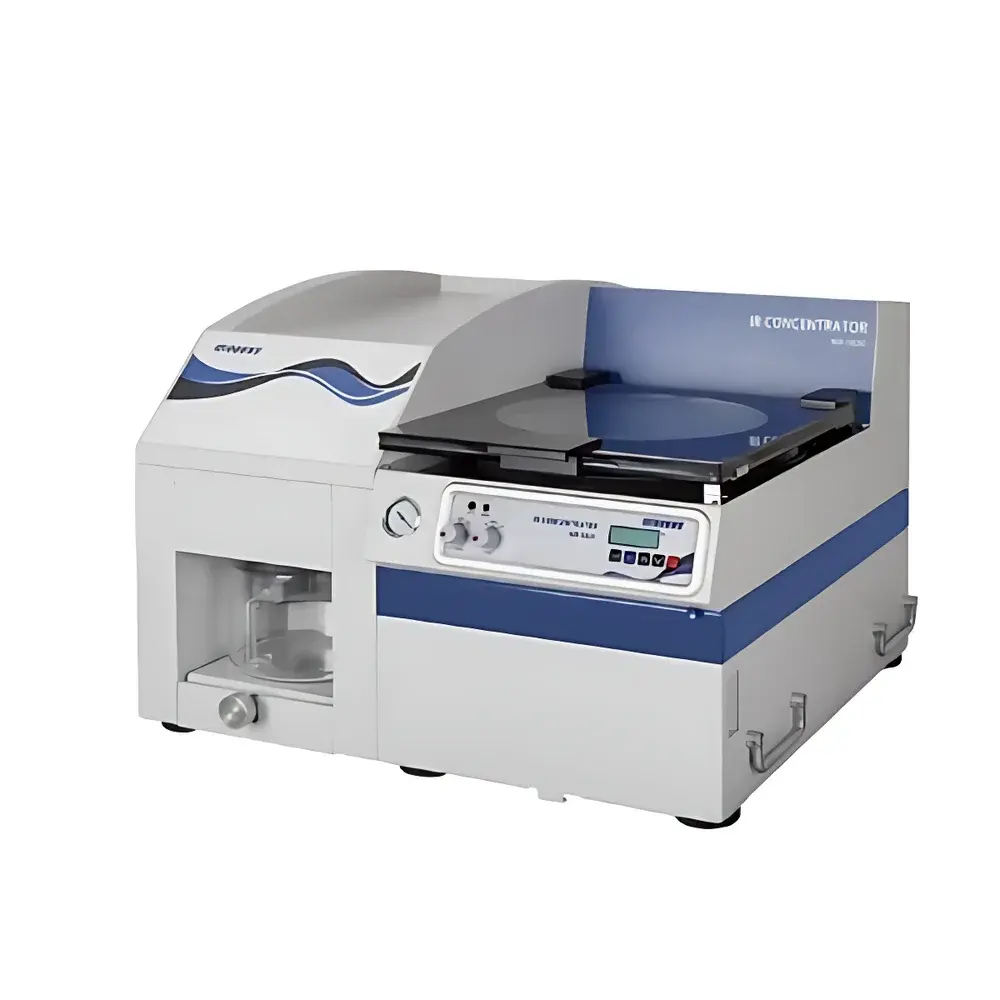
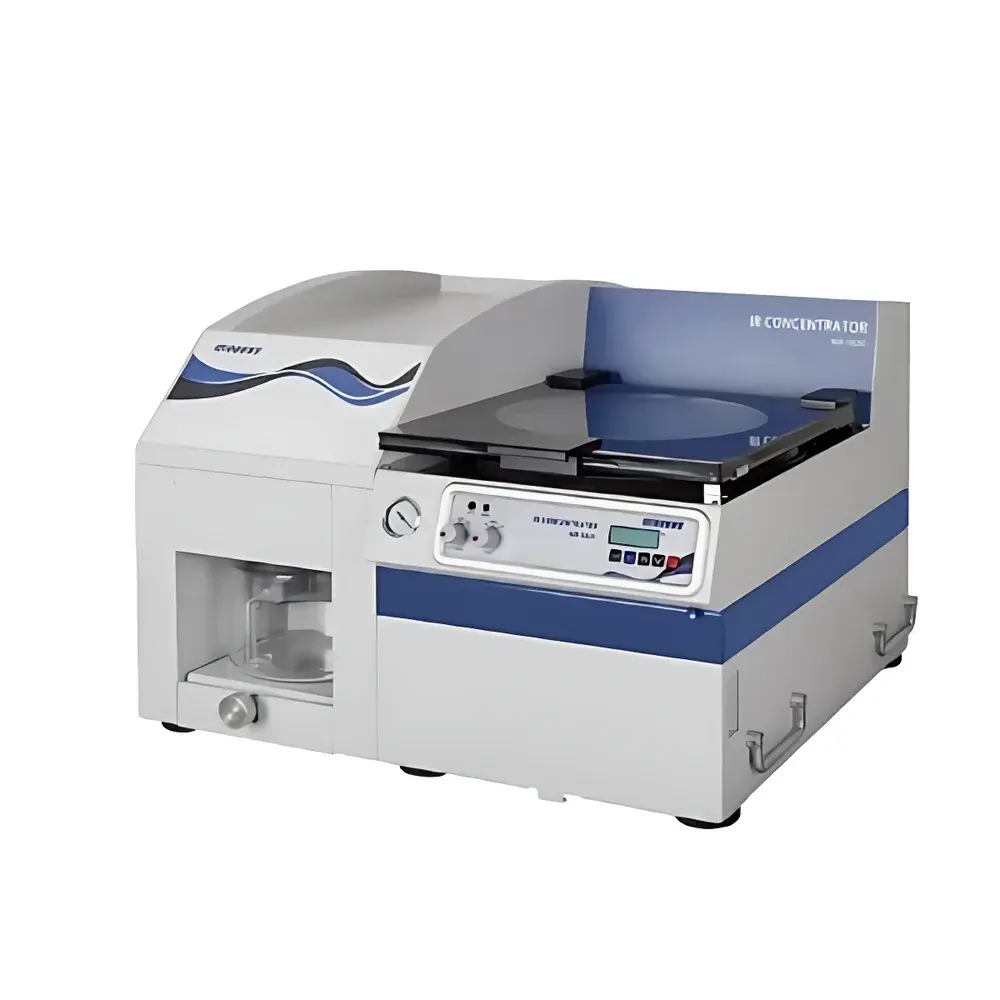
WIGGENS WB-502C Vacuum Centrifugal Concentrator
| Brand | WIGGENS |
|---|---|
| Origin | Germany |
| Model | WB-502C |
| Temperature Range | 4–80 °C |
| Temperature Accuracy | ±0.1 °C |
| Sample Capacity | 132 × 1.5 mL tubes |
| Max Rotor Speed | ≤1500 rpm |
| Vacuum System | PTFE-coated diaphragm pump (WIGGENS C410), ultimate vacuum ≥13 mbar |
| Integrated Cold Trap | −20 °C |
| Heating Options | IR-only / IR + conductive / conductive-only |
| Timer Range | 00:01–99:59 (h:min) |
| Dimensions (W×D×H) | 670 × 685 × 480 mm |
| Power Supply | 220 V, 50/60 Hz, 1200 W |
Overview
The WIGGENS WB-502C Vacuum Centrifugal Concentrator is an integrated benchtop system engineered for precise, reproducible concentration and solvent removal from biological and chemical samples under controlled low-pressure and temperature conditions. It operates on the principle of simultaneous centrifugal force, vacuum-assisted evaporation, and programmable thermal input—enabling rapid yet gentle sample processing without thermal degradation or cross-contamination. Unlike conventional rotary evaporators or nitrogen blow-down systems, the WB-502C maintains sample integrity by minimizing exposure to ambient oxygen and uncontrolled heating, making it especially suitable for labile biomolecules including nucleic acids (DNA/RNA), peptides, enzymes, metabolites, and small-molecule pharmaceuticals. Its fully sealed evaporation chamber, combined with a −20 °C cold trap and chemically resistant PTFE diaphragm pump, ensures efficient condensate capture and long-term vacuum stability—even during extended runs with volatile solvents such as ethanol, methanol, acetonitrile, or ethyl acetate.
Key Features
- Triple-mode heating architecture: Independent selection of infrared (IR) radiant heating only, IR + conductive heating, or conductive heating only—optimized for diverse sample matrices and solvent volatility profiles.
- Ultra-precise temperature control: PID-regulated heating with ±0.1 °C accuracy across a 4–80 °C range, validated at multiple setpoints per IEC 61000-4-30 compliance protocols.
- Center-axis vacuum inlet design: Minimizes turbulence and aerosol carryover; reduces risk of sample loss or cross-contamination between tubes during high-speed rotation (≤1500 rpm).
- Chemically inert vacuum system: WIGGENS C410 PTFE-coated diaphragm pump achieves stable vacuum ≥13 mbar and withstands aggressive organic solvents without lubricant contamination or performance drift.
- Modular rotor compatibility: Supports interchangeable rotors for 1.5 mL microtubes (132 positions), 15 mL conical tubes (12 positions), 50 mL tubes (8 positions), and dual 96-well plates—enabling seamless workflow scaling from discovery to QC batch processing.
- Benchtop-integrated cold trap: −20 °C thermoelectric cooling unit captures >95% of solvent vapors, eliminating external chiller requirements and reducing laboratory footprint.
Sample Compatibility & Compliance
The WB-502C accommodates a broad spectrum of sample formats and chemistries, including aqueous buffers, acidic or basic solutions (pH 1–13), and common organic solvents used in nucleic acid precipitation, peptide synthesis, and HPLC fraction collection. All wetted parts—including chamber gasket, rotor housing, and vacuum path—are constructed from borosilicate glass, PTFE, and anodized aluminum to ensure resistance to hydrolysis, oxidation, and halogenated solvent attack. The system supports GLP/GMP-aligned workflows through audit-trail-capable operation logging (via optional USB data export), and its temperature and vacuum parameters meet critical method requirements outlined in USP , ISO/IEC 17025:2017 Annex A.3, and ASTM E2656-18 for analytical instrument qualification.
Software & Data Management
Operation is managed via a front-panel LED touchscreen interface with intuitive icon-driven navigation and multilingual support (English, German, French, Spanish). All run parameters—including temperature setpoint, vacuum mode, heating profile, time duration, and rotor identification—are stored in non-volatile memory and can be recalled as user-defined methods. While the base WB-502C does not include Ethernet or Wi-Fi connectivity, it supports timestamped parameter export via USB flash drive in CSV format for integration into LIMS or electronic lab notebook (ELN) platforms. Optional firmware upgrades enable enhanced data integrity features compliant with FDA 21 CFR Part 11—specifically electronic signatures, role-based access control, and immutable audit trails for critical concentration steps in regulated bioanalytical labs.
Applications
- Rapid ethanol precipitation recovery of genomic DNA and total RNA from column-eluted or phenol-chloroform-extracted samples.
- Concentration of dilute protein digests prior to LC-MS/MS analysis—preserving post-translational modifications and preventing carbamylation artifacts.
- Desalting and buffer exchange of synthetic oligonucleotides and CRISPR guide RNAs without column binding losses.
- Lyophilization pre-concentration of unstable enzyme preparations prior to freeze-drying.
- High-throughput sample preparation for metabolomics: parallel concentration of 96-well plate extracts in GC-MS and LC-HRMS workflows.
- Removal of residual solvents following solid-phase extraction (SPE) or liquid–liquid extraction (LLE) in environmental and forensic toxicology labs.
FAQ
What types of solvents are compatible with the WB-502C’s vacuum system?
The PTFE-coated C410 diaphragm pump is compatible with water, methanol, ethanol, isopropanol, acetonitrile, ethyl acetate, chloroform, and dichloromethane. Strong oxidizers (e.g., concentrated nitric acid) and highly corrosive halogenated compounds (e.g., bromine trifluoride) are not recommended.
Can the WB-502C be used for complete dry-down of samples?
Yes—when operated with IR heating at 60–80 °C and full vacuum, the system achieves near-complete solvent removal. For ultra-sensitive applications requiring absolute dryness (e.g., mass spec calibration standards), a final desiccation step under inert gas may be advised.
Is rotor balancing required before each run?
Yes. Although the brushless DC motor provides smooth acceleration, proper tube-to-tube mass balance within ±0.1 g is mandatory to maintain mechanical stability and extend bearing life per DIN EN 61000-3-2.
Does the system require external cooling water or refrigerant lines?
No. The integrated −20 °C thermoelectric cold trap eliminates dependency on external chillers or glycol loops, simplifying installation and maintenance.
How often should the PTFE vacuum pump membrane be replaced?
Under normal usage (≤4 h/day, aqueous/organic solvent mixtures), membrane service life exceeds 12 months. Replacement intervals should be logged in accordance with ISO 13485 preventive maintenance schedules.



