
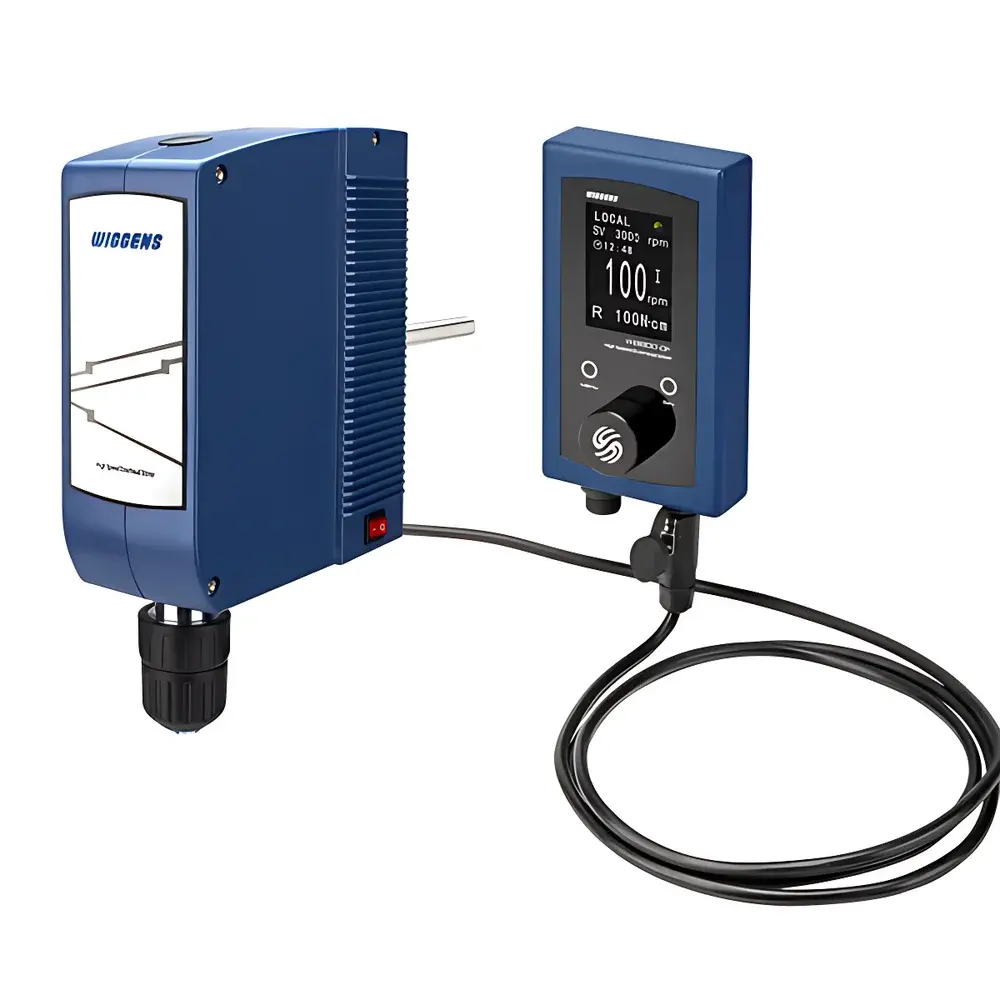
WIGGENS WB1800-DF Split-Design Overhead Stirrer
| Brand | WIGGENS |
|---|---|
| Origin | Germany |
| Model | WB1800-DF |
| Stirrer Type | Electric Overhead Stirrer |
| Max. Mixing Volume | 40 L |
| Speed Range | Gear I: 20–600 rpm |
| Gear II | 361–1800 rpm |
| Speed Accuracy | ±1 rpm or ±1% of reading |
| Torque Output | 565 N·cm (Gear I), 113 N·cm (Gear II) |
| Viscosity Range | ≤150,000 cP |
| Shaft Clamp Diameter | ≤10 mm |
| Power Input | 150 W |
| Dimensions (W×D×H) | 200 × 95 × 230 mm |
| Head Weight | 5 kg |
| Controller Cable Length | 2 m |
| Display | TFT Touchscreen |
| Control Interface | Detachable Handheld Controller with Quick-Connect Aviation Connectors |
| Housing Material | Anodized Aluminum |
| Compliance | CE, RoHS, IEC 61010-1 |
Overview
The WIGGENS WB1800-DF is a high-torque, split-design overhead stirrer engineered for precision mixing and dispersion in demanding laboratory environments—including fume hoods, biosafety cabinets, and jacketed reactor systems. Unlike conventional integrated stirrers, its modular architecture separates the motor-driven stirring head from the control unit via a shielded 2-meter cable terminated with IP67-rated aviation connectors—enabling safe, ergonomic operation at a distance without compromising responsiveness or stability. The device operates on a brushless DC motor platform, delivering consistent torque output across its dual-range speed profile (20–600 rpm and 361–1800 rpm), while maintaining low mechanical vibration and acoustic noise (<55 dB(A) at 1 m). Its thermal management relies on an anodized aluminum housing that functions as both structural frame and passive heat sink, ensuring stable performance during extended duty cycles with viscous or exothermic media.
Key Features
- Split-system design with detachable handheld controller (150 × 100 mm) for remote operation—critical for containment compliance in biosafety Level 2+ or chemical fume hood workflows.
- TFT touchscreen interface with real-time digital display of rotational speed, motor load (as torque proxy), and active gear mode—supporting intuitive parameter adjustment without physical access to the drive head.
- Brushless DC motor architecture ensures maintenance-free operation, high efficiency (>85%), and exceptional speed stability—even under variable load conditions up to 150,000 cP.
- Two-stage speed gearing optimized for application flexibility: low-speed range (20–600 rpm) delivers maximum torque (565 N·cm) for high-viscosity homogenization; high-speed range (361–1800 rpm) enables rapid dispersion of low-to-medium viscosity suspensions.
- Quick-connect aviation interfaces between controller, cable, and drive head ensure repeatable electrical contact, EMI shielding, and tool-free assembly/disassembly—reducing setup time and cross-contamination risk.
- Integrated microprocessor logic prevents splashing via ramped acceleration/deceleration profiles and overload protection—automatically limiting current draw if stall torque exceeds safe thresholds.
Sample Compatibility & Compliance
The WB1800-DF accommodates standard laboratory impellers (propeller, paddle, anchor, and helical ribbons) with shaft diameters up to 10 mm and supports aqueous and non-aqueous media up to 40 L volume. Its sealed motor housing and Class I insulation meet IEC 61010-1 safety requirements for laboratory electrical equipment. The system complies with CE marking directives (2014/30/EU EMC, 2014/35/EU LVD) and RoHS 2011/65/EU restrictions on hazardous substances. While not intrinsically rated for explosive atmospheres, its separation architecture inherently reduces spark risk near volatile solvents when used with grounded reaction vessels and proper grounding of the controller unit.
Software & Data Management
This model operates as a standalone instrument without proprietary software dependency. All operational parameters—including speed setpoint, gear selection, and real-time torque estimation—are locally stored in non-volatile memory and retained after power cycling. The handheld controller logs the last 10 operating sessions (timestamp, duration, average speed, peak torque), accessible via menu navigation. Though it lacks USB/RS-232 or Ethernet ports, its analog torque signal output (0–10 V) and digital pulse train interface (optional accessory) support integration into third-party data acquisition systems compliant with GLP/GMP audit trails per FDA 21 CFR Part 11 when paired with validated DAQ hardware and software.
Applications
- High-shear dispersion of nanoparticles, pigments, and polymer emulsions in R&D-scale reactors.
- Controlled agitation of cell culture media and fermentation broths under laminar airflow—without opening biosafety cabinet sashes.
- Polymer synthesis requiring precise shear history management across multi-stage temperature ramps.
- Preparation of pharmaceutical suspensions and ointment bases under cGMP-aligned mixing protocols.
- Viscosity profiling of non-Newtonian fluids using torque-derived load trends as indirect rheological indicators.
- Long-duration dissolution testing where operator proximity must be minimized for occupational exposure control.
FAQ
Is the WB1800-DF suitable for use inside a Class II biosafety cabinet?
Yes—the split design allows full control from outside the cabinet sash, preserving containment integrity while maintaining ISO 14644-1 Class 5 air quality.
Can the torque reading be calibrated traceably to SI units?
Torque is derived from motor current and internal gain calibration; WIGGENS provides factory calibration certificates traceable to national standards upon request (additional service).
What is the ingress protection rating of the drive head?
The motor housing meets IP54 (dust-protected, splash-resistant); the handheld controller is rated IP42.
Does the system support external analog speed control input?
No—speed is set exclusively via the touchscreen or handheld controller; no 0–10 V or 4–20 mA analog input is provided.
Is the 2-meter controller cable length extendable?
Extension is not recommended beyond 2 m due to potential signal attenuation and voltage drop affecting touch responsiveness and torque feedback fidelity.



