
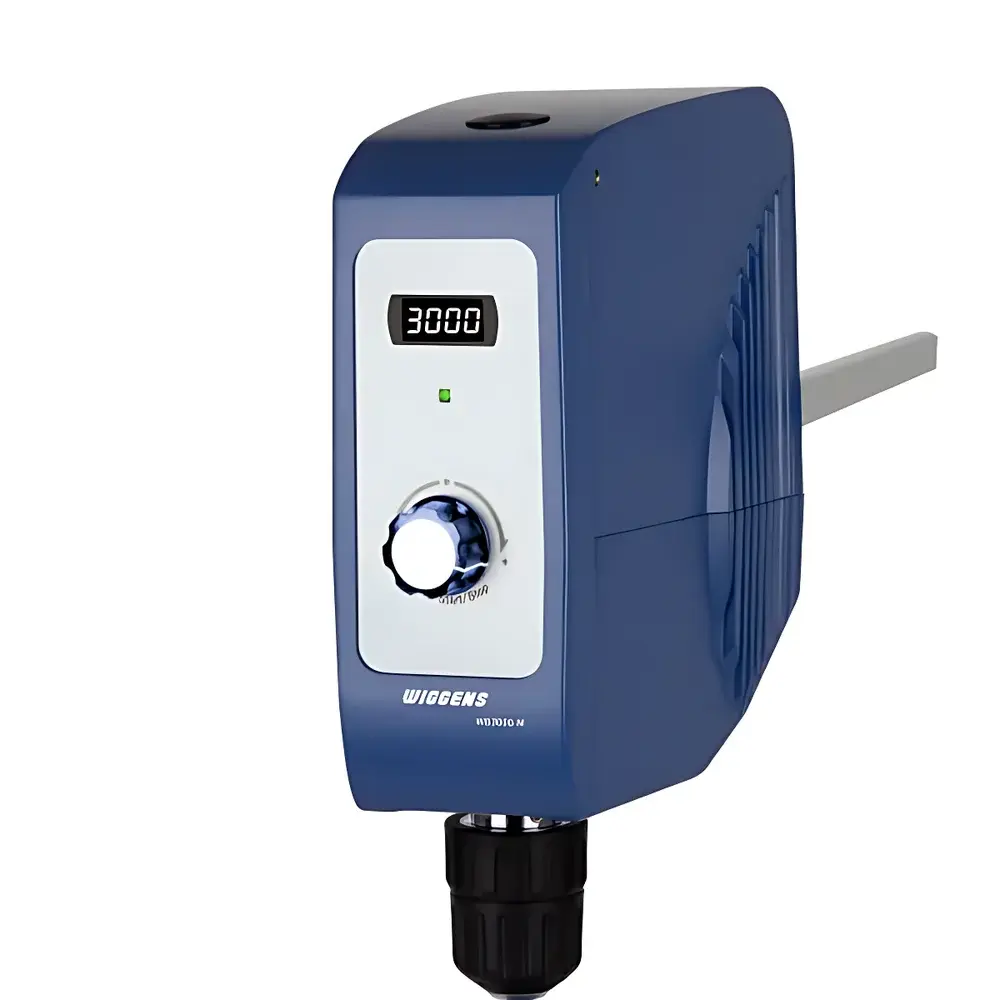
WIGGENS WB3000-M Overhead Stirrer
| Brand | WIGGENS |
|---|---|
| Origin | Germany |
| Model | WB3000-M |
| Stirrer Type | Overhead Stirrer |
| Max. Mixing Volume | 50 L |
| Speed Range | 70–3000 rpm |
| Torque | ≤70 N·cm |
| Viscosity Range | ≤50,000 mPa·s |
| Display Resolution | 1 rpm (≥1 rpm) |
| Speed Accuracy | ≤±3% at n > 300 rpm |
| Motor | Brushless DC |
| Shaft Clamp Range | 0.5–10 mm |
| Hollow Shaft Inner Diameter | 10.2 mm |
| Power Input | 200 W |
| Dimensions (W×D×H, excl. support rod) | 100 × 241 × 295 mm |
| Weight (main unit + power supply) | 6.3 kg |
| Communication Interface | RS485 |
| Operating Temperature Resolution | 0.1 °C |
| LED Display | High-brightness, remote-readable |
| Control | Analog rotary knob with glove-compatible design |
| Safety Features | Auto overload protection, soft-start at low speed, status LED indicators (standby: blue, operation: green, alarm: red) |
Overview
The WIGGENS WB3000-M Overhead Stirrer is an industrial-grade, microprocessor-controlled laboratory stirring system engineered for precision, long-term reliability, and operational safety in demanding R&D and quality control environments. Designed according to the fundamental principles of torque-controlled mechanical agitation, it delivers consistent rotational energy transfer to viscous and heterogeneous samples via a vertically mounted drive shaft—eliminating magnetic coupling limitations and enabling direct mechanical coupling with high-inertia or high-viscosity media. Its brushless DC motor architecture ensures zero carbon dust generation, thermal stability under continuous duty cycles, and minimal maintenance across extended operational lifetimes—critical for GLP-compliant labs where instrument uptime and data traceability are non-negotiable. The unit operates within a validated speed range of 70–3000 rpm, maintaining ±3% accuracy above 300 rpm through closed-loop tachometric feedback, and supports mixing volumes up to 50 L of aqueous systems—making it suitable for scale-up trials, formulation development, and batch homogenization tasks in pharmaceutical, chemical, and materials science laboratories.
Key Features
- Brushless DC motor with integrated thermal and current monitoring—designed for uninterrupted 24/7 operation under high-load conditions
- Hollow-axis design (10.2 mm internal diameter) allows full-length insertion of stir rods without height adjustment; simplifies setup for tall vessels or jacketed reactors
- Self-locking, tool-free chuck with 0.5–10 mm clamping range and high concentricity (<0.05 mm runout), ensuring vibration-free rotation even at maximum speed
- Glove-compatible large-diameter analog speed control knob with tactile feedback and visual LED confirmation of setpoint
- High-brightness LED display with 1-rpm resolution—optimized for readability at distances ≥2 m and under standard lab lighting conditions
- Three-color status LED system (blue = standby, green = active, red = fault) provides immediate operational awareness without interface interaction
- Soft-start functionality at low speeds minimizes splashing and mechanical shock during initiation—enhancing operator safety and sample integrity
- Integrated electronic overload protection triggers automatic shutdown upon torque exceedance (>70 N·cm), preventing motor stall and drive train damage
Sample Compatibility & Compliance
The WB3000-M accommodates a broad spectrum of sample types—from low-viscosity solvents to shear-thinning polymer solutions (up to 50,000 mPa·s)—and supports compatibility with common laboratory vessel geometries (cylindrical, conical, jacketed) via interchangeable impeller mounts and universal support rods. Its corrosion-resistant housing meets IP20 environmental rating standards for indoor laboratory use, and surface treatment complies with ISO 9227 neutral salt spray testing protocols for long-term resistance to chemical exposure. While not certified as intrinsically safe, the unit conforms to IEC 61010-1:2010 for electrical safety in laboratory equipment and supports audit-ready operation when paired with validated software workflows. Optional lock-screen functionality enables user-access restriction per SOP-defined roles—supporting alignment with FDA 21 CFR Part 11 requirements for electronic records in regulated environments.
Software & Data Management
Equipped with an RS485 serial interface compliant with EIA/TIA-485-A physical layer specifications, the WB3000-M enables bidirectional communication with external controllers, SCADA systems, or custom LabVIEW/Python-based acquisition platforms. It supports ASCII-based command protocols for remote speed setpoint adjustment, real-time RPM readback, status polling, and alarm logging—facilitating integration into automated reactor control loops or centralized lab equipment management systems. When connected to WIGGENS IoT-enabled gateways (sold separately), the device transmits timestamped operational metadata—including cumulative runtime, peak torque events, and thermal history—to cloud-hosted dashboards for predictive maintenance analytics. All data exchanges adhere to IEEE 802.3 Ethernet encapsulation standards when routed through compatible network bridges, ensuring interoperability with existing IT infrastructure.
Applications
- Pharmaceutical: Suspension homogenization, API crystallization seeding, buffer preparation in stainless-steel bioreactor vessels
- Chemical R&D: Polymerization reaction mixing, catalyst dispersion in viscous monomer systems, emulsion stabilization trials
- Materials Science: Ceramic slurry deagglomeration, nanoparticle suspension uniformity validation, battery electrolyte blending
- Food & Beverage: Viscosity profiling of dairy formulations, starch gelatinization kinetics, flavor oil dispersion in aqueous bases
- Academic Research: Teaching labs requiring robust, intuitive stirring platforms for undergraduate chemistry and chemical engineering curricula
FAQ
What is the maximum viscosity the WB3000-M can handle?
It is rated for continuous operation with media up to 50,000 mPa·s under standard ambient conditions (23 °C, 50% RH) and proper impeller selection.
Can the stirrer be integrated into a PLC-controlled process line?
Yes—the RS485 interface supports Modbus RTU protocol implementation via third-party protocol converters or native driver libraries.
Is calibration required before first use?
No factory calibration is needed; however, users should verify speed accuracy using a traceable tachometer during IQ/OQ qualification per ISO/IEC 17025 guidelines.
Does the unit support temperature feedback from external probes?
The WB3000-M does not include built-in temperature input channels, but external PT100 or thermocouple signals can be logged in parallel via connected DAQ systems using synchronized timestamps.
What safety certifications does the WB3000-M hold?
It complies with IEC 61010-1:2010 (Safety Requirements for Electrical Equipment for Measurement, Control, and Laboratory Use) and carries CE marking for the European Economic Area.



