
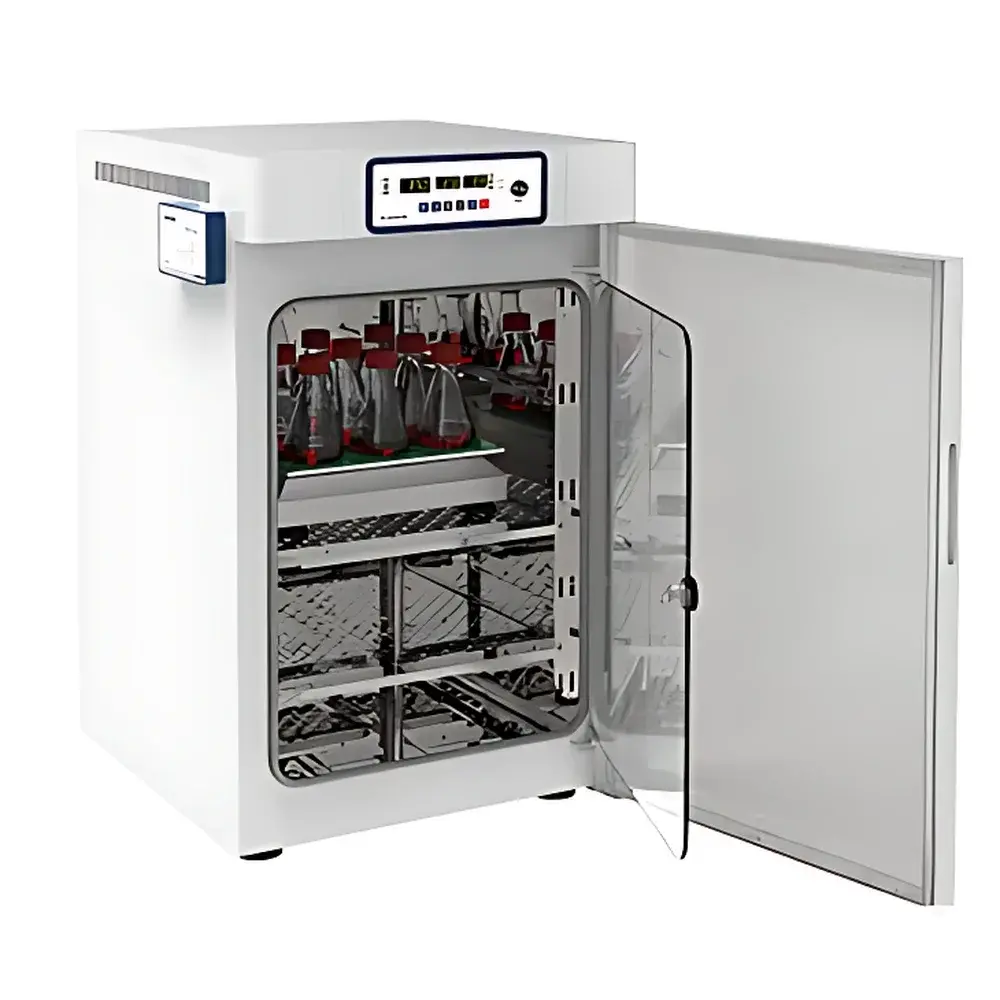
WIGGENS WCI-180S Carbon Dioxide Incubator with Integrated Magnetic Drive Shaker or Roller System
| Brand | WIGGENS |
|---|---|
| Origin | Germany |
| Model | WCI-180S |
| Temperature Control Range & Accuracy | +5–60 °C (±0.1 °C at 37 °C) |
| CO₂ Concentration Control Range & Accuracy | 0–20% (±0.1% at 5% setpoint, 37 °C) |
| Chamber Volume | 180 L |
| Humidity | ≥70% RH (at 37 °C, via water pan humidification) |
| Shaking Speed | 30–300 rpm (±1 rpm, 1 rpm step) |
| Display | LED touchscreen interface |
| Heating System | Six-sided air-jacketed heating with three independently calibrated Pt100 sensors |
| CO₂ Sensor | Dual-beam infrared (NDIR), temperature- and humidity-compensated |
| Chamber Material | AISI 304 stainless steel |
| Safety Features | Overtemperature cutoff, door-heating anti-condensation, PID-controlled microprocessor system |
| Compliance | Designed for GLP-compliant cell culture workflows |
Overview
The WIGGENS WCI-180S Carbon Dioxide Incubator is an engineered platform for controlled mammalian cell culture under physiologically relevant conditions. It integrates precise CO₂ regulation, uniform thermal management, and optional in-chamber mechanical agitation—either via a magnetic drive shaker (WNB-101S) or roller apparatus (WNB-180R)—within a compact 180 L stainless steel chamber. Unlike conventional CO₂ incubators limited to static culture, the WCI-180S enables concurrent cultivation of adherent and suspension cell lines in a single, ISO Class 5-compatible environment. Its operation relies on fundamental bioreactor principles: CO₂ concentration is maintained through feedback-controlled gas injection using a dual-beam NDIR sensor, while temperature uniformity is achieved via six-sided air-jacketed heating with independent Pt100 monitoring per zone. Humidity is sustained passively via bottom-mounted heated water pan and forced-air convection—eliminating external steam generators and associated contamination risks. The system meets essential requirements for routine passage, transfection, and pre-clinical expansion workflows in academic core facilities, biotech process development labs, and QC/QA environments.
Key Features
- Six-sided air-jacketed heating architecture with three independently calibrated Pt100 sensors ensures ±0.1 °C thermal stability at 37 °C and rapid recovery (<15 min) after door opening.
- Dual-beam non-dispersive infrared (NDIR) CO₂ sensor provides real-time, drift-free measurement across 0–20% range with ±0.1% accuracy at 5% setpoint—immune to ambient humidity and temperature fluctuations.
- Integrated magnetic drive shaker (WNB-101S) or roller system (WNB-180R) operates within the CO₂-controlled chamber, supporting scalable suspension cultures (100–1000 mL flasks) or roller bottle formats (four × Ø100–120 mm).
- Brushless DC motor drive delivers low-vibration, low-noise (<50 dB(A)), particle-free agitation—critical for sensitive primary and stem cell lines.
- Door-heated double-glazed viewing window and frame-integrated heating prevent condensation during high-humidity operation (≥70% RH at 37 °C).
- AISI 304 stainless steel interior with radius-corner construction enables effective cleaning and disinfection; compatible with 70% ethanol, hydrogen peroxide vapor (HPV), and validated autoclave protocols.
- Microprocessor-based PID control system manages CO₂, temperature, humidity, and agitation parameters simultaneously—with programmable ramp/soak profiles and event logging.
Sample Compatibility & Compliance
The WCI-180S accommodates diverse vessel formats without modification: standard flat-bottom plates (including 96-well), conical flasks (100–1000 mL), test tube racks, and roller bottles. Optional adhesive mats and universal platforms ensure secure positioning during oscillation. All materials contacting the chamber interior comply with USP Class VI and ISO 10993-5 cytotoxicity standards. The system supports GLP-aligned documentation practices—including audit-trail-enabled data export (via optional RS-232/USB interface) and user-access-level controls. While the base unit does not include 21 CFR Part 11 compliance firmware, it is architecturally prepared for integration with validated third-party LIMS or ELN systems requiring electronic signature, change tracking, and data integrity safeguards.
Software & Data Management
Control and monitoring occur via an intuitive LED touchscreen interface with multilingual support (English, German, French, Spanish). Parameters—including temperature (range +5–60 °C), CO₂ (0–20%), relative humidity (displayed as %RH), and shaker speed (30–300 rpm)—are adjustable with 0.1-unit resolution. The system logs up to 30 days of operational history (timestamped CO₂, temperature, and alarm events) internally. Data export is supported via USB flash drive in CSV format for traceability. Optional analog/digital I/O modules enable connection to building management systems (BMS) or centralized lab monitoring platforms. Firmware updates are performed locally via USB—no cloud dependency or remote access capability is implemented, preserving network security boundaries required in regulated environments.
Applications
- Mammalian cell expansion for monoclonal antibody production and viral vector manufacturing.
- Stem cell differentiation assays requiring continuous low-shear agitation under hypoxic or normoxic CO₂ setpoints.
- Primary neuron or organoid culture where static adhesion and dynamic suspension phases must be sequenced within identical environmental parameters.
- Microbial co-culture studies involving aerobic bacteria and oxygen-sensitive eukaryotic cells.
- Regulatory batch record generation for ISO 13485 or GMP Annex 1–aligned processes, when paired with validated SOPs and calibration certificates.
- Teaching laboratories performing hands-on instruction in aseptic technique, growth kinetics, and environmental parameter interdependence.
FAQ
Can the shaker or roller module be removed for static incubation?
Yes—the WNB-101S shaker platform and WNB-180R roller assembly are mechanically detachable, allowing full use of the 180 L chamber for conventional static culture.
Is external humidification required?
No—humidity is generated solely by evaporation from the internal heated water pan, eliminating external humidifiers and associated microbial growth risks.
What is the temperature recovery time after a 30-second door opening?
Typically ≤12 minutes to return to ±0.3 °C of setpoint at 37 °C, verified per ASTM E171-21 Annex A1 protocols.
Does the CO₂ sensor require periodic recalibration?
The dual-beam NDIR sensor is factory-calibrated and exhibits <0.5% drift/year; annual verification against certified gas standards is recommended for GLP compliance.
Are replacement parts such as water pans or shelves available separately?
Yes—WIGGENS supplies OEM-certified consumables and wear components (e.g., water pans, stainless steel shelves, adhesive mats) under part numbers W6027181 (pan), W6027182 (shelf), and W6027183 (mat).




