
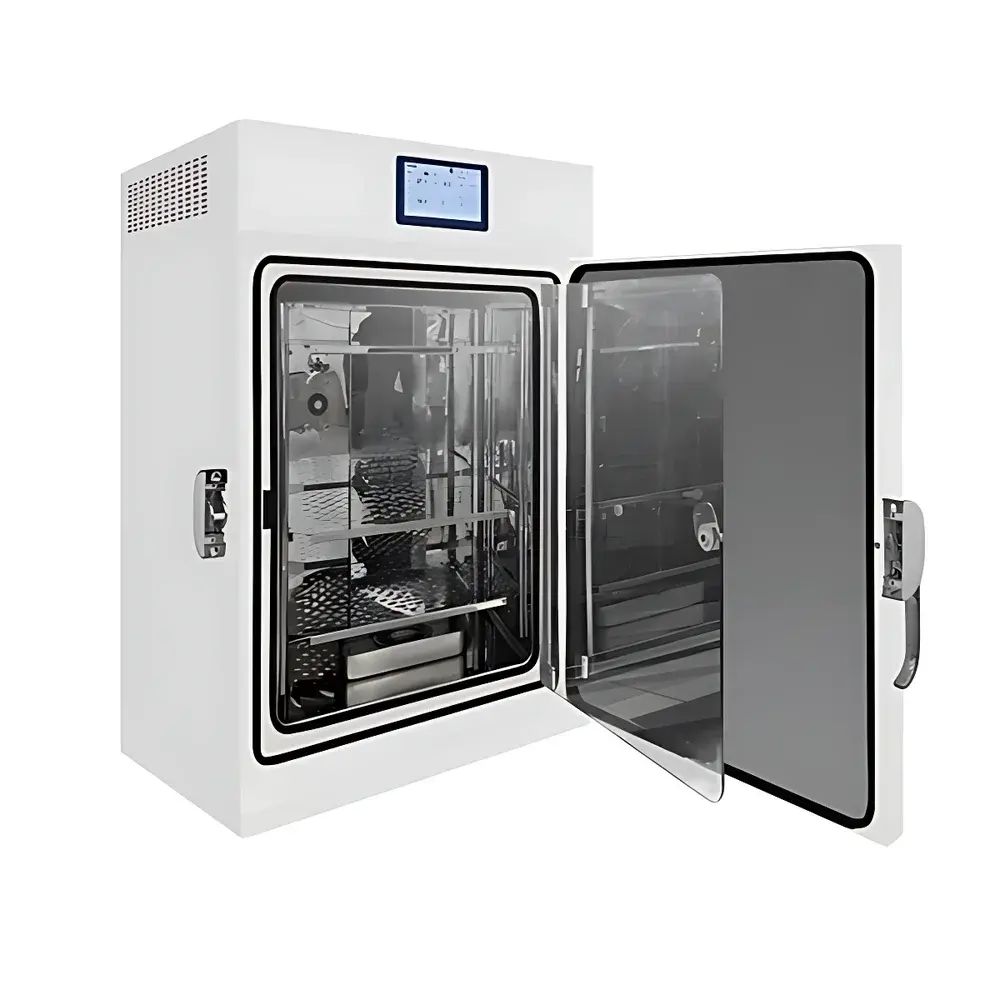
WIGGENS WCI-260H High-Temperature Dry-Heat Sterilizable CO₂ Incubator
| Brand | WIGGENS |
|---|---|
| Origin | Germany |
| Model | WCI-260H |
| Instrument Type | Air-Jacketed CO₂ Incubator |
| CO₂ Detection | Dual-Wavelength Infrared (NDIR) Sensor |
| Temperature Range & Accuracy | Ambient +5°C to 60°C, ±0.1°C display resolution |
| Temperature Uniformity | ±0.3°C (@37°C and RT 20°C) |
| CO₂ Concentration Range & Accuracy | 0–20%, ±0.1% (at 5% setpoint, 37°C) |
| Chamber Capacity | 260 L |
| Internal Dimensions (W×D×H) | 640 × 500 × 800 mm |
Overview
The WIGGENS WCI-260H is a high-performance, air-jacketed CO₂ incubator engineered for stringent cell culture applications requiring long-term environmental stability, contamination control, and regulatory-compliant sterilization. Designed around a dual-circulation architecture—comprising independent inner-chamber and jacket airflow systems—the WCI-260H ensures rapid thermal recovery (<5 min after 30 s door opening per DIN 12880), exceptional temperature uniformity (±0.3°C at 37°C), and precise CO₂ regulation across its full 0–20% range. Its defining capability is integrated 180°C dry-heat sterilization: the entire chamber—including the dual-wavelength NDIR CO₂ sensor—is rated for in-situ thermal decontamination without disassembly. This eliminates reliance on external autoclaves or chemical agents, supporting GLP/GMP workflows where sterility validation, traceability, and minimal operator intervention are mandatory.
Key Features
- Six-sided heating with three independently calibrated PT100 sensors—each field-adjustable for metrological traceability and ISO/IEC 17025-aligned calibration protocols.
- Dual-wavelength NDIR CO₂ sensor with high-temperature tolerance (180°C), 15-year service life, and humidity/temperature compensation—ensuring ±0.1% accuracy at 5% CO₂, 37°C per ASTM E2919-22.
- Active humidity management: bottom-heated water pan + Peltier cold trap system maintains ≥90% RH while preventing condensation on optical surfaces or culture vessels.
- 180°C dry-heat sterilization cycle (≈10 h duration) with automated post-cycle transition to user-defined culture conditions—no manual reset required.
- 7-inch capacitive touchscreen interface with multilingual support, real-time parameter overlay (setpoint vs. actual), trend curves, and embedded alarm history (30 entries).
- RS-485 Modbus RTU interface as standard; optional Wi-Fi/IoT module enables remote monitoring, parameter logging, and alarm notification via cloud dashboard or SMS (GSM).
Sample Compatibility & Compliance
The WCI-260H accommodates standard tissue culture formats—including T-flasks, multiwell plates, roller bottles, and cell factories—on up to eight reinforced shelves (50 kg load capacity per shelf). Optional copper-clad interior panels or stainless-steel trays provide intrinsic antimicrobial resistance against fungal colonization, aligning with USP guidance on microbial control in pharmaceutical environments. HEPA filtration (ISO Class 5 compliance within 5 min of door closure, per ISO 14644-1) and UV-C irradiation (ozone-free coated lamps, installed in recirculation ducts) are available as validated add-ons. All sterilization cycles generate timestamped, tamper-evident logs compatible with FDA 21 CFR Part 11 audit trails when paired with the optional IoT module.
Software & Data Management
Data integrity is maintained through onboard USB logging (≥5 years of continuous operation data, stored in CSV format), encrypted parameter backups, and time-stamped event records (door openings, alarms, sterilization cycles). The optional IoT application supports role-based access control (four-tier user permissions), password-protected screen lockout, and configurable alert thresholds. Logged parameters—including chamber temperature, CO₂ concentration, relative humidity, and sterilization profile—are exportable for inclusion in electronic lab notebooks (ELN) or quality management systems (QMS). Firmware updates are performed via secure HTTPS push, ensuring alignment with current IEC 62304 medical device software standards.
Applications
The WCI-260H serves primary and secondary cell culture workflows in academic research labs, biopharmaceutical process development, and clinical diagnostics. Its 180°C sterilization capability makes it suitable for mycoplasma-sensitive lines, stem cell expansion under cGMP Annex 1 conditions, and regenerative medicine applications requiring end-to-end sterility assurance. Optional low-oxygen (0.6–21% O₂) and hyperoxic (5–85% O₂) modules enable hypoxia modeling for cancer biology, neurogenesis studies, and organoid differentiation. The robust mechanical design and thermal inertia support uninterrupted operation during power fluctuations common in shared core facilities.
FAQ
Does the CO₂ sensor require recalibration after 180°C sterilization?
No—the dual-wavelength NDIR sensor is thermally qualified for repeated 180°C exposure and retains factory calibration; one-touch zero-point verification is supported via the touchscreen interface.
Can the incubator operate under GLP or GMP audit requirements?
Yes—when configured with IoT logging, user access controls, and sterilization cycle documentation, it meets foundational requirements for ALCOA+ data integrity principles and supports 21 CFR Part 11 compliance.
What is the maximum allowable ambient temperature for stable 37°C operation?
The unit maintains specified performance at ambient temperatures up to 30°C; cooling module integration extends operational range to ≥15°C chamber temperature in warmer environments.
Is third-party validation support available for IQ/OQ/PQ protocols?
WIGGENS provides factory-issued test certificates and DQ/IQ templates; qualified vendors may perform site-specific OQ/PQ using built-in sensor diagnostics and Modbus-accessible real-time values.
How is condensation prevented during high-humidity operation?
The integrated Peltier cold trap actively removes moisture from recirculated air before reintroduction into the chamber—eliminating droplet formation on vessel lids or optical components without desiccant consumables.




