
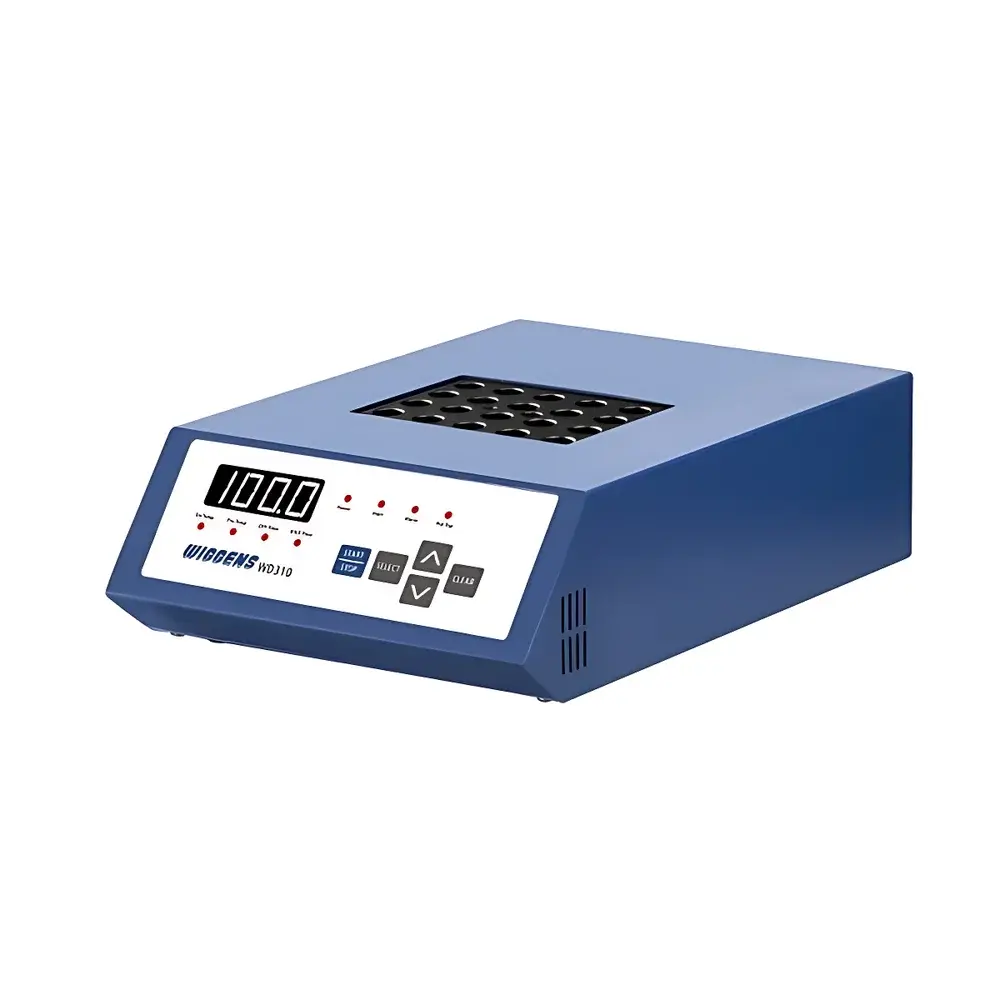
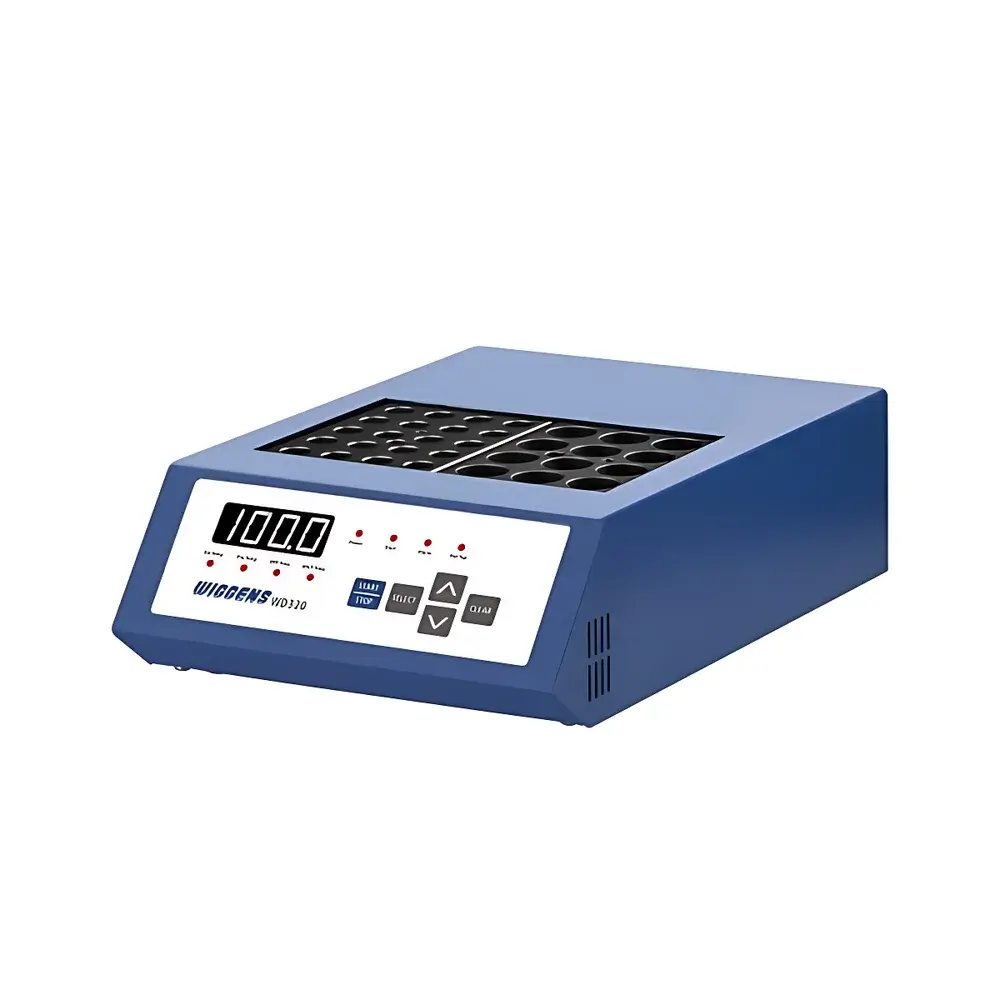
WIGGENS WD310 Multi-Function Dry Block Heater
| Brand | WIGGENS |
|---|---|
| Origin | Germany |
| Model | WD310 |
| Temperature Range | 40–150 °C |
| Temperature Accuracy | ±0.1 °C |
| Temperature Resolution | 0.1 °C |
| Heating Time to 150 °C | ≤25 min |
| Dimensions (W×L×H) | 200 × 270 × 80 mm |
| Net Weight | 3.0 kg |
| Safety Cutoff | 170 °C |
| Display | 4½-digit LED |
| Interface | RS232 |
| Operating Modes | OFF / OFF-TIME / WAIT-TIME |
| Heating Block Material | Stainless Steel (AISI 304) |
| Block Compatibility | 8 interchangeable aluminum blocks (order separately) |
Overview
The WIGGENS WD310 Multi-Function Dry Block Heater is a precision-engineered thermal platform designed for consistent, contamination-free sample heating in analytical, clinical, and research laboratories. Unlike water baths, this metal bath utilizes solid-state conduction through high-purity aluminum heating blocks mounted on a thermally optimized stainless steel (AISI 304) heating plate—eliminating evaporation, condensation, microbial growth, and cross-contamination risks associated with liquid media. Its operating principle relies on Peltier-free resistive heating combined with PID-controlled feedback from an integrated PT100 sensor (standard on WD310), enabling stable thermal regulation across the full 40–150 °C range. The device is engineered for reproducibility in time-sensitive protocols such as enzyme inactivation, PCR pre-incubation, sample thawing, calibration standard equilibration, and reagent conditioning—where precise thermal history directly impacts assay validity.
Key Features
- PID temperature control with integrated PT100 sensor ensures ±0.1 °C accuracy and 0.1 °C resolution across the entire operating range
- 4½-digit LED display with real-time temperature readout and intuitive keypad navigation for rapid parameter entry
- Three operational modes: OFF (standby), OFF-TIME (auto-shutdown after user-defined duration), and WAIT-TIME (delayed start with programmable hold)
- Overtemperature safety cutoff at 170 °C—hardware-independent fail-safe circuitry interrupts power independently of microcontroller status
- RS232 serial interface compliant with standard laboratory instrument protocols, enabling integration into centralized lab management systems
- Stainless steel housing and heating surface provide corrosion resistance, mechanical durability, and compatibility with routine decontamination procedures (e.g., 70% ethanol wipe-down)
- Compact footprint (200 × 270 × 80 mm) and low mass (3.0 kg) support benchtop deployment in space-constrained environments including biosafety cabinets and laminar flow hoods
Sample Compatibility & Compliance
The WD310 accommodates eight standardized aluminum heating blocks—each machined to ISO-toleranced dimensions and certified for thermal uniformity (±0.3 °C across block surface at 100 °C). Compatible vessel formats include microcentrifuge tubes (0.2–2.0 mL), culture tubes (10–25 mL), and custom inserts (e.g., cuvettes, vials). All blocks feature optimized thermal mass-to-surface-area ratios to minimize gradient formation and accelerate heat transfer. The system meets IEC 61010-1:2010 safety requirements for electrical equipment used in laboratory environments and conforms to EN 61326-1:2013 for electromagnetic compatibility. While not inherently GLP/GMP-certified, its audit-ready features—including RS232 data logging, user-accessible calibration offset adjustment, and traceable temperature verification protocol—support validation under FDA 21 CFR Part 11 and ISO/IEC 17025 frameworks when paired with validated software.
Software & Data Management
Via the optional WIGGENS LabControl Suite (v3.2+), users can configure ramp-soak profiles, schedule timed operations, export timestamped temperature logs (.CSV), and perform remote diagnostics. The RS232 interface supports ASCII command protocol (e.g., “TEMP?”, “SET 95.0”, “LOG ON”) compatible with LabVIEW, Python (pySerial), and MATLAB environments. Calibration data—including date, technician ID, reference standard serial number, and deviation values—is stored in non-volatile memory and retrievable via query command. Audit trails record all parameter changes, mode transitions, and safety events—enabling full traceability for quality assurance documentation.
Applications
- Thermal inactivation of restriction enzymes and phosphatases prior to downstream ligation or sequencing library prep
- Controlled thawing of cryopreserved cell suspensions to prevent thermal shock-induced membrane damage
- Pre-equilibration of standards and controls in HPLC, GC, and spectrophotometric assays
- Incubation of immunoassay plates during antigen-antibody binding steps requiring strict thermal consistency
- Heating of viscous samples (e.g., glycerol stocks, polymer solutions) to reduce viscosity prior to pipetting or filtration
- Use as a compact, low-maintenance alternative to circulating water baths in QC release testing per USP and
FAQ
Is the WD310 suitable for use with flammable solvents?
No. The device is not rated for Class I, Division 1 hazardous locations. Do not operate with open containers of volatile organic compounds.
Can the temperature calibration be adjusted by the end user?
Yes. A two-point calibration procedure (using NIST-traceable reference thermometers at 37 °C and 100 °C) is supported via the front-panel menu; offset values are retained after power cycling.
What is the thermal uniformity across a loaded heating block?
Measured uniformity is ≤±0.3 °C at 100 °C with a fully inserted 1.5 mL tube array (per ISO 8573-1 Annex B methodology); uniformity degrades marginally at extremes (>140 °C or <50 °C).
Does the WD310 require routine maintenance beyond cleaning?
No scheduled maintenance is required. Annual verification of temperature accuracy and safety cutoff functionality is recommended per laboratory quality management policy.
Are third-party heating blocks compatible?
Only WIGGENS-certified blocks (order codes 179300-xx) guarantee dimensional fit, thermal interface integrity, and firmware recognition; non-OEM blocks may compromise safety interlocks and temperature stability.



