
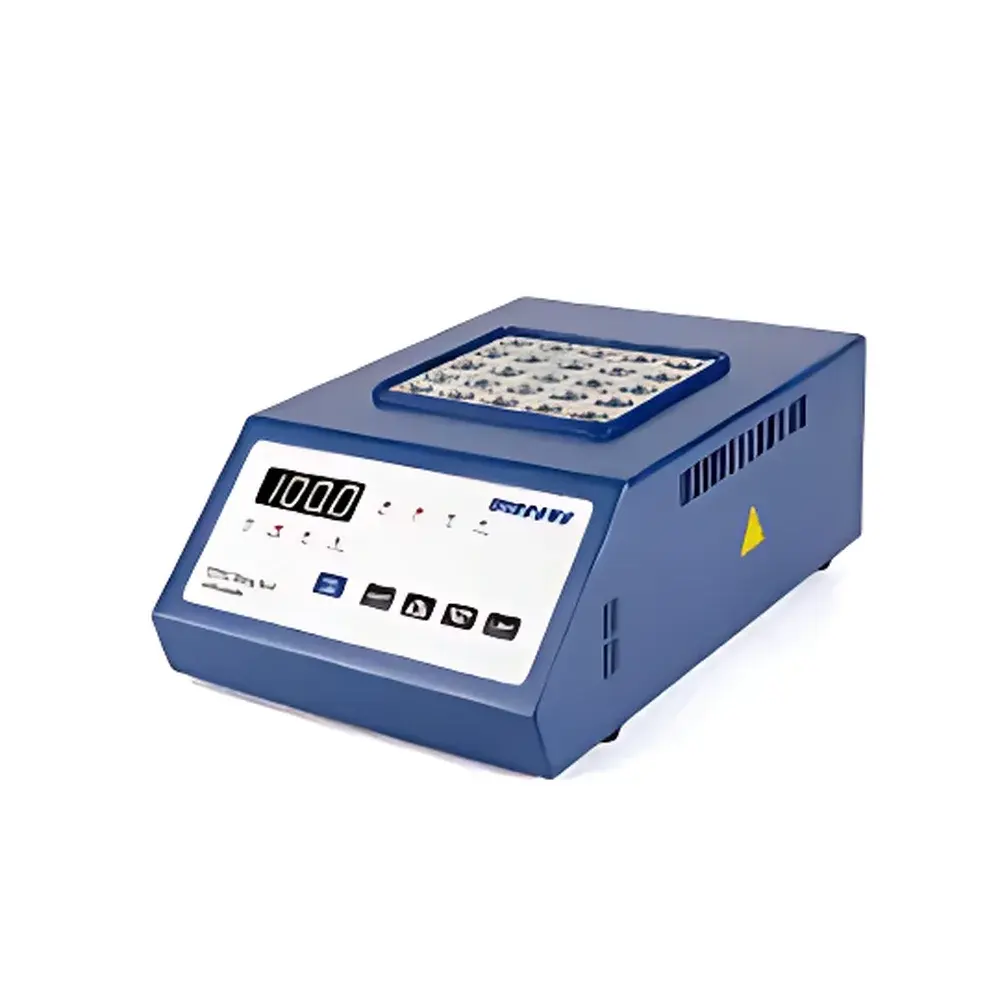
WIGGENS WD325 Chemical Oxygen Demand (COD) Digestion Block
| Brand | WIGGENS |
|---|---|
| Origin | Germany |
| Model | WD325 |
| Instrument Type | Laboratory Digestion Block |
| Digestion Principle | Standard 2-Hour Closed-Vessel Thermal Digestion (EPA Method 410.4 Compliant) |
| Temperature Range | 60–200 °C (Fixed 150 °C COD Program) |
| Accuracy | ±2 °C at 150 °C |
| Timer Range | 0–1999 min + Continuous Mode |
| Heating Block Quantity | 1 |
| Display | 4-Digit LED |
| Power Supply | 220 V, 50 Hz |
| Dimensions (W×H×D) | 189 × 116 × 315 mm |
| Weight | 4.5 kg |
| Safety Features | Dual-Temperature Interlock (70 °C Warning Light, 240 °C Auto-Shutdown) |
| Programmable Memory | 3 User-Defined Programs |
| Standard Accessories | Main Unit, Aluminum Heating Block (Ø16.5 × 55 mm), 25 Digestion Tubes |
Overview
The WIGGENS WD325 Chemical Oxygen Demand (COD) Digestion Block is a precision-engineered laboratory thermal digestion system designed for reproducible, standardized COD sample preparation in accordance with U.S. Environmental Protection Agency (EPA) Method 410.4. It operates on the principle of closed-vessel, high-temperature acid digestion—where water samples are heated with potassium dichromate and sulfuric acid under controlled thermal conditions to oxidize organic matter. The WD325 delivers a fixed 150 °C digestion profile with a precisely timed 120-minute cycle, ensuring consistent reaction kinetics across batches. Unlike open-heating mantles or hot plates, its integrated aluminum heating block provides uniform thermal distribution across all 25 sample positions, minimizing inter-sample variance and supporting GLP-compliant workflows. The unit is not a complete COD analyzer but serves as the critical pre-analytical digestion module—enabling downstream quantification via titrimetric, colorimetric, or spectrophotometric methods (e.g., using Hach DR3900 or similar UV-Vis spectrophotometers).
Key Features
- Pre-programmed EPA 410.4-compliant digestion protocol: automatic ramp to 150 °C and 120-minute countdown with audible end-of-cycle alarm and auto-shutdown.
- Three independent programmable memory slots for custom temperature/time profiles (60–200 °C; 1–1999 min), supporting method development for TOC, TN, TP, or heavy metal digestion per ISO 11908, ASTM D1252, or SM 4500-OC.
- Dual-stage thermal safety system: visual warning indicator activates at ≥70 °C surface temperature; hardware-level cutoff disables heating at 240 °C to prevent thermal runaway and ensure instrument longevity.
- High-stability aluminum heating block (Ø16.5 × 55 mm) optimized for standard 16-mm COD vials—engineered for minimal thermal lag and <±2 °C accuracy at setpoint (150 °C).
- Four-digit LED display with intuitive push-button interface—no software installation required; operation remains fully functional in ISO 17025-accredited labs where IT restrictions apply.
Sample Compatibility & Compliance
The WD325 accommodates standard 16-mm round-bottom digestion tubes (25 positions per block), compatible with common reagent kits including Hach LCK, Merck Spectroquant®, and Palintest COD vials. Its thermal performance meets the repeatability and stability requirements specified in EPA 410.4 for wastewater, surface water, and industrial effluent matrices. While the device itself does not perform optical or electrochemical detection, its digestion output is validated for use in laboratories operating under ISO/IEC 17025, USP , and EU Water Framework Directive (2000/60/EC) monitoring programs. All electrical components comply with IEC 61010-1:2010 for laboratory equipment safety.
Software & Data Management
The WD325 operates as a standalone hardware module with no embedded firmware, network interface, or data logging capability—ensuring deterministic behavior and eliminating cybersecurity risks associated with connected lab instruments. Temperature and time settings are retained in non-volatile memory across power cycles. For audit-trail compliance in GMP or regulated environments (e.g., pharmaceutical wastewater testing), users may document run parameters manually or integrate the unit into electronic lab notebooks (ELNs) via external timestamped observation logs. No FDA 21 CFR Part 11 functionality is provided, consistent with its classification as a Class A laboratory accessory rather than a regulated analytical instrument.
Applications
- Routine COD determination in municipal wastewater treatment plants (WWTPs) and industrial pretreatment facilities.
- Method validation and inter-laboratory comparison studies requiring strict thermal protocol adherence.
- Alternative digestion optimization for emerging contaminants (e.g., microplastics-associated organics) where extended hold times or elevated temperatures (up to 200 °C) improve oxidation efficiency.
- Training laboratories and academic institutions seeking a robust, low-maintenance digestion platform that supports EPA, ISO, and APHA Standard Methods instruction.
- Supporting total nitrogen (TN) and total phosphorus (TP) digestion when paired with alkaline persulfate or sulfuric acid–potassium sulfate protocols.
FAQ
Does the WD325 include built-in COD measurement capability?
No. It is a dedicated digestion block only. Quantitative COD analysis requires separate instrumentation—such as a burette for titration, a colorimeter for dichromate reduction assays, or a UV-Vis spectrophotometer for absorbance-based quantification.
Can the heating block be replaced with alternative geometries?
Yes. WIGGENS offers optional interchangeable blocks for 12-mm, 20-mm, and 24-mm tube formats (sold separately); compatibility must be confirmed against mechanical mounting specifications and thermal mass limits.
Is calibration traceable to national standards?
The unit ships with a factory calibration certificate referencing PTB (Physikalisch-Technische Bundesanstalt) traceable reference thermometers. Users may perform periodic verification using NIST-traceable RTD probes per ISO/IEC 17025 Clause 6.5.
What maintenance is required?
Annual inspection of heating element resistance and thermal fuse integrity is recommended. No lubrication or consumable parts are required; cleaning is limited to exterior surfaces and block recesses using ethanol-dampened lint-free wipes.
Is the WD325 suitable for hazardous waste digestion?
It is rated for use with standard COD reagents (e.g., H₂SO₄, K₂Cr₂O₇, AgSO₄, HgSO₄) under fume hood conditions. For halogenated or highly chlorinated matrices, consult EPA Method 410.4 Appendix B for modified digestion protocols and corrosion-resistant block options.
Related Products







