
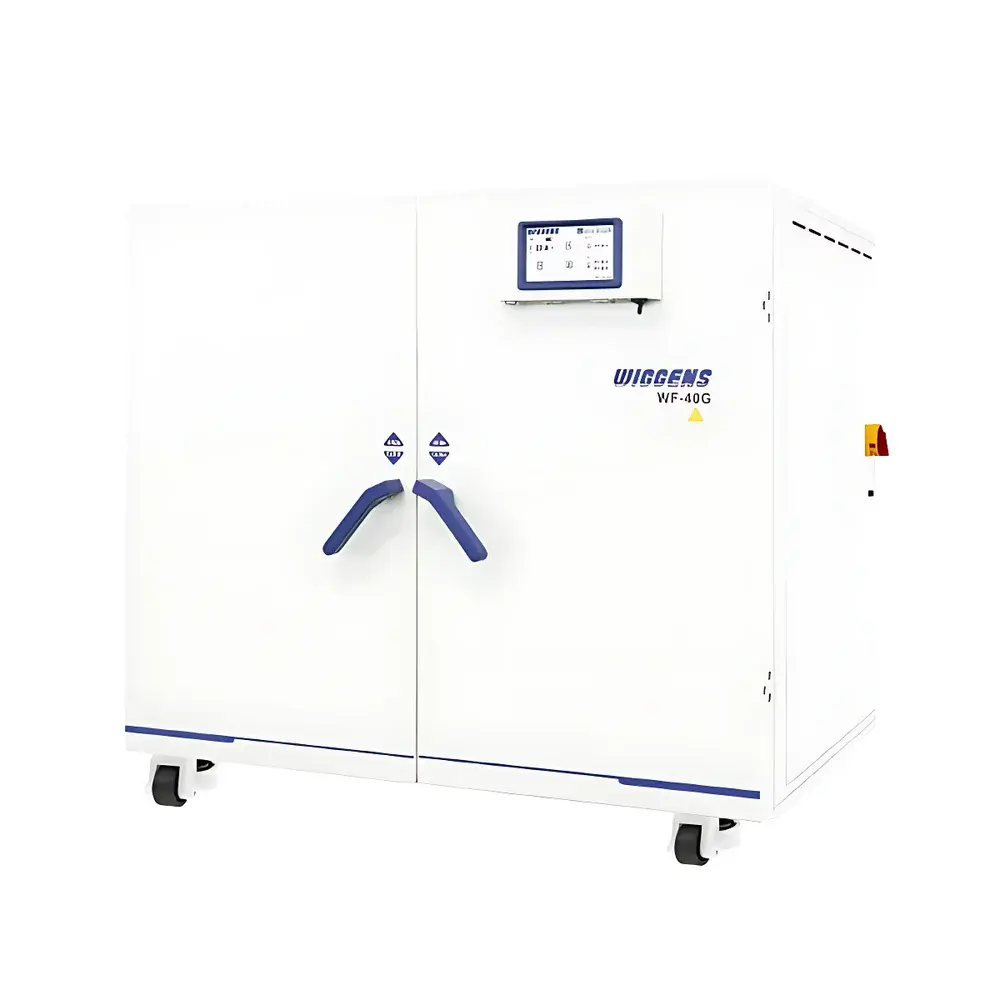
WIGGENS WF-40G Forced-Convection Dry Oven
| Brand | WIGGENS |
|---|---|
| Origin | Germany |
| Model | WF-40G |
| Convection Type | Forced-air convection |
| Temperature Range | Ambient +10°C to 300°C |
| Temperature Control Accuracy | ±0.5°C at 100°C |
| Heating Power | 3.4 kW |
| Internal Dimensions (W×D×H) | 998 × 495 × 802 mm |
| Display Resolution | 0.1°C |
| Timer Range | 1 min – 99 h 59 min |
| Interface | RS232 standard |
| Safety Features | Overheat protection, door-open alarm |
| Pre-stored Temperature Setpoints | 3 |
| Ventilation Ports | Two sliding-type, Ø35 mm |
| Chamber Material | Nickel-chromium-iron alloy sheathed heaters, arc-cornered stainless steel interior |
| Optional | Tempered glass observation window |
Overview
The WIGGENS WF-40G Forced-Convection Dry Oven is an ISO 17025-aligned laboratory-grade thermal processing instrument engineered for precision drying, heat treatment, sterilization, and material conditioning under controlled dry-heat environments. Operating on the principle of uniform forced-air circulation via a multi-blade, low-noise centrifugal fan, the oven ensures exceptional thermal homogeneity across its 400 L chamber—critical for applications demanding reproducible thermal exposure per ASTM E2234, ISO 14644-1 cleanroom validation protocols, and GLP-compliant stability testing. Its maximum operating temperature of 300°C supports both routine glassware drying and validated dry-heat sterilization cycles (e.g., 160°C for 120 min or 180°C for 30 min per USP and EN 285 Annex C), while the PID-controlled microprocessor system maintains setpoint stability within ±0.5°C at 100°C—meeting the repeatability requirements for calibration laboratories accredited to ISO/IEC 17025.
Key Features
- PID-based digital temperature controller with intuitive LED touchscreen interface and 0.1°C display resolution
- Three user-programmable temperature presets for rapid recall of frequently used setpoints
- Programmable timer with adjustable range from 1 minute to 99 hours and 59 minutes, supporting unattended operation
- Robust heating system using corrosion-resistant, high-emissivity nickel-chromium-iron alloy (Inconel®-type) sheathed elements mounted on all chamber walls
- Smooth, ergonomic door handle and arc-radius internal corners for easy cleaning and residue-free maintenance
- Dual sliding-type ventilation ports (Ø35 mm each) enabling precise control of internal vapor pressure and moisture evacuation during drying cycles
- Integrated safety architecture including independent overtemperature cut-off (dual-limit thermostat), real-time door-open detection with audible/visual alarm, and automatic power cutoff upon abnormal thermal deviation
- Standard RS232 serial interface for external data logging, remote monitoring, and integration into centralized lab management systems compliant with FDA 21 CFR Part 11 audit-trail requirements
Sample Compatibility & Compliance
The WF-40G accommodates diverse sample formats—including borosilicate glassware (vials, Petri dishes, pipettes), metal components, ceramic substrates, polymer films, and powder samples—without risk of oxidation or surface degradation up to 300°C. Its chamber geometry (998 × 495 × 802 mm internal) permits vertical stacking of standard-sized trays and compatibility with ISO/IEC 17025-mandated temperature mapping procedures using calibrated thermocouples (Class 1 accuracy per IEC 60584-2). The unit conforms to EN 61000-6-3 (EMC emissions), EN 61000-6-2 (immunity), and EN 61010-1:2019 (safety for electrical equipment in laboratory use). Optional tempered glass observation window (order code W6062401) facilitates non-intrusive visual monitoring without compromising thermal integrity.
Software & Data Management
While the WF-40G operates autonomously via its embedded controller, the RS232 port enables seamless connection to third-party data acquisition platforms such as LabVIEW™, MATLAB®, or custom Python-based logging tools. When integrated with validated software packages meeting ALCOA+ principles (Attributable, Legible, Contemporaneous, Original, Accurate), the device supports full traceability of operational parameters—including start/stop timestamps, actual vs. setpoint temperature profiles, door-open events, and alarm logs. This configuration satisfies GMP Annex 11 and EU GMP Annex 11 requirements for electronic records in pharmaceutical manufacturing environments.
Applications
- Drying of moisture-sensitive analytical standards and reference materials prior to gravimetric analysis (ASTM D2240, ISO 11357-3)
- Pre-sterilization depyrogenation of glass containers and stainless-steel instruments in biopharmaceutical QC labs
- Thermal aging studies of polymers and composites per ISO 2578 and ASTM D3045
- Baking of filter membranes and chromatographic supports to remove residual solvents
- Conditioning of desiccants, catalysts, and adsorbent materials prior to BET surface area analysis
- Stabilization of hygroscopic reagents and calibration weights in metrology laboratories
FAQ
What is the maximum validated sterilization temperature and cycle duration supported by the WF-40G?
The oven is rated for continuous operation up to 300°C; dry-heat sterilization cycles must be validated per site-specific protocols but commonly include 160°C for 120 minutes or 180°C for 30 minutes in accordance with USP and EN 285.
Is the WF-40G suitable for use in ISO Class 5 cleanrooms?
Yes—when installed with HEPA-filtered air supply and operated with closed ventilation ports, it meets particle generation limits specified in ISO 14644-1 for background environment support; optional static-dissipative finish available upon request.
Can temperature mapping be performed inside the chamber?
Absolutely—the internal volume allows placement of ≥9 calibrated PT100 sensors per ICH Q5C guidance; WIGGENS provides optional mapping kits with NIST-traceable probes and reporting templates aligned with Annex 15 qualification standards.
Does the RS232 interface support Modbus RTU or only ASCII protocol?
The standard firmware uses ASCII command structure; Modbus RTU implementation requires optional firmware upgrade and dedicated communication module (part no. W-COM-MB-01), subject to factory configuration.
What is the recommended recalibration interval for the built-in temperature sensor?
Per ISO/IEC 17025 Clause 6.5.2, annual verification against a NIST-traceable reference thermometer is advised; WIGGENS offers certified on-site calibration services with full uncertainty budget documentation.



