
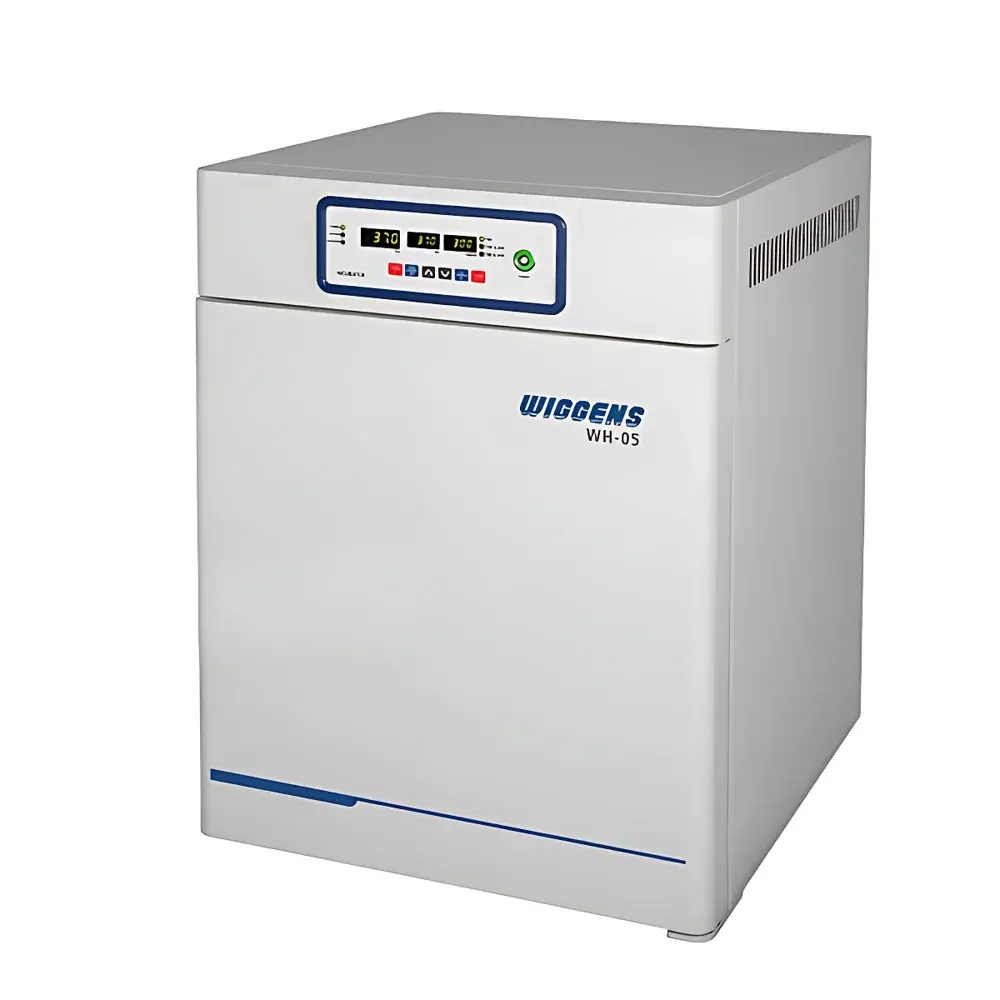
WIGGENS WH-10P Pro Series Peltier-Cooled Biochemical Incubator
| Brand | WIGGENS |
|---|---|
| Origin | Germany |
| Model | WH-10P |
| Heating Method | Air-jacketed |
| Cooling Method | Peltier Thermoelectric |
| Convection Type | Forced-air |
| Temperature Range | +10 to +60 °C (at 20 °C ambient) |
| Temperature Fluctuation | ±0.1 °C |
| Temperature Uniformity | < ±0.6 °C at 37 °C and 25 °C RT |
| Capacity | 100 L |
| External Dimensions | 620 × 668.5 × 806 mm |
Overview
The WIGGENS WH-10P Pro Series Peltier-Cooled Biochemical Incubator is an engineered solution for precise, stable, and contamination-controlled temperature environments in life science laboratories. Designed for applications requiring both heating and active cooling within a single compact unit, it employs solid-state Peltier thermoelectric technology—eliminating the need for compressors, refrigerants, or mechanical vibration sources. This architecture delivers inherently low acoustic emissions (<42 dB(A)), minimal heat dissipation into surrounding lab spaces, and enhanced long-term reliability under continuous operation. Unlike conventional compressor-based incubators, the WH-10P achieves bidirectional thermal control (heating and cooling) through an integrated air-jacketed heating system combined with high-efficiency Peltier modules and microprocessor-regulated forced convection. Its operational envelope spans +10 to +60 °C at ambient conditions of 20 °C, with temperature stability maintained at ±0.1 °C and spatial uniformity better than ±0.6 °C across the full working volume at standard setpoints (25 °C and 37 °C). The stainless steel chamber, sealed double-glass door with anti-condensation design, and modular internal layout support GLP-compliant workflows in pharmaceutical QC, cell culture, enzymatic assays, and microbial growth studies.
Key Features
- Peltier-based thermoelectric cooling system: Zero ozone-depleting refrigerants, no oil lubrication, and no moving parts in the cold stage—ensuring maintenance-free operation and compliance with EU F-Gas Regulation (EU No 517/2014)
- Air-jacketed stainless steel heating system: Rapid thermal response, uniform surface heating, and resistance to chemical corrosion and sterilization agents
- Forced-air convection with 0–100% adjustable fan speed: Optimized airflow distribution minimizes thermal stratification and supports sensitive sample integrity
- TFT touchscreen controller with PID auto-tuning: Real-time temperature curve logging, programmable ramp-soak profiles (up to 4 programs × 5 steps each), and AutoStart recovery after power interruption
- Comprehensive safety architecture: Dual independent overtemperature protection (electromechanical cut-off + digital limit), overcurrent protection, door-open detection with automatic heater/fan shutoff, and audible/visual alarm with event timestamping
- Energy-efficient design: Typical power consumption of 450 W (heating) and 350 W (cooling), meeting IEC 60335-1 and EN 61000-6-3 EMC standards
Sample Compatibility & Compliance
The WH-10P accommodates standard microbiological and cell culture vessels—including Petri dishes, multiwell plates, flasks, and test tubes—within its 100 L stainless steel chamber (480 × 478.9 × 500 mm internal). The chamber features three adjustable stainless steel shelves with perforated surfaces for unrestricted airflow, and optional accessories such as internal LED lighting (W6551501), RS232/USB data export ports, and calibrated PT100 probe inputs are available for audit-ready validation. The unit conforms to ISO 13485:2016 requirements for medical device manufacturing environments and supports IQ/OQ/PQ documentation protocols. Its temperature performance meets ASTM E122-22 criteria for statistical sampling of environmental chambers and aligns with USP for incubator qualification in pharmaceutical microbiology testing.
Software & Data Management
The embedded controller logs temperature data at user-defined intervals (1 s to 60 min) with automatic storage of up to 10,000 data points. Event-driven records—including alarms, door openings, program starts/stops, and parameter changes—are time-stamped with UTC synchronization and stored in non-volatile memory. Optional WIGGENS LabLink software enables remote monitoring, CSV export, trend analysis, and PDF report generation compliant with FDA 21 CFR Part 11 requirements (electronic signatures, audit trails, and data integrity controls). All firmware updates are delivered via secure USB interface with version rollback capability.
Applications
- Cell culture maintenance at physiological temperatures (37 °C) with tight homogeneity for reproducible proliferation assays
- Low-temperature enzyme kinetics studies (e.g., 15–25 °C) requiring stable sub-ambient control without condensation risk
- Pharmaceutical stability testing per ICH Q1A(R2) guidelines under controlled +25/60% RH and +30/65% RH conditions (when paired with external humidifier)
- Bacterial and fungal growth monitoring in clinical microbiology labs, including AST (antibiotic susceptibility testing) incubation
- Long-term reagent and reference standard storage where thermal drift must remain below ±0.15 °C over 72 h
- Environmental simulation for material biodegradability testing (ISO 14855-1) and composting studies
FAQ
What is the maximum ambient temperature at which the WH-10P maintains its specified temperature range?
The unit is rated for operation at ambient temperatures up to 30 °C; performance specifications (+10 to +60 °C range, ±0.1 °C fluctuation) assume 20 °C ambient per DIN EN 60068-3-5.
Does the WH-10P support external humidity control?
No—the WH-10P is a dry incubator. For humidity-dependent applications, integration with third-party saturated salt solutions or standalone humidification modules is required.
Can the internal temperature sensor be calibrated independently?
Yes—field calibration is supported via two-point adjustment using NIST-traceable reference thermometers, with calibration offsets stored in non-volatile memory.
Is the unit suitable for GMP-regulated environments?
Yes—its audit trail functionality, electronic signature support (via LabLink), and documented design history meet Annex 11 and EU GMP Chapter 4 requirements for computerized systems.
What is the expected service life of the Peltier modules?
Rated for >50,000 hours of continuous operation at 25 °C ambient, with mean time between failures (MTBF) exceeding 120,000 hours under typical laboratory duty cycles.
Related Products




