
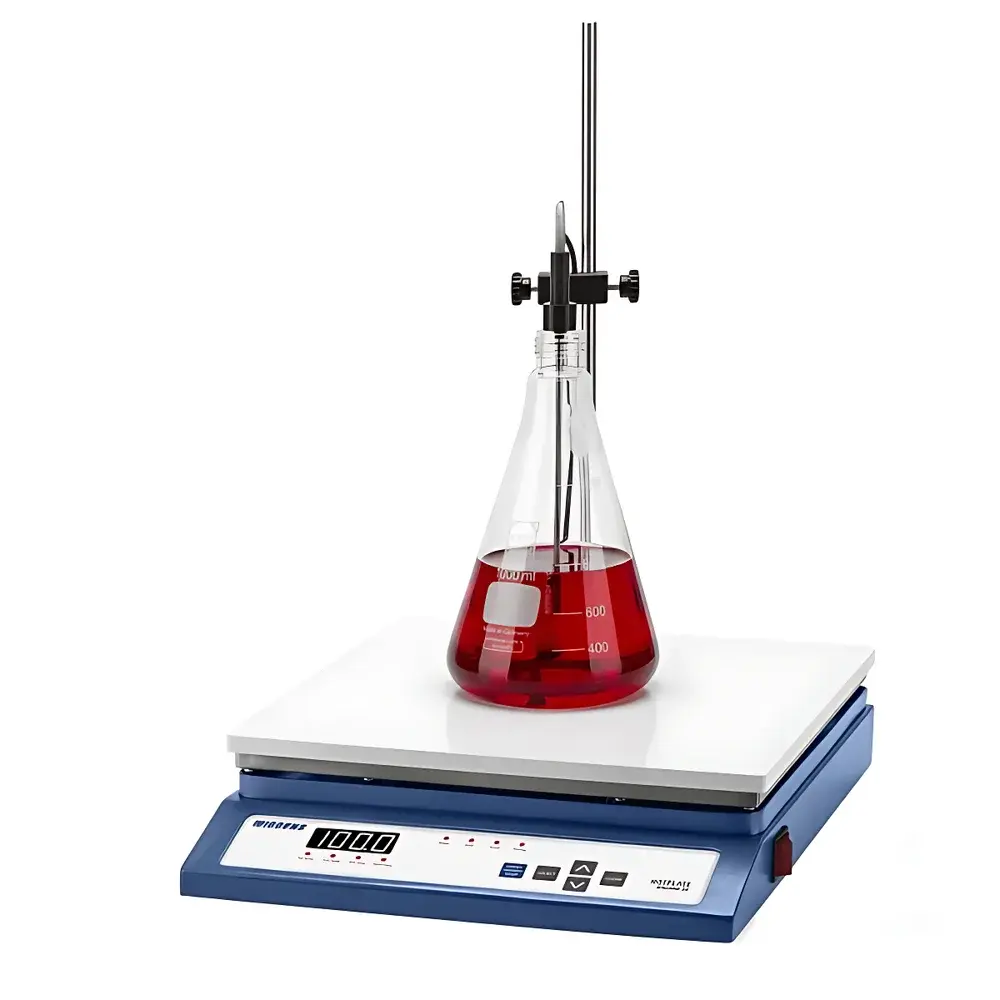
WIGGENS WH200D-3K Digital Programmable Electric Heating Plate
| Brand | WIGGENS |
|---|---|
| Origin | Germany |
| Model | WH200D-3K |
| Heating Power | 1000 W |
| Max. Heating Temperature | 300 °C |
| Temperature Uniformity | ±2 °C |
| Plate Dimensions | 320 × 320 mm |
| Heating Zone Dimensions | 320 × 320 mm |
| Display | White LED |
Overview
The WIGGENS WH200D-3K Digital Programmable Electric Heating Plate is a precision-engineered thermal platform designed for reproducible, stable, and controllable heating in analytical laboratories, sample preparation workflows, and digestion protocols. Built on a robust aluminum heating plate with ceramic coating, it delivers uniform thermal distribution across its full 320 × 320 mm surface—critical for consistent sample treatment during acid digestion, solvent evaporation, reagent preheating, or controlled drying procedures. Its core temperature regulation relies on a digital PID control algorithm, enabling dynamic compensation for thermal load changes, ambient fluctuations, and vessel-specific heat transfer characteristics. Unlike basic analog hotplates, the WH200D-3K supports both internal sensor feedback (integrated thermistor) and external Pt100 probe input, allowing users to close the control loop directly at the sample interface—essential for applications where surface temperature alone does not reflect actual sample thermal conditions (e.g., thick-walled digestion vessels or low-conductivity media).
Key Features
- Digital PID temperature control with dual-sensor capability: internal thermistor for plate monitoring and optional external Pt100 input for direct sample-zone temperature feedback
- Three operational timing modes: OFF (manual termination), OFF-Time (auto-shutdown after user-defined duration), and WAIT-Time (delayed activation)
- Programmable timer range from 1 minute to 99 hours and 59 minutes, supporting unattended overnight or multi-stage heating protocols
- Real-time dual-display of setpoint and actual temperature via high-contrast white LED indicators
- Over-temperature safety system: automatic visual alert (amber indicator LED) activates when plate surface exceeds 60 °C; independent high/low limit alarms trigger audible and visual warnings if programmed thresholds are breached
- Factory reset function ensures configuration integrity after maintenance or user error
- Aluminum heating plate with durable ceramic coating resists corrosion from acidic vapors and solvents commonly encountered in digestion workflows
Sample Compatibility & Compliance
The WH200D-3K accommodates standard laboratory glassware (e.g., beakers, Erlenmeyer flasks, digestion tubes) and PTFE or quartz vessels up to 400 mm in diameter. Its flat, chemically inert ceramic-coated surface minimizes contamination risk and facilitates cleaning between runs. The unit complies with IEC 61010-1:2010 for electrical safety in laboratory equipment and meets CE marking requirements for electromagnetic compatibility (EMC Directive 2014/30/EU). While not certified for Class I Div 1 hazardous locations, its design adheres to GLP-aligned operational practices—including audit-trail-ready parameter logging when integrated with compatible data acquisition systems. For regulated environments (e.g., ISO/IEC 17025-accredited labs), traceable calibration using NIST-traceable Pt100 probes is supported.
Software & Data Management
The WH200D-3K operates as a standalone instrument without proprietary software dependency. However, its analog 0–10 V output (optional accessory interface) enables connection to third-party data loggers or SCADA systems for time-stamped temperature recording. When used with an external Pt100 sensor, the device maintains stable setpoint tracking within ±0.5 °C repeatability over 8-hour continuous operation—enabling validation of thermal profiles per ASTM E2251 or USP . All user-modifiable parameters (setpoint, timer mode, alarm thresholds) are retained in non-volatile memory during power loss. No firmware updates are required under normal operation; configuration persistence eliminates recalibration drift associated with volatile memory-based controllers.
Applications
- Open-vessel acid digestion (HNO₃, HCl, HF mixtures) prior to ICP-OES or ICP-MS analysis
- Controlled evaporation of organic solvents in EPA Method 503.1 and 504.1 workflows
- Preheating of reaction mixtures in synthetic chemistry and enzymatic assays
- Thermal conditioning of calibration standards and reference materials
- Stabilization of viscosity measurement baths for rotational rheometers
- Supporting ASTM D5293 (cold cranking simulator) and ISO 3104 (kinematic viscosity) sample equilibration steps
FAQ
Can the WH200D-3K be used with a Pt100 sensor for closed-loop sample temperature control?
Yes—the rear-panel analog input accepts standard 2-, 3-, or 4-wire Pt100 sensors, enabling direct feedback control of the target sample’s thermal environment rather than the plate surface.
Is the temperature uniformity specification (±2 °C) verified across the entire 320 × 320 mm zone?
Yes—uniformity is measured at nine points (center + eight grid positions) per DIN EN 61000-4-3 test methodology, with all readings falling within ±2 °C of the setpoint at 200 °C steady state.
Does the unit support 21 CFR Part 11-compliant electronic records?
No—the WH200D-3K lacks built-in audit trail or user authentication features. However, when paired with validated external data loggers meeting Part 11 requirements, it can contribute to compliant thermal process documentation.
What is the maximum recommended load weight on the heating surface?
The ceramic-coated aluminum plate supports static loads up to 5 kg distributed evenly; exceeding this may compromise thermal contact and long-term coating integrity.
How frequently should calibration verification be performed in a GLP lab?
Per ISO/IEC 17025:2017 Clause 7.7.1, calibration checks using a traceable reference thermometer are recommended before each critical run or daily—whichever occurs more frequently.



