
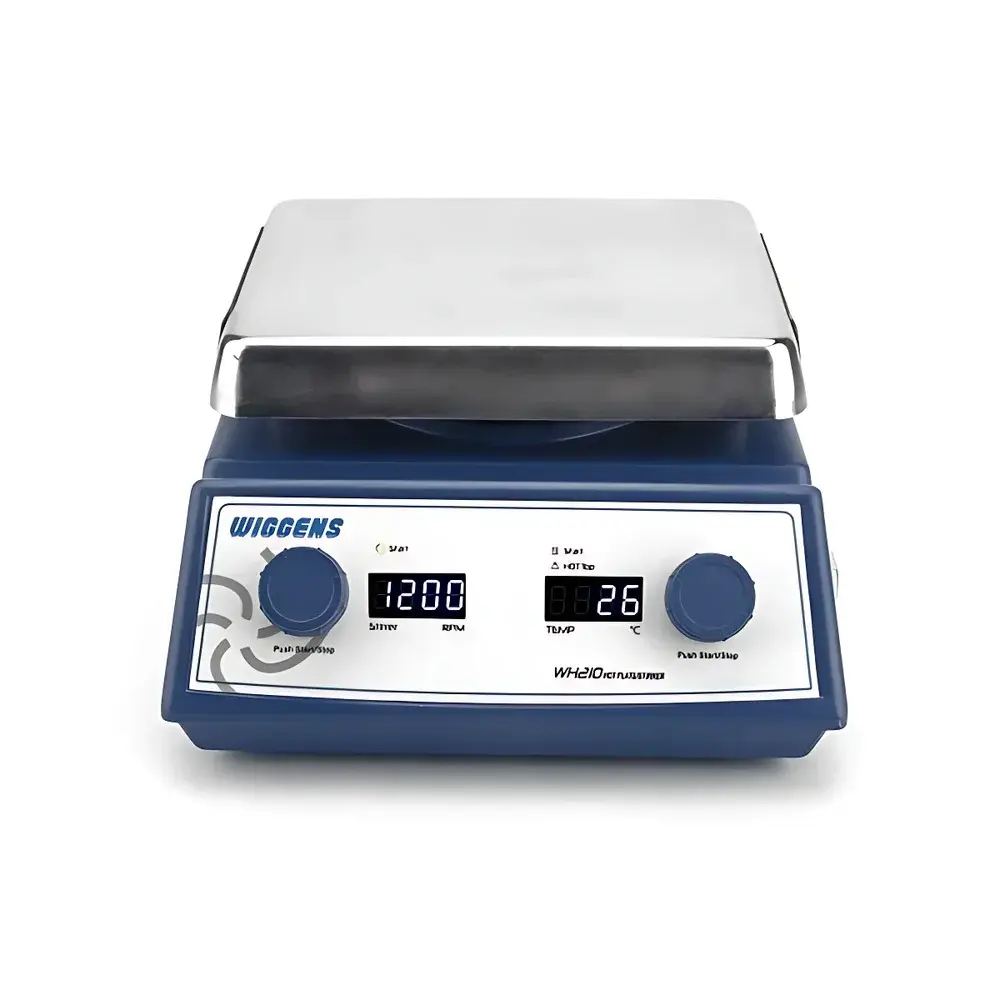
WIGGENS WH210 Heating Magnetic Stirrer
| Brand | WIGGENS |
|---|---|
| Origin | Germany |
| Model | WH210 |
| Maximum Stirring Volume | 2 L |
| Speed Range | 100–1500 rpm |
| Heating Plate Temperature | ≤350 °C |
| Sample Temperature (with thermocouple probe) | ≤350 °C |
| Temperature Control Accuracy (with thermocouple) | ±1 °C |
| Safety Overtemperature Cut-off | 380 °C |
| Heating Power | 500 W |
| Heating Plate Dimensions | 180 × 145 mm |
| Heating Plate Material | Enamel-coated stainless steel |
| PID Control | Integrated single-set PID algorithm |
| Display | LED digital display with rotary knob control |
| Safety Features | Spill-resistant drip channel, sealed enclosure, dual overtemperature alarm (E02), high-temp warning LED (flashing above 50 °C) |
Overview
The WIGGENS WH210 Heating Magnetic Stirrer is an engineered laboratory instrument designed for precise, reproducible heating and agitation of liquid samples in research, quality control, and teaching laboratories. It operates on the principle of magnetic coupling—where a rotating permanent magnet beneath the heating plate induces rotation in a magnetic stir bar immersed in the sample—combined with resistive plate heating and closed-loop temperature regulation. Its robust architecture integrates microprocessor-based control logic with analog feedback pathways to ensure stable thermal output and consistent rotational torque across the full speed range. The WH210 is intended for routine use with aqueous and low-viscosity organic media up to 2 L volume, supporting protocols requiring simultaneous thermal equilibration and homogeneous mixing—such as dissolution testing, buffer preparation, reagent synthesis, and standard solution conditioning.
Key Features
- Enamel-coated stainless steel heating plate (180 × 145 mm) offering corrosion resistance, thermal uniformity, and mechanical durability under repeated thermal cycling.
- Microprocessor-controlled PID temperature regulation with ±1 °C accuracy when used with an optional external thermocouple probe (type K recommended), enabling traceable thermal management compliant with GLP documentation requirements.
- Dual-stage thermal safety system: visual LED alert (flashing above 50 °C surface temperature) and automatic E02 fault lockout at 380 °C internal cutoff—designed to prevent uncontrolled thermal runaway per IEC 61010-1 safety guidelines.
- Integrated spill containment design featuring a raised perimeter drip channel above the control panel, minimizing ingress risk from accidental splashes during active operation.
- Hermetically sealed housing with isolated mounting of critical electronics, enhancing operational reliability in environments with elevated humidity, solvent vapors, or particulate exposure.
- Non-volatile memory retains last-used speed and temperature settings upon power cycle—reducing setup time for standardized procedures and improving inter-operator consistency.
Sample Compatibility & Compliance
The WH210 is validated for use with water, saline solutions, alcohols, acetone, ethyl acetate, and other non-aggressive solvents compatible with PTFE- or glass-coated stir bars. It is not rated for highly viscous media (>500 mPa·s), abrasive suspensions, or corrosive acids (e.g., concentrated HNO₃, HF) without protective shielding. The device complies with CE marking requirements under Directive 2014/30/EU (EMC) and 2014/35/EU (LVD), and conforms to EN 61010-1:2010+A1:2019 for laboratory electrical equipment safety. While not intrinsically safe, its design meets typical Class II laboratory installation standards per ISO/IEC 17025:2017 Annex A.3 for equipment suitability assessment.
Software & Data Management
The WH210 operates as a standalone analog-digital hybrid instrument with no embedded data logging or USB/RS232 connectivity. All parameter adjustments—including speed (100–1500 rpm) and plate temperature (ambient to 350 °C)—are executed via front-panel rotary encoder and confirmed in real time on the high-contrast LED display. For audit-trail compliance in regulated environments (e.g., pharmaceutical QC labs adhering to FDA 21 CFR Part 11), users must manually record setpoints and duration in bound logbooks or integrate the unit into validated environmental monitoring systems using external thermocouple dataloggers (e.g., Omega OM-DAQPRO-5300 series). No firmware updates or remote configuration are supported.
Applications
- Preparation of calibration standards and reference solutions requiring temperature-stabilized homogenization (e.g., USP dissolution medium conditioning).
- Heating-assisted titration setups where constant temperature minimizes endpoint drift.
- Cell culture media warming and pH buffer equilibration prior to sterile filtration.
- Synthesis reaction monitoring where gentle agitation prevents localized overheating or bumping.
- Educational demonstrations of Arrhenius kinetics, heat transfer principles, and fluid dynamics in undergraduate chemistry and chemical engineering curricula.
FAQ
Does the WH210 support external temperature feedback control?
Yes—when paired with a compatible type K thermocouple probe (sold separately), the unit enables sample temperature feedback mode with ±1 °C control accuracy.
Can it be used with flammable solvents?
Only under strict adherence to local fire safety protocols; the unit lacks explosion-proof certification and must be operated in ventilated fume hoods when handling volatile organics.
Is the heating plate removable for cleaning?
No—the enamel-coated plate is permanently integrated into the chassis; cleaning requires damp lint-free cloth and neutral detergent only.
What is the expected service life under continuous operation?
Rated for >10,000 hours of cumulative use at ≤250 °C and 1000 rpm average load, assuming periodic verification of thermal calibration per ISO/IEC 17025 clause 6.5.2.
Does WIGGENS provide calibration certificates?
Factory calibration reports are available upon request at time of purchase; third-party accredited calibration (e.g., NIST-traceable) requires external service provider engagement.



