
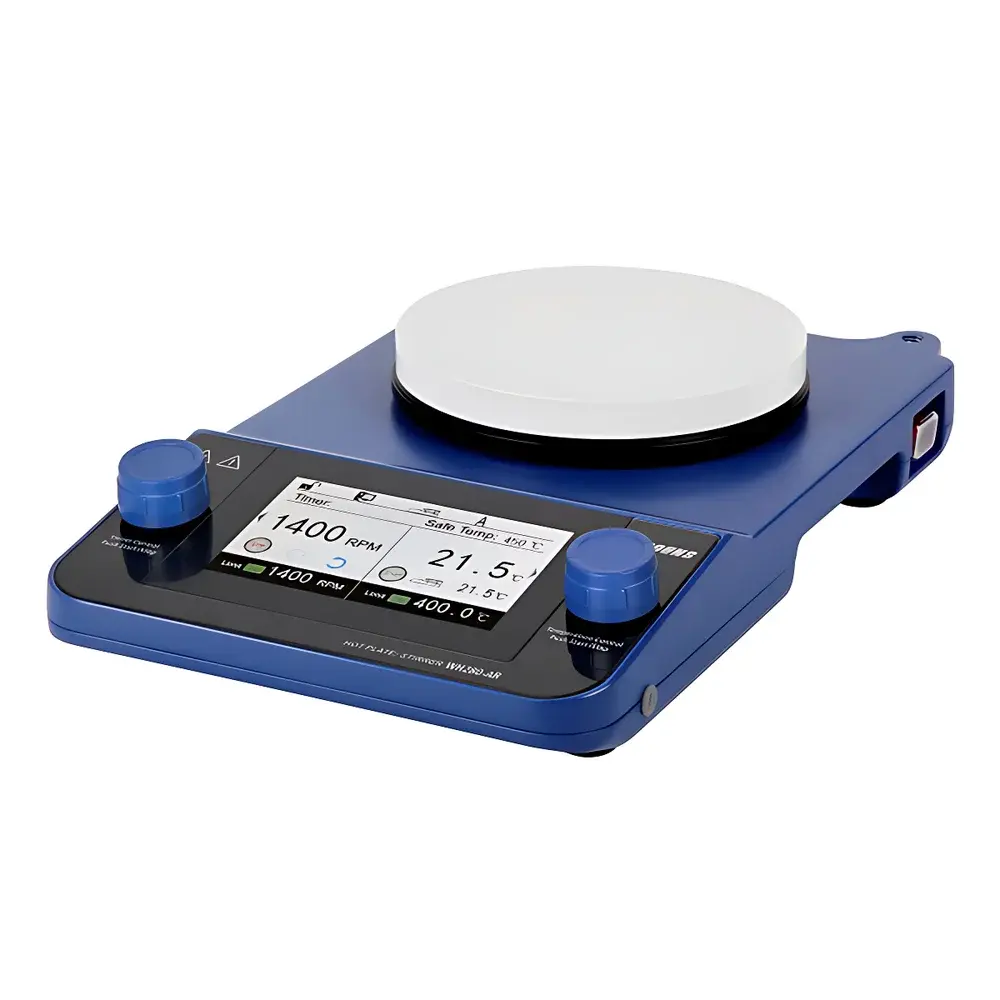
WIGGENS WH280-AR Infrared Heating Magnetic Stirrer
| Brand | WIGGENS |
|---|---|
| Origin | Germany |
| Model | WH280-AR |
| Stirrer Type | Magnetic Stirrer |
| Max. Stirring Volume | 20 L |
| Speed Range | 100–1500 rpm |
| Temperature Control Range | 50–430 °C |
| Heating Plate Max. Temp. | 380 °C |
| Sample Temp. Control (with Pt100) | up to 200 °C |
| Heating Power | 800 W |
| Temp. Stability (with Pt100) | ±1 °C |
| Over-Temp. Protection Range | 2–50 °C above setpoint |
| Timer Range | 00:01:00 to 99:59:00 or continuous |
| Display | Full-color capacitive touchscreen with rotary encoder |
| Interface | RS-232 & RS-485 |
| Plate Material | Enamel-coated stainless steel |
| Plate Dimensions | 140 × 140 mm |
| Unit Dimensions (W×D×H) | 187 × 315 × 93 mm |
| Weight | 3.0 kg |
| Power Supply | 220 V / 50 Hz |
Overview
The WIGGENS WH280-AR Infrared Heating Magnetic Stirrer is an integrated laboratory instrument engineered for precise, reproducible thermal and mechanical control during sample preparation and reaction monitoring. Unlike conventional resistive-heating stirrers, the WH280-AR employs a high-efficiency infrared heating element coupled with a sealed enamel-coated stainless steel plate, enabling rapid thermal response and stable temperature maintenance across demanding applications—from gentle homogenization to vigorous high-temperature synthesis. Its dual-sensor architecture supports both process temperature regulation (via external Pt100 probe) and independent safety monitoring (via dedicated thermocouple), ensuring compliance with GLP/GMP workflows where traceable, auditable thermal control is mandatory. Designed and manufactured under German engineering standards, the unit meets IEC 61010-1 safety requirements for laboratory electrical equipment and is suitable for use in ISO 17025-accredited testing laboratories.
Key Features
- Infrared-enhanced heating system delivering uniform thermal distribution and faster ramp-up to target temperatures (up to 380 °C on plate; up to 200 °C at sample with Pt100 feedback)
- Full-color capacitive touchscreen interface with intuitive rotary encoder for simultaneous adjustment of speed, temperature, timer, and safety thresholds
- Dual independent temperature sensing: Pt100 input for closed-loop sample temperature control + separate thermocouple input for redundant over-temperature protection
- Auto-recall function retains last-used parameters—including speed, temperature setpoint, timer duration, and safety offset—reducing setup time for routine protocols
- Corrosion-resistant liquid containment groove integrated above control panel to prevent ingress of spilled reagents into electronics
- Sealed enclosure design with isolated internal components, rated IP20 for operation in standard laboratory environments with moderate chemical exposure
- RS-232 and RS-485 digital interfaces enable remote parameter control, data logging, and integration into centralized lab automation systems compliant with ASTM E2500 and FDA 21 CFR Part 11 requirements
Sample Compatibility & Compliance
The WH280-AR accommodates a wide range of vessel types—including borosilicate glass beakers (up to 20 L capacity), stainless steel reactors, and ceramic crucibles—without compromising thermal uniformity or magnetic coupling efficiency. Its adjustable over-temperature protection (2–50 °C above setpoint) and hardware-based thermal cutoff switch provide fail-safe operation per IEC 60335-1 and DIN EN 61000-6-3 EMC standards. When used with a calibrated Pt100 sensor, the system achieves ±1 °C stability over time, supporting applications requiring adherence to USP , ISO 8573-1, or ASTM D2196 viscosity test conditions where thermal consistency directly impacts measurement validity.
Software & Data Management
While the WH280-AR operates as a standalone instrument, its RS-232/RS-485 ports support bidirectional communication with third-party SCADA platforms, LIMS, or custom Python/Matlab scripts via ASCII command protocol. All parameter changes—including real-time speed and temperature readings, timer status, and fault events—are timestamped and exportable for audit trail generation. The device logs critical events (e.g., sensor disconnection, over-temp trigger, power interruption) internally and transmits them upon query, fulfilling documentation requirements for ISO/IEC 17025 clause 7.7 and FDA 21 CFR Part 11 electronic record integrity provisions.
Applications
- Controlled-temperature synthesis of metal-organic frameworks (MOFs) and nanomaterials requiring sustained 180–250 °C conditions
- Accelerated solvent extraction (ASE) and Soxhlet-style digestions under inert atmosphere
- Preparation of high-viscosity polymer solutions and colloidal dispersions where shear rate and thermal history must be independently managed
- Standardized dissolution testing per USP using jacketed vessels with external Pt100 feedback
- Calibration of thermistors and RTDs under dynamic heating/stirring profiles
- Long-duration stability studies involving aqueous and organic media under reflux or open-vessel conditions
FAQ
Can the WH280-AR maintain temperature accuracy without a Pt100 probe?
No. The ±1 °C stability specification applies only when using a calibrated Pt100 sensor in direct contact with the sample. Plate temperature alone serves as a proxy and exhibits greater thermal lag and gradient variation.
Is the infrared heating element compatible with aluminum or plastic containers?
Infrared radiation requires emissive surfaces for efficient absorption. Aluminum reflects IR energy and will not heat effectively; non-blackened plastics may deform or outgas. Use only glass, ceramic, or black-enamel-coated metal vessels.
Does the unit support programmable multi-step temperature ramps?
No. The WH280-AR provides single-setpoint control with timer-based hold functionality. For multi-stage thermal profiles, external PLC or PC-based scripting via RS-485 is required.
What is the maximum ambient operating temperature for this stirrer?
The device is rated for continuous operation at ambient temperatures up to 40 °C and relative humidity ≤80% non-condensing, per IEC 60068-2-1/2 environmental classification.
How often should the Pt100 sensor be recalibrated?
Per ISO/IEC 17025, calibration interval depends on usage frequency and criticality of application; typical recommendation is every 6–12 months or before each high-stakes validation study.
Related Products



