
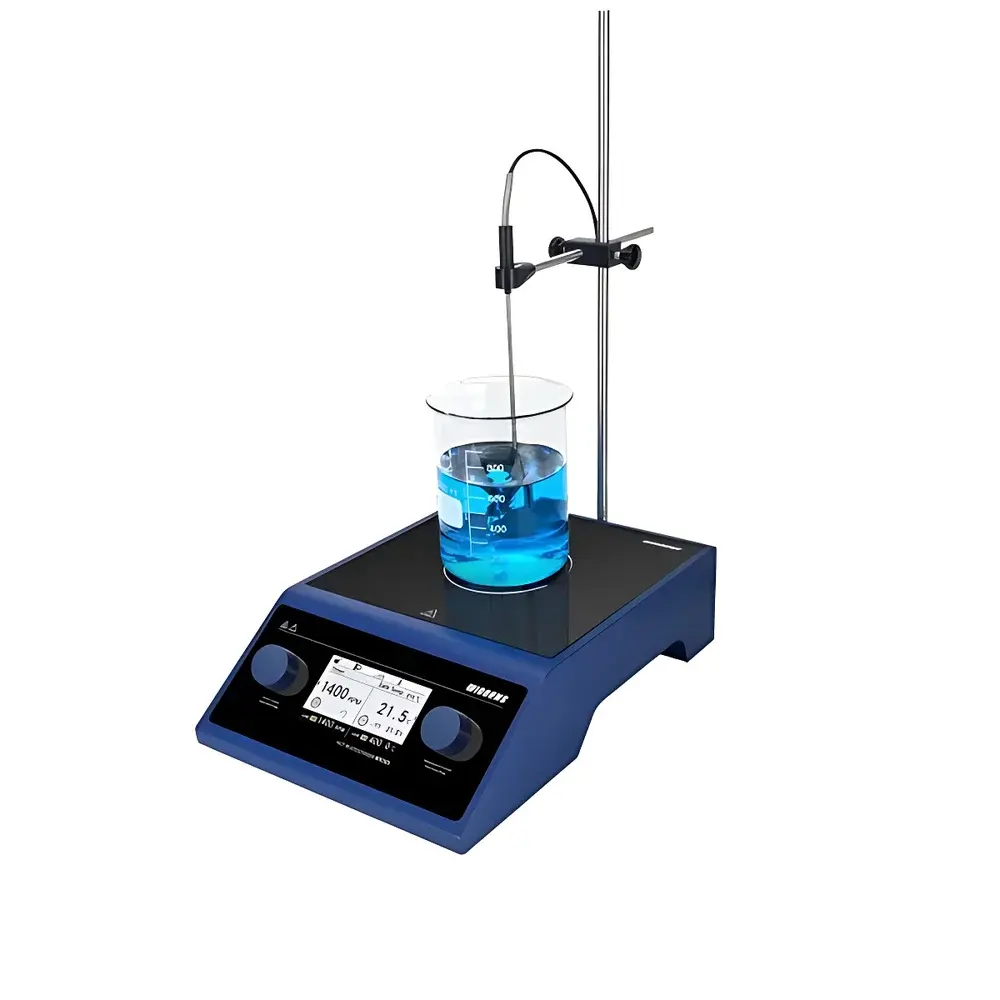
WIGGENS WH380/WH385 Infrared Heating Magnetic Stirrer
| Brand | WIGGENS |
|---|---|
| Origin | Germany |
| Model | WH380 / WH385 |
| Maximum Stirring Volume | 30 L |
| Speed Range | 100–1500 rpm |
| Heating Temperature Range (Plate) | ≤550 °C |
| Sample Temperature Control Range (with Pt100) | ≤300 °C |
| Temperature Stability (with Pt100) | ±1 °C |
| Safety Overtemperature Cut-off Range | 50–600 °C (adjustable) |
| ΔT Overtemperature Protection | 10–50 °C (adjustable) |
| Heating Power | 1200 W |
| Plate Material | Vitreous Enamel-Coated Steel |
| Plate Dimensions | 280 × 280 mm |
| Heating Zone Diameter | 190 mm |
| Display | LCD (WH380) / TFT (WH385) |
| Control Interface | Rotary Knob (WH380) / Touchscreen + Rotary Knob (WH385) |
| Timer Range | 1–1999 min or Continuous (WH380) / 00:01:00–99:59:00 or Continuous (WH385) |
| External Sensor Inputs | Pt100 (sample), Thermocouple (reference) |
| Communication Interface | RS232 / RS485 |
| Power Supply | 220 V, 50 Hz |
| Weight | 4.0 kg |
| Enclosure | Sealed, corrosion-resistant housing |
| Thermal Shock Resistance | >700 °C |
Overview
The WIGGENS WH380 and WH385 Infrared Heating Magnetic Stirrers are precision-engineered laboratory instruments designed for simultaneous heating and homogeneous mixing of liquid samples under controlled thermal conditions. Unlike conventional resistive-heating stirrers, these models utilize high-efficiency infrared radiation emitted from a ceramic-coated heating element beneath a vitreous enamel plate—enabling rapid thermal transfer with minimal thermal inertia and superior spatial uniformity across the heating zone. The system operates on the principle of magnetic coupling: a rotating permanent magnet beneath the plate induces synchronous rotation of a PTFE- or glass-coated magnetic stir bar immersed in the sample vessel. This non-contact drive mechanism eliminates mechanical wear, ensures leak-tight operation, and supports applications requiring sterile or sealed environments. Both models comply with IEC 61010-1 safety standards for laboratory electrical equipment and are engineered for long-term reliability in QC, R&D, and teaching laboratories where reproducible temperature ramping and stable rotational dynamics are critical.
Key Features
- Infrared heating technology delivering faster warm-up times and reduced energy consumption compared to traditional coil-based systems
- Vitreous enamel-coated steel plate with >700 °C thermal shock resistance and chemical inertness against common solvents and acids
- Dual-mode temperature control: plate surface regulation (≤550 °C) and precise sample temperature feedback (≤300 °C) via integrated Pt100 input
- Adjustable overtemperature protection with two independent safety layers—programmable cut-off (50–600 °C) and differential ΔT monitoring (10–50 °C above setpoint)
- Advanced PID (WH380) or ICC (Intelligent Current Control, WH385) algorithms ensuring ±1 °C thermal stability during extended operation
- Sealed, corrosion-resistant housing rated IP20, suitable for humid or mildly aggressive lab atmospheres
- RS232/RS485 digital interfaces enabling remote parameter setting, real-time data logging, and integration into centralized lab management systems
- Comprehensive timer functionality supporting both discrete intervals (up to 1999 min) and continuous operation modes
Sample Compatibility & Compliance
These stirrers accommodate standard borosilicate glass vessels (e.g., beakers, flasks, crystallization dishes) up to 30 L volume when using appropriately sized stir bars and optimized geometry. Compatibility extends to low-viscosity aqueous solutions, organic solvents (e.g., ethanol, acetone, toluene), and moderately viscous polymer solutions (<500 mPa·s at 25 °C). The vitreous enamel surface resists etching by dilute mineral acids (HCl, HNO₃ ≤10 % v/v) and alkalis (NaOH ≤1 M), though prolonged exposure to hydrofluoric acid or molten alkali metals is prohibited. Device firmware and hardware architecture support audit-trail-capable operation per GLP requirements; optional software packages provide electronic signature, user access levels, and event logging compliant with FDA 21 CFR Part 11 when paired with validated host systems.
Software & Data Management
While standalone operation requires no software, the WH380/WH385 support bidirectional serial communication via RS232/RS485. Third-party SCADA or LIMS platforms can poll real-time parameters—including actual plate temperature, setpoint, stirring speed, elapsed time, and alarm status—using ASCII-based command protocols documented in the technical manual. Optional WIGGENS LabControl Suite (v3.2+) enables scheduled ramp-hold profiles, multi-step temperature–speed sequences, and CSV export of timestamped datasets. All configurations are retained after power cycling. Firmware updates are performed via USB-to-serial adapter and maintain backward compatibility with prior configuration files.
Applications
- Preparation of calibration standards and reference solutions requiring strict thermal homogeneity
- Accelerated dissolution testing in pharmaceutical development (aligned with USP guidelines)
- Synthesis of metal-organic frameworks (MOFs) and colloidal nanoparticles under reflux conditions
- pH adjustment and buffer equilibration in analytical sample preparation workflows
- Enzyme kinetics assays where temperature-dependent activity must be maintained within ±0.5 °C
- Teaching labs demonstrating Arrhenius behavior, heat capacity measurement, or viscosity–temperature relationships
FAQ
Can the WH385 control temperature based solely on an external Pt100 probe without using the built-in plate sensor?
Yes—the instrument prioritizes external Pt100 input for closed-loop sample temperature regulation when enabled in setup mode.
Is the enamel surface resistant to scratching from magnetic stir bars?
Vitreous enamel provides high hardness (≈6–7 Mohs), but repeated use of oversized or damaged stir bars may cause micro-scratching; WIGGENS recommends PTFE-coated bars with rounded ends.
Does the device meet electromagnetic compatibility (EMC) requirements for ISO/IEC 61326-1?
Yes—both models carry CE marking and conform to EN 61326-1:2013 for laboratory measurement and control equipment.
What is the minimum detectable speed resolution?
Speed is adjustable in 1-rpm increments across the full 100–1500 rpm range, with encoder-based feedback ensuring ±2 rpm repeatability.
Can the timer be used independently of heating or stirring functions?
No—the timer governs the active duration of the currently enabled operational mode (heating only, stirring only, or combined).



