
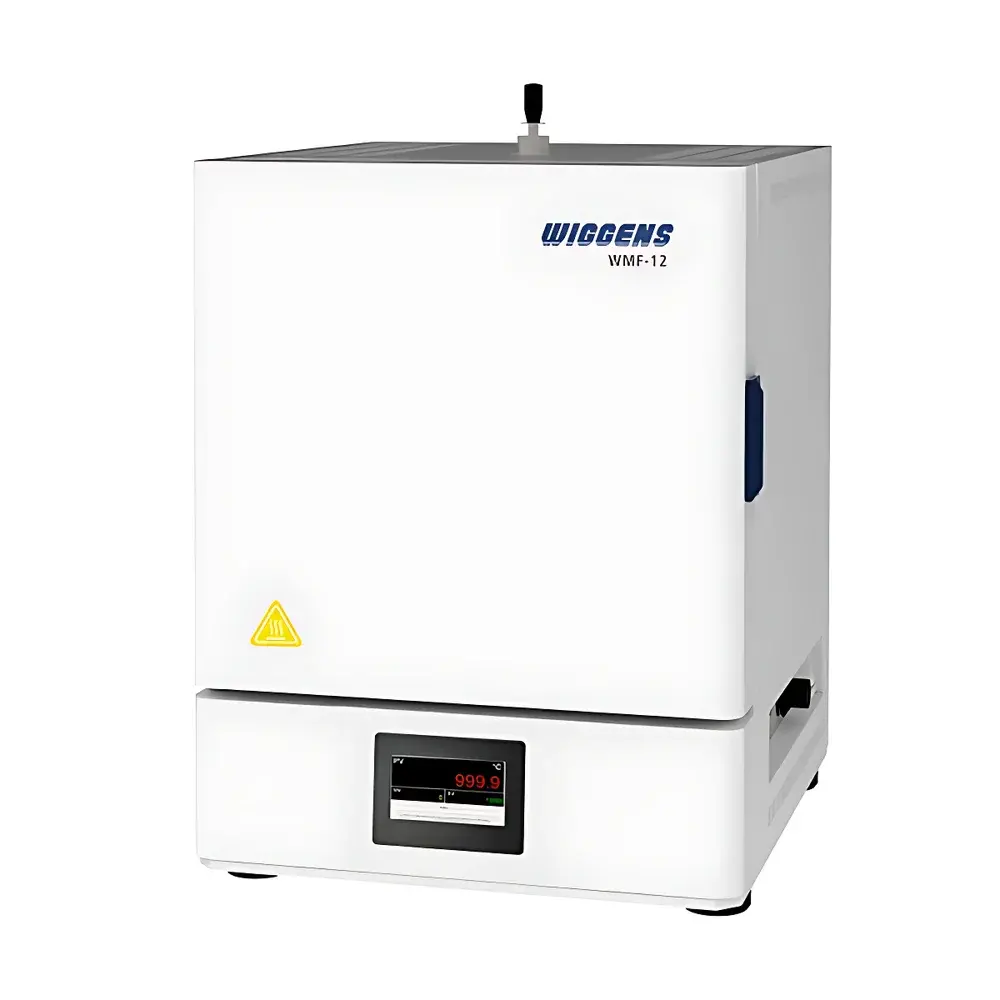
WIGGENS WMF-12 High-Temperature Box-Type Muffle Furnace
| Brand | WIGGENS |
|---|---|
| Origin | Germany |
| Model | WMF-12 / WMF-12H |
| Instrument Type | Box-Type Muffle Furnace |
| Max. Temperature | 1600 °C |
| Temperature Control Accuracy | ±1.5 °C |
| Max. Power | 7 kW |
| Heating Rate | +15 °C to 1600 °C (programmable) |
| Heating Configuration | Triple-Side Heating |
| Internal Chamber Dimensions | 200 × 300 × 200 mm (W × D × H) |
| Temperature Stability | ±1.5 °C (at setpoint) |
| Control System | PID with 5″ LCD Touch Interface |
| Programmability | 10 user-defined programs, up to 30 segments per program |
| Data Logging | Onboard memory + USB export (history, alarms, real-time curves) |
| Communication Interfaces | RS232, RS485, RJ45 Ethernet |
| Safety Features | Dual overtemperature protection (digital + independent mechanical), overload & leakage current protection, password-locked parameter editing, passive pressure-relief vent, long-life Type S thermocouple |
Overview
The WIGGENS WMF-12 is a high-precision, programmable box-type muffle furnace engineered for demanding thermal processing applications in research laboratories, quality control environments, and industrial R&D settings. Designed and manufactured under German engineering standards, it operates on the principle of radiant heat transfer within an insulated refractory chamber, isolating samples from combustion byproducts via a sealed muffle structure. Its maximum operating temperature of 1600 °C enables ashing, calcination, sintering, heat treatment, and thermal gravimetric pre-conditioning of advanced ceramics, metallurgical powders, catalysts, and geological specimens. The triple-side heating configuration ensures uniform thermal distribution across the 200 × 300 × 200 mm internal chamber, minimizing axial and radial gradients — a critical requirement for reproducible ASTM E119, ISO 5660, or USP compliant procedures.
Key Features
- Triple-side heating architecture with high-density ceramic fiber insulation for improved thermal homogeneity and energy efficiency
- PID-based digital temperature controller with 5-inch capacitive touch LCD interface supporting intuitive navigation and direct access to setpoint, real-time temperature, power output, and alarm history
- Programmable thermal profiles: up to 10 stored programs, each configurable with up to 30 ramp-hold segments, including variable heating/cooling rates and loop repetition
- Real-time graphical display of temperature vs. time curves during program execution, enabling immediate verification of thermal compliance
- Dual-layer safety system: primary digital overtemperature cutoff integrated with a physically independent mechanical high-limit switch, both certified to IEC 61000-4-5 surge immunity and EN 61010-1 safety standards
- Comprehensive electrical protection: automatic disconnection upon ground fault detection, thermal overload tripping, and short-circuit response
- Password-protected parameter editing to prevent unauthorized modification during GLP/GMP workflows
- Passive pressure-equalization vent integrated into the muffle wall to mitigate internal overpressure during rapid gas evolution (e.g., carbonate decomposition)
Sample Compatibility & Compliance
The WMF-12 accommodates standard crucibles (alumina, silicon carbide, platinum) and refractory boats up to 180 mm in length. Its inert muffle environment — free from flame contact or flue gas ingress — ensures chemical integrity during oxidation-sensitive processes such as residue-on-ignition (ROI), loss-on-drying (LOD), and elemental ash analysis per AOAC 942.05 or EPA Method 2540E. The furnace meets CE marking requirements under the Low Voltage Directive (2014/35/EU) and Electromagnetic Compatibility Directive (2014/30/EU). Its temperature stability (±1.5 °C at 1600 °C) supports calibration traceability to NIST-traceable reference thermocouples and satisfies routine verification criteria outlined in ISO/IEC 17025 clause 6.4.10 for thermal equipment.
Software & Data Management
Onboard data logging records timestamped temperature readings, power modulation, alarm events, and program state transitions. All records — including full thermal cycle curves — are exportable via USB flash drive in CSV format for post-processing in Excel, MATLAB, or LIMS platforms. RS232/RS485 serial interfaces support Modbus RTU integration with PLC-based SCADA systems, while the RJ45 Ethernet port enables TCP/IP communication for centralized monitoring in networked lab infrastructures. Optional WIGGENS LabLink software (Windows-compatible) provides remote control, automated report generation, and audit-trail-enabled session logging compliant with FDA 21 CFR Part 11 requirements for electronic records and signatures.
Applications
- Quantitative ash content determination in food, pharmaceutical, and environmental matrices
- Thermal stabilization of battery cathode materials (e.g., LiCoO₂, NMC) prior to XRD or SEM analysis
- Sintering of oxide-based functional ceramics (ZrO₂, Al₂O₃) under controlled atmosphere conditions (when used with optional purge kit)
- Pre-firing of dental porcelain and investment casting molds
- Calibration and validation of thermogravimetric analyzers (TGA) using certified reference materials
- Residue analysis in polymer degradation studies per ISO 11358
- Heat treatment of metallographic specimens for microstructural development
FAQ
What type of thermocouple is used for temperature sensing?
The WMF-12 employs a calibrated Type S (Platinum/Rhodium) thermocouple rated for continuous operation up to 1600 °C, ensuring long-term stability and minimal drift under repeated thermal cycling.
Is the furnace compatible with inert or reducing atmospheres?
While the standard model operates in ambient air, optional quartz or alumina tube adapters and gas inlet/outlet ports enable nitrogen, argon, or forming gas purging — consult WIGGENS Application Engineering for validated configurations.
How is temperature uniformity verified across the chamber?
Uniformity is validated per ASTM E2203 using a 9-point thermocouple mapping protocol at 1000 °C and 1600 °C; typical deviation remains ≤±3 °C across the usable zone.
Can the device be integrated into a laboratory information management system (LIMS)?
Yes — through its Ethernet interface and Modbus TCP support, the WMF-12 transmits real-time process data and status flags to LIMS middleware supporting HL7 or ASTM E1384 message formats.
What maintenance is required to sustain calibration integrity?
Annual verification against a secondary reference thermometer is recommended; ceramic fiber insulation requires no scheduled replacement under normal usage, and door gasket integrity should be inspected quarterly.



