
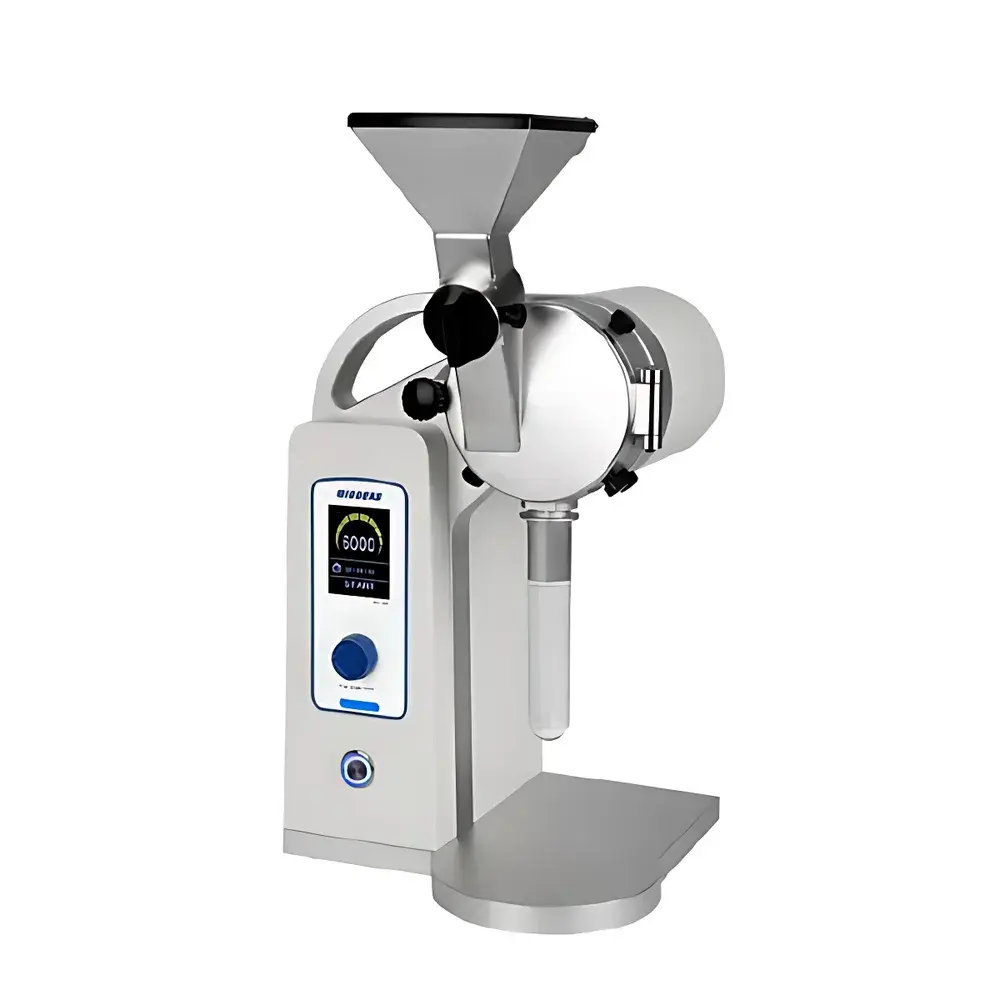
WIGGENS WMF10 Digital Ultra-Fine Grinder
| Brand | WIGGENS |
|---|---|
| Origin | Germany |
| Model | WMF10 |
| Instrument Type | Laboratory Grinder |
| Sample Suitability | Hard, Brittle & Fibrous Materials |
| Final Particle Size | <40 µm (dependent on material and sieve selection) |
| Batch Capacity | 300 mL |
| Grinding Head Options | Impact (hammer-type) & Shear (knife-type) |
| Sieve Aperture Range | 0.2–6 mm |
| Speed Range | 50–6000 rpm |
| Motor Power | 600 W |
| Display | TFT High-Brightness LCD |
| Control | Rotary Knob with Timer (0–120 min) |
| Protection Features | Overload, Overheat, Blockage, Lid-Interlocked Auto-Stop |
| Enclosure Material | ASTM A276 Grade 316L Stainless Steel |
| Noise Level | 70 dB(A) at 6000 rpm |
| IP Rating | IP20 |
| Dimensions (W×D×H) | 250 × 300 × 480 mm |
| Weight | 13 kg |
Overview
The WIGGENS WMF10 Digital Ultra-Fine Grinder is an engineered solution for reproducible, high-precision size reduction of diverse laboratory samples under controlled mechanical stress. It operates on dual grinding principles—impact comminution (via hardened hammer-type rotors) and shear fragmentation (via precision-ground knife-type rotors)—enabling selective particle size control across brittle, fibrous, and moderately tough matrices. The instrument’s core architecture integrates a fully welded 316L stainless steel grinding chamber, thermally treated cutting elements, and interchangeable sieve inserts conforming to ISO 3310-1 tolerances. Designed for routine QC, R&D, and sample preparation in pharmaceutical, food, agricultural, geological, and materials science laboratories, the WMF10 delivers consistent sub-40 µm output when paired with appropriate sieve geometry and process parameters—critical for downstream analytical techniques including XRD, SEM, laser diffraction, and dissolution testing.
Key Features
- Two interchangeable grinding head systems: impact rotor (for hard, brittle materials such as bone, stone, coffee beans, and amber) and shear rotor (for fibrous, elastic, or low-fat samples including dried plant tissue, leather, wool, paper, and synthetic polymers)
- TFT high-brightness LCD display with real-time speed, timer, and operational status feedback
- Stepless speed control from 50 to 6000 rpm via precision rotary encoder, enabling optimization of energy input per material class
- Integrated safety interlock: motor halts immediately upon lid opening, complying with EN 61010-1 functional safety requirements
- Comprehensive protection suite: thermal cut-off, electronic overload detection, and dynamic blockage sensing prevent mechanical damage and ensure operator safety
- Modular sieve system with certified aperture options from 0.2 mm to 6.0 mm; empirical correlation indicates final median particle size approximates 1/5 of selected sieve diameter (e.g., 0.2 mm sieve → ~40 µm d50)
- Dual-mode timer with countdown function (0–120 minutes), supporting both discrete batch processing and method validation protocols
Sample Compatibility & Compliance
The WMF10 accommodates heterogeneous solid samples ranging from desiccated biological tissues (e.g., freeze-dried meat, fish fins, feathers) to inorganic minerals (granite chips, calcined clays, ceramic shards) and polymeric compounds (PET flakes, epoxy residues, fiberglass fragments). Its 316L stainless steel construction meets FDA-recommended material standards for non-reactive sample contact surfaces and supports cleaning validation per GMP Annex 15. The device complies with EU Machinery Directive 2006/42/EC, Electromagnetic Compatibility Directive 2004/108/EC, and Low Voltage Directive 2014/35/EU. All electrical components are certified to EN 61010-1 (Safety Requirements for Electrical Equipment for Measurement, Control, and Laboratory Use) and EN 61326-1 (EMC for Laboratory Instruments). Routine operation falls within ISO 14644-1 Class 8 cleanroom-compatible noise limits (<70 dB(A)).
Software & Data Management
While the WMF10 operates via embedded firmware without external PC dependency, its digital interface provides traceable parameter logging—including speed setpoint, actual RPM, elapsed time, and fault codes—for GLP-compliant recordkeeping. All operational events (start/stop, lid open/close, error triggers) are timestamped and retained in non-volatile memory for audit review. Though not equipped with network connectivity or FDA 21 CFR Part 11–compliant electronic signatures, the unit supports manual data transcription into validated LIMS or ELN platforms. Method templates can be replicated using fixed speed/time/sieve combinations, ensuring inter-laboratory reproducibility when documented per ISO/IEC 17025 clause 7.2.2.
Applications
- Pharmaceutical pre-formulation: homogenization of active pharmaceutical ingredients (APIs) and excipients prior to tablet compression or dissolution testing
- Food safety analysis: preparation of composite grain, nut, and spice samples for mycotoxin screening (AOAC 2005.02) and heavy metal quantification (USP <232>)
- Agricultural research: milling of cereal grains, malt, and botanical extracts for NIR calibration model development
- Geological sample prep: pulverization of rock cores and soil aggregates for XRF and ICP-MS digestion protocols (EPA Method 6010D)
- Materials characterization: size reduction of recycled composites, carbon fibers, and thermoset resins for rheological and thermal analysis (ASTM D3800, D7028)
- Toxicology & forensic labs: standardized grinding of bone, teeth, and keratinous tissues for DNA extraction and elemental profiling
FAQ
What types of materials are incompatible with the WMF10?
Highly viscous, oily, or hygroscopic substances (e.g., fresh meat, wet clay, liquid resins) are unsuitable due to risk of rotor adhesion, sieve clogging, and thermal instability.
Can the WMF10 achieve true nanoscale particles?
No—it is optimized for micrometer-range comminution (d50 ≥ 10 µm); sub-100 nm processing requires planetary ball milling or jet milling technologies.
Is routine calibration required?
Speed calibration is factory-verified against NIST-traceable tachometry; no user recalibration is necessary unless subjected to mechanical impact or long-term voltage fluctuation.
How often should the grinding heads and sieves be replaced?
Hammer and knife rotors typically sustain >500 h of cumulative operation under standard loads; sieve wear is monitored visually—replacement recommended when aperture deviation exceeds ±5% of nominal dimension.
Does the unit support automated sample feeding or integration with robotic workstations?
Not natively; it is a manually loaded benchtop instrument. Integration requires third-party pneumatic or vibratory feed modules compliant with CE machinery directives.



