
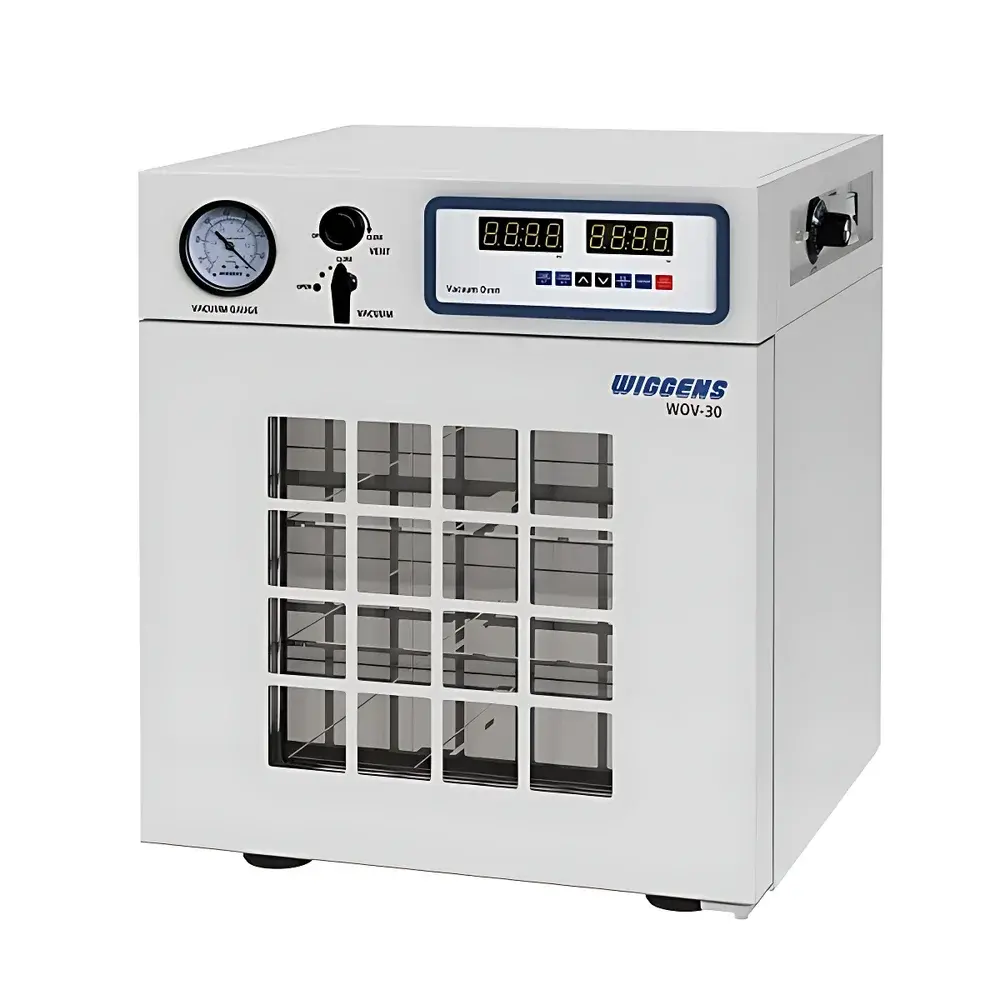
WIGGENS WOV-30 Vacuum Drying Oven
| Brand | WIGGENS |
|---|---|
| Origin | Germany |
| Model | WOV-30 |
| Instrument Type | Vacuum Oven |
| Temperature Range | Ambient +5 °C to 250 °C |
| Temperature Uniformity | ±0.1 °C at 100 °C |
| Chamber Dimensions (W×D×H) | 302 mm × 305 mm × 302 mm |
| External Dimensions (W×D×H) | 680 mm × 453 mm × 495 mm |
| Chamber Material | Stainless Steel (AISI 304) |
| Heating Method | Jacket-type Resistive Heating |
| Vacuum Range | 0 to −0.1 MPa (absolute) |
| Control Interface | PID-controlled Microprocessor with LED Touch Panel |
| Data Interface | RS232 Serial Port |
| Timer Range | 1 min to 99 hr 59 min |
| Display Resolution | 0.1 °C |
| Safety Features | Overtemperature Protection, Door-Open Alarm, Dual Independent Vacuum/Exhaust Ports |
| Viewing Window | Tempered Glass with Spring-Loaded Sealed Door & Silicone Gasket |
Overview
The WIGGENS WOV-30 Vacuum Drying Oven is an engineered solution for precise, solvent-free thermal processing under controlled reduced-pressure environments. Designed and manufactured in Germany, this vacuum oven operates on the fundamental principle of lowering the boiling point of volatile substances—such as solvents, moisture, or residual monomers—by reducing ambient pressure within a sealed stainless-steel chamber. This enables gentle drying, degassing, and heat treatment of thermally sensitive materials without oxidative degradation or structural compromise. Its jacket-type resistive heating system ensures uniform thermal distribution across the entire chamber volume, while the integrated PID microprocessor delivers rapid setpoint attainment and exceptional thermal stability—critical for applications requiring repeatability under GLP, ISO 17025, or pharmaceutical manufacturing (ICH Q5C) protocols.
Key Features
- PID-controlled microprocessor with intuitive LED touch interface and 0.1 °C display resolution for real-time monitoring and fine-tuned parameter adjustment
- Stainless steel (AISI 304) interior chamber (302 × 305 × 302 mm) offering corrosion resistance, cleanability, and long-term dimensional stability under repeated thermal cycling
- Independent vacuum and exhaust ports (both Ø10 mm), enabling rapid evacuation and controlled venting—reducing cycle time and improving process reproducibility
- Tempered glass viewing window with spring-loaded door mechanism and dual-lip silicone gasket, maintaining reliable vacuum integrity up to −0.1 MPa (absolute)
- Programmable timer (1 min – 99 hr 59 min) with auto-start/stop functionality and memory for up to three user-defined temperature profiles
- Comprehensive safety architecture including overtemperature cut-off, door-open vacuum interlock alarm, and thermal fuse redundancy
- RS232 serial port for direct data logging to external PCs—compatible with standard terminal emulators and custom LabVIEW or Python-based acquisition scripts
Sample Compatibility & Compliance
The WOV-30 accommodates a broad spectrum of sample types—including lyophilized biologicals, polymer films, ceramic precursors, pharmaceutical intermediates, and analytical standards—without risk of oxidation or thermal decomposition. Its chamber geometry and uniform heating profile support compliance with ASTM D2857 (moisture content in plastics), ISO 293 (thermoplastic sheet conditioning), and USP (loss on drying). The vacuum control range (0 to −0.1 MPa) meets requirements for low-residue solvent removal per ICH Q3C guidelines. While not certified for Class I Div 1 hazardous locations, the unit adheres to EN 61010-1:2019 safety standards for laboratory electrical equipment and carries CE marking for conformity with EU directives.
Software & Data Management
No proprietary software is required; the RS232 interface outputs ASCII-formatted timestamped records (temperature, setpoint, vacuum level, elapsed time) at user-selectable intervals. Raw serial logs can be parsed using open-source tools (e.g., PuTTY, Tera Term) or integrated into LIMS via Python’s pySerial library. Audit-trail-capable data capture is achievable when paired with FDA 21 CFR Part 11-compliant electronic lab notebooks (ELNs), provided timestamp synchronization and operator authentication are externally managed. Firmware supports firmware-level calibration offset storage—enabling traceable adjustments aligned with internal metrology procedures.
Applications
- Drying heat-labile APIs and excipients prior to tablet compression or capsule filling
- Removing residual solvents from coated stents, thin-film photovoltaic layers, or MEMS device substrates
- Accelerated aging studies of elastomers and adhesives under controlled humidity-free thermal stress
- Pre-conditioning reference standards for gravimetric moisture analysis (e.g., ASTM E1868)
- Outgassing of optical components and vacuum-compatible instrumentation prior to high-vacuum integration
- Thermal stabilization of nanomaterial dispersions and metal-organic frameworks (MOFs)
FAQ
What vacuum pump compatibility does the WOV-30 require?
The unit accepts standard two-stage rotary vane pumps with ultimate vacuum ≤5 × 10⁻² mbar and pumping speed ≥2 m³/h. Oil-free diaphragm pumps may be used for less demanding applications but will extend evacuation time significantly.
Is the temperature uniformity specification validated per ISO 17025?
The stated ±0.1 °C uniformity at 100 °C reflects factory verification using calibrated PT100 sensors at nine chamber locations per DIN 12880 Annex B. Full uncertainty budget documentation is available upon request for accredited calibration labs.
Can the WOV-30 be integrated into a central building management system (BMS)?
Direct BMS integration is not supported natively; however, third-party RS232-to-Modbus gateways enable read-only status monitoring (temperature, vacuum, fault codes) when deployed with compatible SCADA infrastructure.
Does the oven support nitrogen purging?
While not equipped with a dedicated inert gas inlet, users may manually introduce nitrogen via the exhaust port during venting cycles—provided pressure differentials remain within safe operational limits (<0.02 MPa gauge). A custom gas manifold kit is available as optional accessory (Part No. W607-NGK1).
What maintenance intervals are recommended for long-term reliability?
Silicone door gaskets should be inspected quarterly and replaced annually or after 500 vacuum cycles. Heating jacket insulation integrity is verified biannually via thermal imaging during routine IQ/OQ validation. Vacuum port O-rings require replacement every 18 months under continuous use.



