
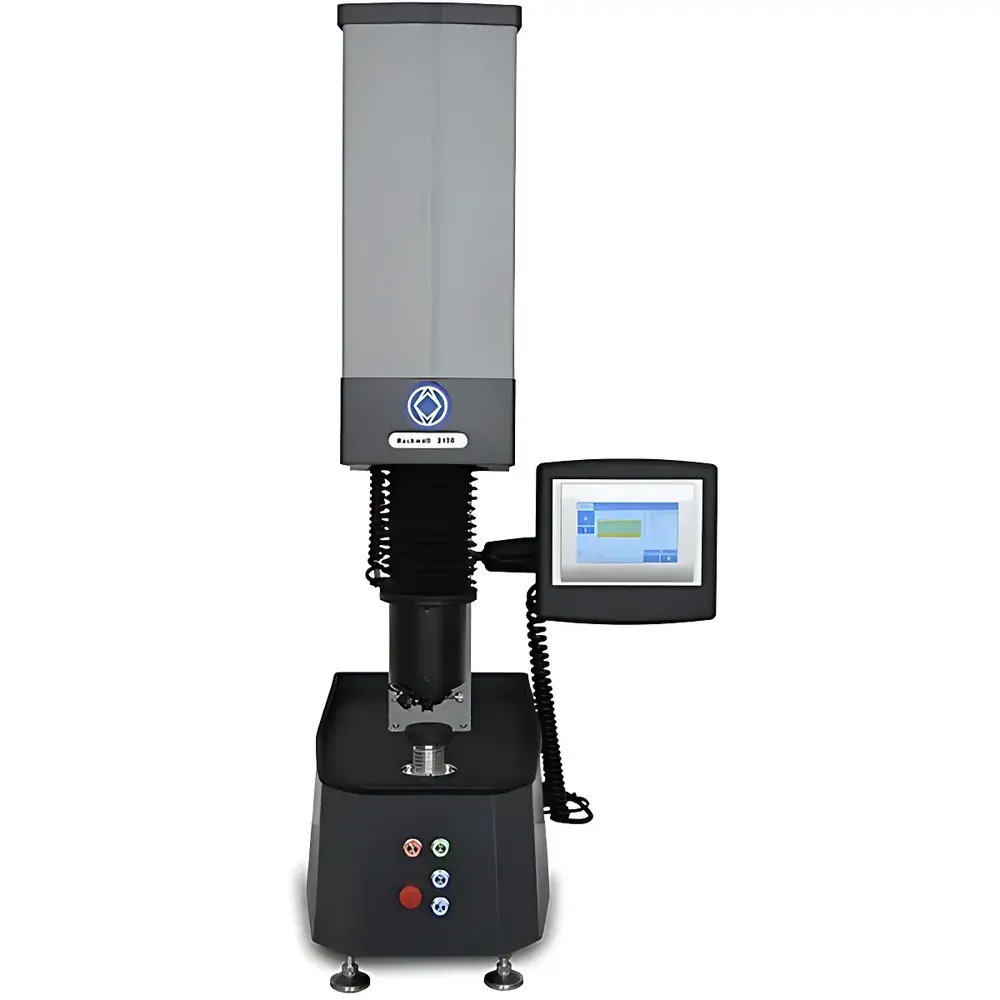
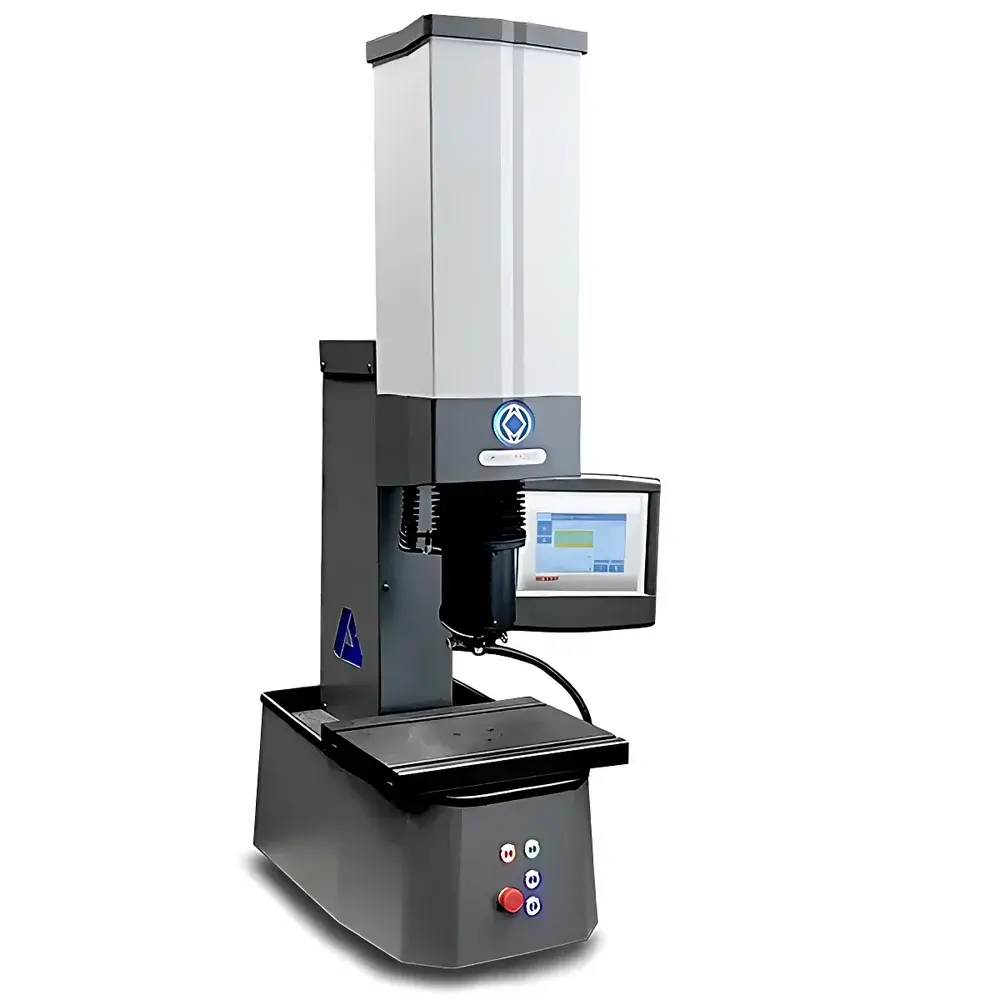
Wilson RH2150 Rockwell Hardness Tester
| Brand | Wilson Hardness |
|---|---|
| Origin | USA |
| Manufacturer | Wilson Instruments (A Buehler Company) |
| Model | RH2150 |
| Rockwell Scale Range | 10–100 HR |
| Total Test Force | 1–187.5 kgf (9.81–1838.7 N) |
| Maximum Specimen Height | 254 mm (10 in) or 356 mm (14 in) |
| Depth of Test Zone | 200 mm |
| Z-axis Travel | Motorized, Programmable |
| Test Space (H × D) | 254 mm × 200 mm |
| Compliance | ISO 6508-1, ASTM E18, ISO 2039-1/2, DIN 51917 |
| Control Interface | 7″ Touchscreen Panel with DiaMet™ Software Integration |
| Data Export | USB, Ethernet |
| Clamp Force (Optional) | 55 kgf |
| Net Weight | 125 kg |
| Power Supply | 110–240 VAC, 50–60 Hz |
Overview
The Wilson RH2150 Rockwell Hardness Tester is a precision-engineered, production-grade hardness measurement system designed for high-throughput laboratories and industrial quality control environments. It operates on the principle of depth-sensing indentation under controlled load application—measuring the permanent depth of penetration made by a standardized indenter (diamond cone or hardened steel/tungsten carbide ball) under major and minor loads. This method conforms to the fundamental mechanics defined in ASTM E18 and ISO 6508-1, ensuring traceable, repeatable, and internationally recognized Rockwell hardness values across 30+ scales—including conventional (HRA, HRB, HRC), superficial (15N–45Y), plastic (HRR, HRL), and electrocarbon (HR2.5, HR5, HR10) variants. The RH2150 integrates closed-loop force feedback via high-resolution load cells and motorized Z-axis positioning, eliminating mechanical hysteresis and enabling precise load ramping, dwell timing, and unloading profiles. Its dual-load configuration (1–187.5 kgf or 10–187.5 kgf) supports both surface-hardness evaluation of thin coatings and bulk-material characterization of forgings, castings, and heat-treated components.
Key Features
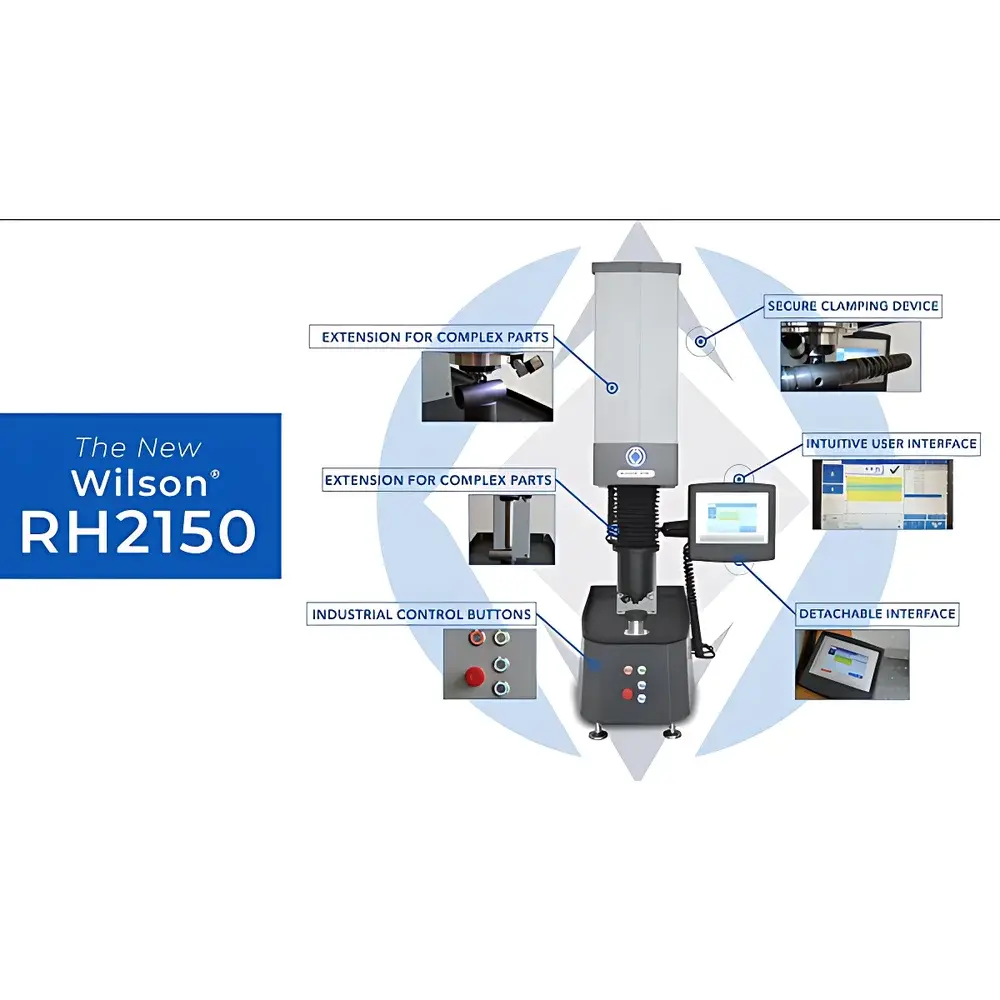
- Motorized Z-axis with programmable travel and real-time position feedback for consistent indenter approach and retraction.
- Quick-change indenter mount with standardized ISO-compliant holders for 120° diamond cones and tungsten carbide balls (1/16″, 1/8″, 1/4″, 1/2″; HBW 1, 2.5, 5, 10 mm).
- 7-inch high-brightness touchscreen control panel with tactile physical buttons for manual operation—fully detachable for ergonomic placement during large-part testing.
- Integrated LED work area illumination with adjustable intensity, precisely focused on the indentation zone to ensure optical clarity during manual alignment or post-test verification.
- Optional pneumatic/hydraulic sample clamping system (55 kgf clamping force) with footswitch programmability—supporting pre-test clamp + manual/auto test initiation, and post-test manual/auto release sequences.
- Extendable indenter rods (2″, 4″, 6″) compatible with clamp collars, enabling access to recessed or contoured surfaces without compromising force vector alignment.
- Standard 19 mm T-slot base pattern on the anvil plate—interchangeable with Wilson RB2000 and R574 accessories for lab-wide hardware consistency.
- Robust all-metal frame with fully encapsulated load sensor assembly, providing mechanical protection against accidental impact and long-term drift resistance.
Sample Compatibility & Compliance
The RH2150 accommodates specimens up to 50 kg mass (centered on the anvil), with maximum vertical clearance of 254 mm (10 in) or 356 mm (14 in), and horizontal reach of 200 mm from the centerline. Its modular anvil system supports flat, V-groove, and custom fixtures—including hydraulic jacks and rotary stages (optional). All test protocols adhere strictly to regulatory and industry standards: ASTM E18 (Metallic Materials), ISO 6508-1 (Rockwell), ISO 2039-1/2 (Plastics), and DIN 51917 (Electrocarbon). The system meets GLP/GMP documentation requirements through DiaMet™ software’s audit-trail-enabled data logging, user-access controls, and electronic signature support compliant with FDA 21 CFR Part 11. Indentation geometry and force calibration are verified using NIST-traceable Wilson-certified reference blocks, with automated indirect verification routines embedded in the firmware.
Software & Data Management
DiaMet™ software serves as the central interface for test method definition, statistical analysis, and report generation. Running on an embedded Linux OS, it enables full customization of test sequences—including multi-scale runs, sequential indentations, and conditional branching based on prior results. Statistical outputs include mean, standard deviation, Cpk, histogram distribution, and trend charts—all exportable in CSV, PDF, or XML formats. Data integrity is preserved via time-stamped, user-logged entries with tamper-evident digital signatures. USB and Ethernet connectivity allow direct transfer to network drives or LIMS integration. Optional cloud-based remote monitoring permits real-time machine status review and predictive maintenance alerts based on actuator cycle counts and thermal drift logs.
Applications
- Automotive: Verification of case-hardened gears, camshafts, and brake components per SAE J417 and AIAG CQI-9 requirements.
- Aerospace: Batch qualification of turbine blades, landing gear alloys, and fasteners per AMS 2242 and Nadcap AC7101.
- Medical Device Manufacturing: Surface hardness validation of stainless steel implants and nitrided orthopedic tools under ISO 148-1 and ASTM F2129.
- Tool & Die Shops: In-process monitoring of HSS and carbide tooling after heat treatment and grinding cycles.
- Academic Research: Correlation studies between Rockwell hardness and tensile strength, microstructural phase mapping, and coating adhesion assessment via hardness gradient profiling.
FAQ
Does the RH2150 support automated hardness mapping across large-area samples?
Yes—when integrated with optional X-Y motorized stages and DiaMet™ Advanced Mapping Module, the system performs grid-based indentation arrays with positional repeatability ≤ ±2 µm.
Can test methods be password-protected to prevent unauthorized modification?
Yes—DiaMet™ implements role-based access control (Operator, Technician, Administrator) with encrypted method storage and change-log tracking.
Is calibration verification required before each shift?
Per ISO/IEC 17025 and internal QA protocols, daily indirect verification using certified reference blocks is recommended; full recalibration is performed annually or after impact events.
What is the typical warm-up time before achieving measurement stability?
The system reaches thermal equilibrium within 30 minutes of power-on under ambient conditions of 23 ± 2°C and ≤60% RH.
Are third-party hardness blocks compatible with the RH2150?
Only NIST-traceable blocks certified to ASTM E18 Annex A1 or ISO 6508-2 specifications are supported; non-certified blocks void warranty and invalidate compliance reporting.



