
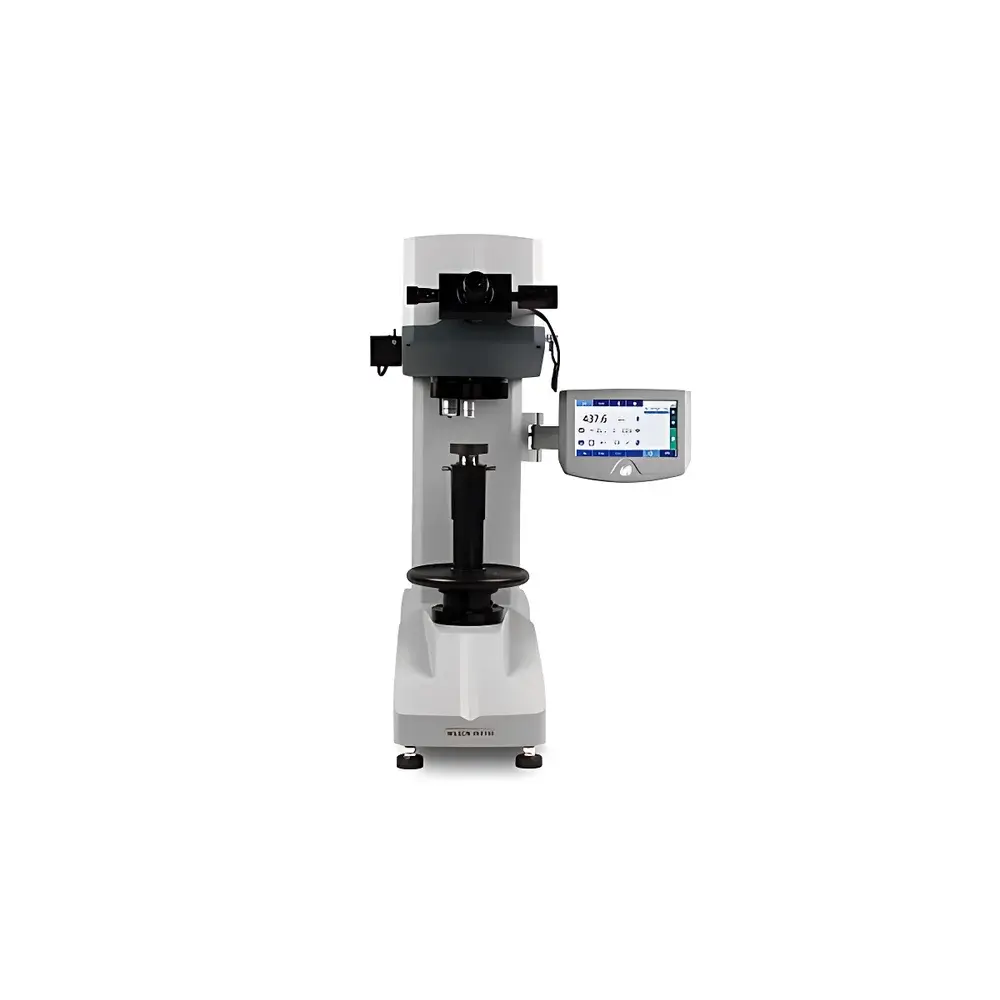
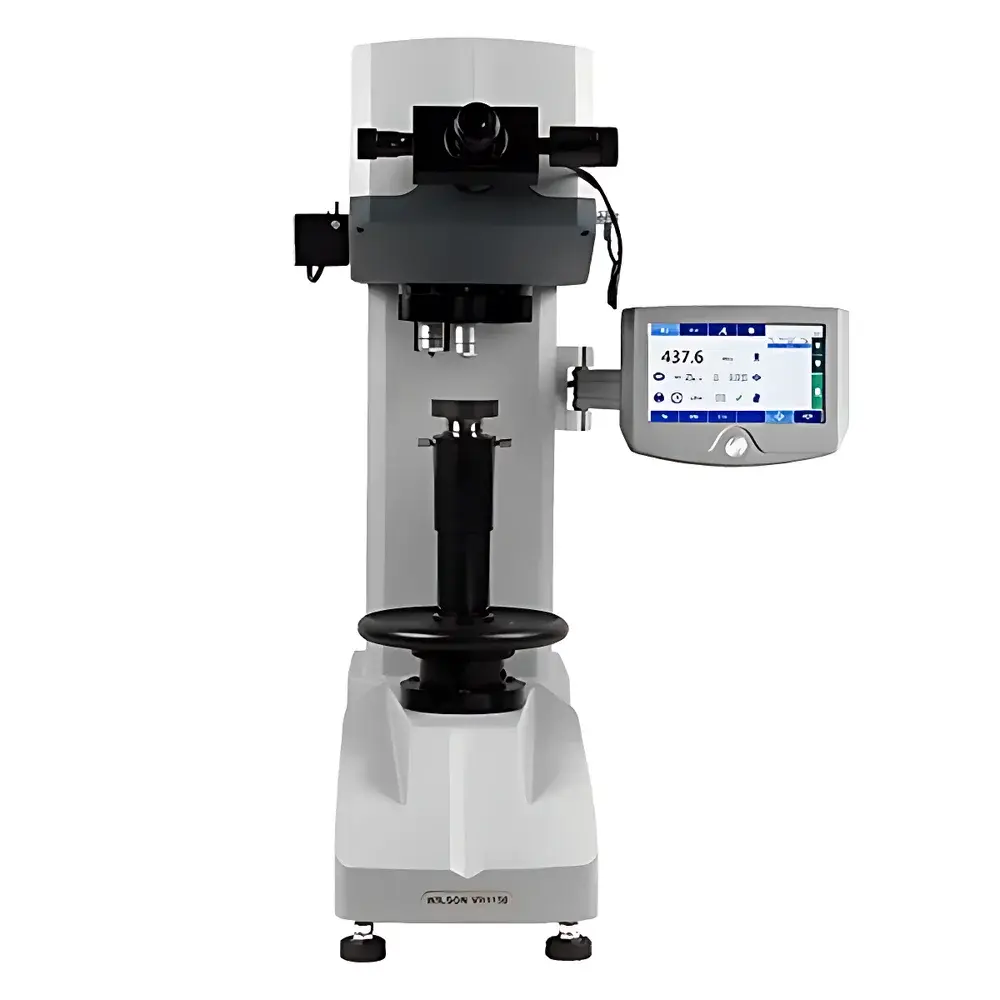
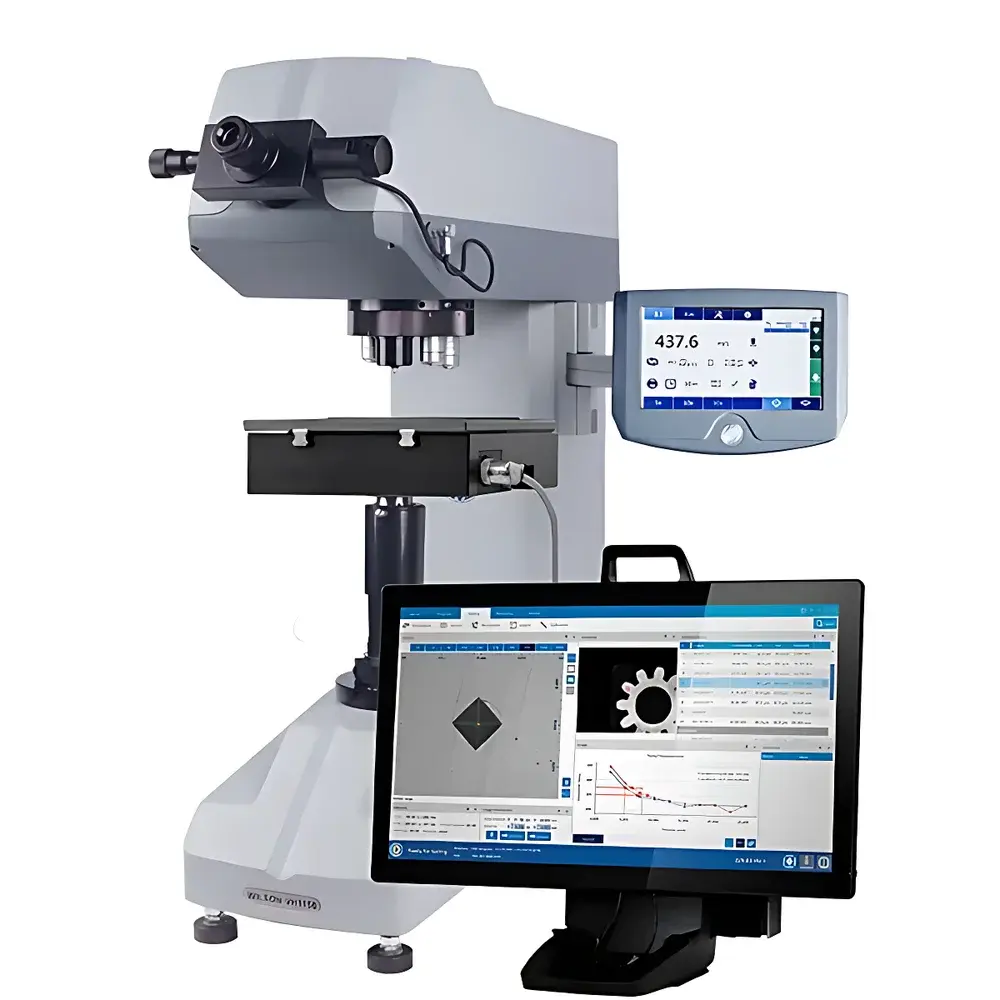
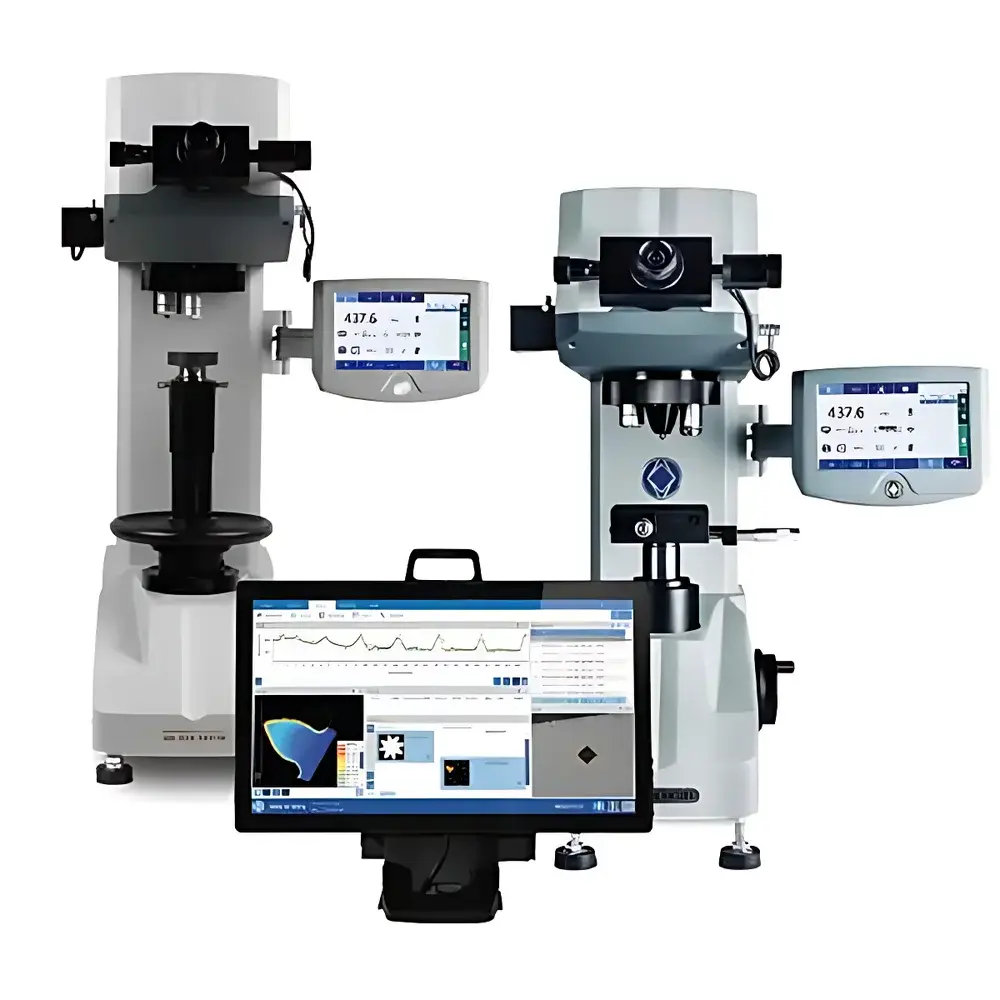
Wilson VH1150 Macro Vickers Hardness Tester
| Brand | Wilson Hardness |
|---|---|
| Origin | USA |
| Manufacturer | Wilson Instruments (A Division of ITW) |
| Model | VH1150 |
| Hardness Scale | Vickers (HV) and Knoop (HK) |
| Load Range | 0.3–50 kgf (2.94–490.3 N) |
| Test Force Accuracy | ±0.5% of full scale per ASTM E10 and ISO 6507-2 |
| Indentation Measurement Resolution | 0.1 µm |
| Optical Magnification | 10×, 20×, 50×, 100× (optional) |
| Test Height Clearance | 210 mm (H) × 160 mm (D) |
| Turret | 5-position automatic revolver (4 objective positions + 1 indenter position) |
| Display | 7″ capacitive touchscreen with Smart UI interface |
| Data Output | USB 2.0 port |
| Compliance | ASTM E92, ASTM E384, ISO 6507-1/2/3/4, JIS Z2244, GB/T 4340.1–4340.4 |
| Hardness Conversion | Integrated HV/HK ↔ HRB/HRC/HBW/UTS per ASTM E140 and ISO 18265 |
Overview
The Wilson VH1150 Macro Vickers Hardness Tester is an engineered precision instrument designed for standardized macro-scale hardness evaluation of metallic, ceramic, and composite materials in quality control, metallurgical research, and production environments. It operates on the principle of Vickers indentation hardness measurement: a diamond pyramid indenter (136° apex angle) is applied under controlled static load for a defined dwell time (typically 10–15 s), and the resulting diagonal lengths of the permanent impression are optically measured to calculate hardness according to HV = 0.1891·F/d² (where F is load in kgf and d is mean diagonal in mm). The system also supports Knoop microhardness testing (HK) using a rhombic pyramidal indenter, enabling anisotropic material characterization. With a load range spanning 0.3 kgf to 50 kgf — covering HV0.3 through HV50 and HK0.3 through HK50 — the VH1150 bridges the gap between microhardness testers and large-capacity Brinell systems, delivering traceable, repeatable results aligned with international metrological requirements.
Key Features
- Five-position automated turret: Precision-machined revolver enables silent, repeatable positioning of up to four objectives (standard 10× and 20× long-working-distance lenses; optional 5× wide-field, 50×, or 100×) and one indenter (Vickers or Knoop), fully integrated into programmable test cycles.
- Touchscreen-controlled load selection: Eliminates mechanical load-selection knobs; all test forces from 0.3 kgf to 50 kgf are selected via intuitive tap interface, reducing operator-induced variability and supporting GLP-compliant audit trails.
- Optical metrology subsystem: High-resolution optical path with parfocal lens design ensures consistent focus across magnifications; optional internal-mounted digital camera (not externally coupled) provides dust-resistant, alignment-stable imaging for automated diagonal measurement and image archiving.
- Smart UI interface: 7″ capacitive touchscreen delivers 50% increased visible area versus prior-generation interfaces; tab-based navigation streamlines test setup, statistical analysis, and calibration without nested menus; mechanical shortcut keys (e.g., “Indent”, “Turret”, “Brightness”) ensure long-term tactile reliability.
- Geometric compensation algorithms: Built-in curvature correction compensates for convex or concave specimen surfaces per ASTM E384 Annex A3, maintaining measurement fidelity on cylindrical shafts, bearing races, or turbine blades without manual offset adjustment.
- Eco-Power standby mode: Automatically reduces power consumption during idle periods while preserving calibration state and network connectivity — critical for labs operating under ISO/IEC 17025 energy management protocols.
Sample Compatibility & Compliance
The VH1150 accommodates specimens up to 210 mm in height and 160 mm in depth, supporting standard metallographic mounts, raw forgings, weld cross-sections, and coated components. Its modular base plate allows tilt-angle adjustment (±15°) for ergonomic access during extended testing sessions. All hardness values are traceable to NIST SRM reference blocks and certified per ASTM E92 (Vickers) and ASTM E384 (Knoop/microhardness). The system meets ISO 6507-1 (test method), ISO 6507-2 (verification), ISO 6507-3 (reference blocks), and ISO 6507-4 (uncertainty calculation), and supports FDA 21 CFR Part 11-compliant electronic records when paired with validated LIMS integration. Hardness conversions to Rockwell (HRB/HRC), Brinell (HBW), and tensile strength (UTS) follow ASTM E140 and ISO 18265, with uncertainty propagation documented in the exported CSV metadata.
Software & Data Management
Data acquisition and reporting are managed via the embedded Smart UI firmware, which stores all test parameters (load, dwell time, magnification, operator ID, timestamp) and calculated results (HV/HK value, diagonals, standard deviation) in non-volatile memory. One-touch USB export generates ISO-compliant CSV files containing raw pixel measurements, calibrated diagonal lengths (µm), hardness values, and statistical aggregates (mean, SD, min/max, CV%). Files open natively in Microsoft Excel, MATLAB, or Minitab for SPC charting and ANOVA. Optional software modules enable Gage R&R studies, CPK/PPK capability analysis, and automated PDF report generation with lab logo, test certificate header, and digital signature fields — fully auditable for ISO 17025 accreditation and automotive PPAP submissions.
Applications
- Heat treatment verification of alloy steels, tool steels, and stainless grades (e.g., AISI 4140 quench-and-temper validation)
- Case depth profiling of carburized or nitrided components using sequential HV0.3–HV10 loads on cross-sectioned samples
- Quality assurance of additive-manufactured (AM) metal parts where bulk hardness correlates with porosity and build-layer integrity
- Failure analysis of fracture surfaces, inclusion mapping, and intermetallic phase hardness differentiation in aluminum and titanium alloys
- Coating adhesion assessment via progressive-load indentation (e.g., HV0.3 → HV5) to detect cohesive vs. adhesive failure modes
- Calibration laboratory use as a primary hardness reference instrument for transfer standards and inter-laboratory comparison programs
FAQ
Does the VH1150 support both Vickers and Knoop hardness testing?
Yes — the system accepts interchangeable Vickers (136°) and Knoop (172.5°/130°) diamond indenters, with automatic recognition and scale-specific calibration routines stored in firmware.
Is the internal digital camera required for automated measurement?
The camera is optional but strongly recommended for repeatable, operator-independent diagonal measurement; manual measurement via eyepiece reticle remains supported for legacy workflows.
Can test data be exported directly to a networked LIMS or ERP system?
While native network export requires optional Ethernet-enabled firmware upgrade, CSV files generated via USB are structured for seamless ingestion by common LIMS platforms (e.g., LabWare, STARLIMS) via scheduled import scripts.
What maintenance intervals are specified for ISO 17025 compliance?
Annual verification against certified reference blocks (e.g., NIST SRM 2822, 2823) and biannual mechanical inspection of load train and turret repeatability are required; full calibration certificates include uncertainty budgets per ISO/IEC 17025 Clause 6.5.
Is the VH1150 compatible with third-party automation integrations (e.g., robotic sample handling)?
Yes — RS-232 and Ethernet TCP/IP command sets are documented in the Programmer’s Manual; OEM-level API support is available under NDA for integration with gantry robots or conveyor-fed staging systems.



