
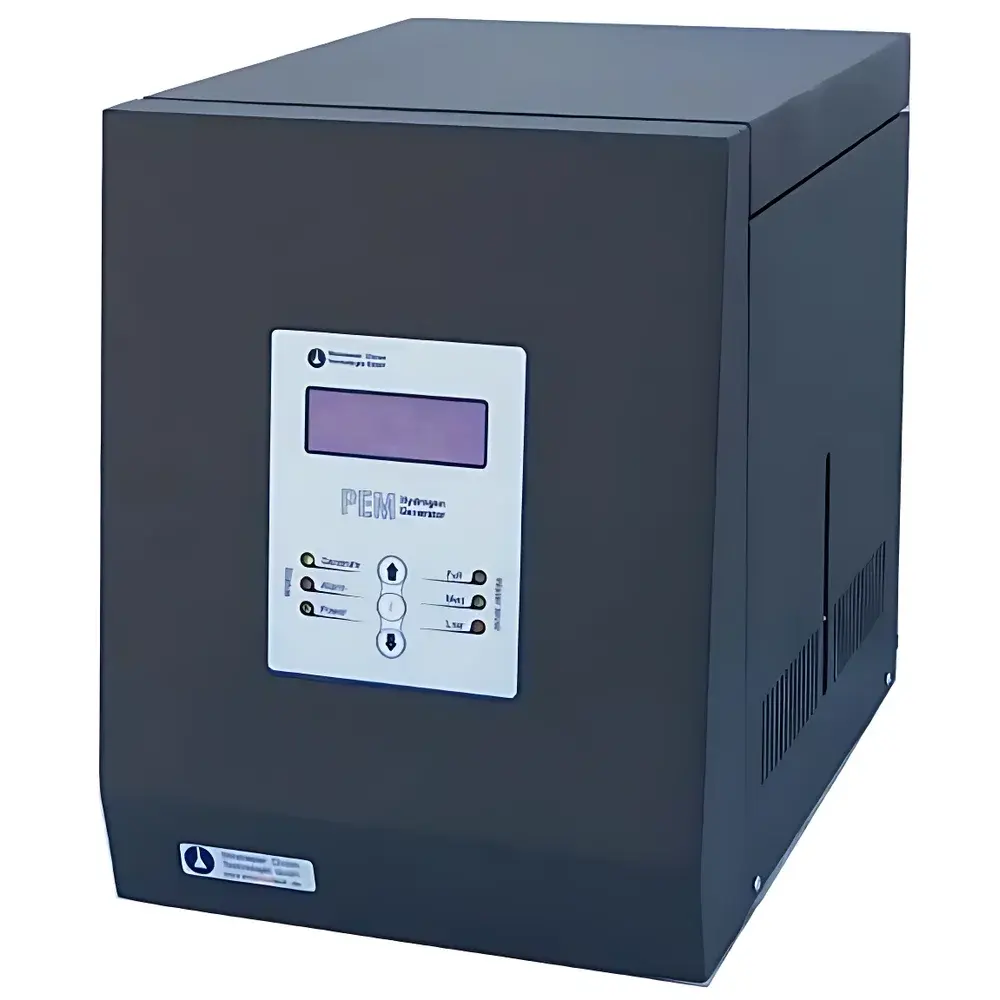
Winchester WHG EHG Hydrogen Generator
| Origin | Germany |
|---|---|
| Manufacturer Type | Authorized Distributor |
| Origin Category | Imported |
| Model | EHG |
| Price Range | USD 7,000 – 14,000 (FOB) |
| Hydrogen Generation Principle | Pure Water Electrolysis (PEM Membrane Technology) |
| Output Flow Rate | 350 mL/min |
| Output Pressure | 90 psi (6.2 bar) |
| Hydrogen Purity | 99.9995% (5.5 N) |
| Power Consumption | 150 W |
| Water Resistivity Requirement | ≥1 MΩ·cm (Deionized or Double-Distilled Water) |
| Input Voltage | 220 V AC |
| Dimensions (W×D×H) | 27 × 38.5 × 36.5 cm |
| Net Weight | 11 kg |
| Shipping Weight | 18 kg |
| Warranty | 12 months |
| Service Life (Maintenance Interval) | 10 years |
Overview
The Winchester WHG EHG Hydrogen Generator is a compact, laboratory-grade on-demand hydrogen source engineered for precision gas supply in analytical instrumentation—including gas chromatography (GC), GC–MS, and hydrogenation reactors. It employs proton exchange membrane (PEM) electrolysis of high-purity deionized water to generate ultra-high-purity hydrogen without the need for metal hydride cartridges, compressed gas cylinders, or external gas purification columns. Unlike alkaline electrolyzers, the PEM-based architecture delivers rapid start-up (<2 min), zero hydrocarbon contamination, and inherently stable output pressure—critical for flame ionization detectors (FID) and thermal conductivity detectors (TCD) requiring consistent stoichiometric H2/air ratios. The system operates autonomously once filled with ≥1 MΩ·cm water, eliminating operator intervention during routine analysis. Its sealed, corrosion-resistant stainless-steel fluidic path ensures long-term reliability under continuous operation at up to 350 mL/min and 90 psi (6.2 bar) backpressure—fully compatible with modern GC oven configurations and capillary column inlet pressures.
Key Features
- PEM electrolysis core with iridium–platinum anode/cathode catalysts for >10,000 hours of stable operation
- Digital pressure regulation with closed-loop feedback control, maintaining ±1 psi stability across flow variations
- Integrated water level sensor and dry-run protection circuitry to prevent membrane desiccation
- Front-panel programmable interface with real-time display of flow rate, pressure, water level, and system status
- No consumables required beyond deionized water; no KOH solution handling or periodic electrolyte replacement
- Low thermal signature (150 W nominal draw) and passive cooling design suitable for benchtop placement in temperature-controlled labs
- CE-marked, compliant with IEC 61010-1:2010 for electrical safety in laboratory environments
Sample Compatibility & Compliance
The EHG is designed exclusively for use with ultrapure water (≥1 MΩ·cm resistivity), eliminating silica, sodium, and organic contaminants that could degrade PEM performance or introduce trace impurities into the H2 stream. It meets ASTM D4083–22 requirements for hydrogen purity in GC carrier and fuel gas applications. The 99.9995% (5.5 N) purity specification includes verified limits: O2 < 0.5 ppmv, H2O < 1 ppmv, total hydrocarbons < 0.1 ppmv, and particulates < 0.1 µm. The unit supports GLP-compliant workflows via optional RS-232/USB data logging and satisfies baseline requirements for FDA 21 CFR Part 11 when paired with validated LIMS integration.
Software & Data Management
While the EHG operates as a standalone instrument, its embedded microcontroller supports ASCII-based serial communication (9600 baud, N-8-1) for remote monitoring of operational parameters—including cumulative runtime, water consumption estimates, and fault codes. Third-party software (e.g., LabVIEW, Python pySerial) can poll status registers at user-defined intervals. Audit trail functionality is enabled through timestamped event logging (power-on, pressure alarm, low-water alert), stored internally for up to 30 days. No proprietary drivers or cloud dependencies are required.
Applications
- Fuel gas supply for GC-FID and GC-TCD systems, replacing cylinder-based H2 with improved safety and repeatability
- Carrier gas alternative in specialized GC methods where helium scarcity or cost drives H2-based separation optimization
- Hydrogen feed for catalytic hydrogenation reactors requiring precise, pulse-free flow delivery
- Calibration gas generation in environmental monitoring labs performing EPA Method 8260C (VOC analysis)
- On-site H2 supply for portable FTIR or Raman spectrometers equipped with hydrogen-cooled detectors
FAQ
What water quality is mandatory for optimal PEM membrane longevity?
Deionized or double-distilled water with resistivity ≥1 MΩ·cm (measured at 25 °C) is required. Conductivity must remain below 1 µS/cm. Tap water, distilled-only water, or water from non-certified purification systems will cause irreversible membrane fouling.
Can the EHG operate continuously for 24/7 unattended use?
Yes—designed for uninterrupted operation up to 8,760 hours/year. The integrated water reservoir (2.5 L capacity) supports ~12 hours of full-load output (350 mL/min); automated low-level shutdown prevents dry operation.
Is external pressure regulation needed before connecting to a GC inlet?
No. The built-in pressure regulator maintains stable 90 psi output within ±1 psi tolerance, eliminating the need for secondary regulators or needle valves in most GC configurations.
How often does maintenance occur over its 10-year service life?
Annual visual inspection and water system flush are recommended. No scheduled part replacements are required under normal operating conditions per manufacturer’s MTBF analysis.
Does the unit comply with ISO/IEC 17025 calibration traceability requirements?
While the EHG itself is not a measuring instrument, its output pressure and flow are factory-verified against NIST-traceable standards. Certificate of Conformance (CoC) and test reports are supplied with each unit.
Related Products



