
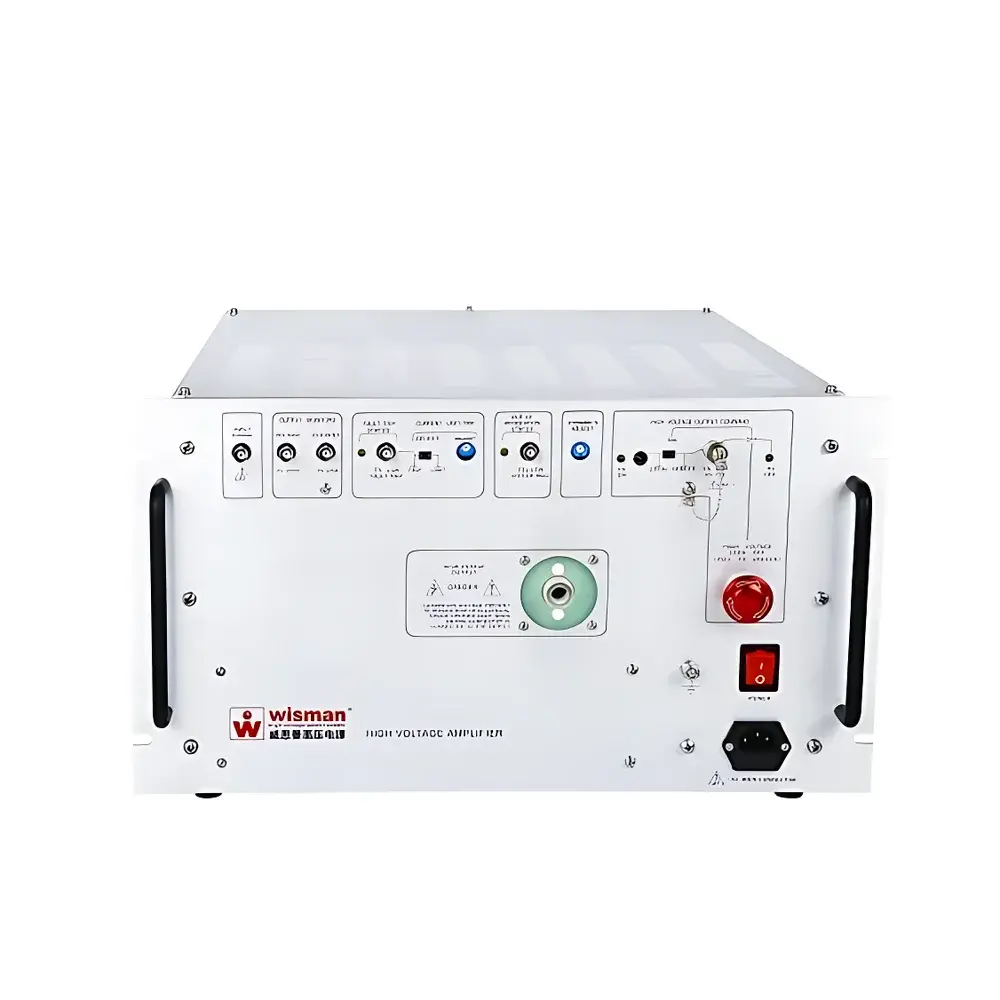
Wiseman AMW ±20 kV / 400 W High-Voltage Power Amplifier
| Brand | Wiseman |
|---|---|
| Origin | Shaanxi, China |
| Model | AMW |
| Output Voltage | ±20 kV DC or AC peak |
| Output Power | 400 W |
| Output Current | ±20 mA DC or AC peak |
| Input Range | ±10 V DC or AC peak |
| Gain | 2000 V/V (DC) |
| Gain Accuracy | < ±0.1% of full scale |
| Output Noise | < 1.5 Vrms |
| Slew Rate | > 450 V/µs (10–90%) |
| Large-Signal Bandwidth | DC to > 7.5 kHz (–3 dB), DC to > 3.75 kHz (1% THD) |
| Small-Signal Bandwidth | DC to > 20 kHz (–3 dB) |
| Stability | < 50 ppm/hr (non-cumulative) |
| Tempco | < 25 ppm/°C |
| Operating Temp | 0–40 °C |
| Humidity | ≤85% RH, non-condensing |
| Altitude | ≤2000 m |
| Dimensions | 264 × 483 × 635 mm (H×W×D) |
| Weight | 25 kg |
| Input Impedance | 25 kΩ |
| Output Impedance | 47 Ω |
| Display Resolution | Voltage: 2000:1 (0.1% FS accuracy) |
| Current | 1 V / 6 mA (0.5% FS accuracy) |
Overview
The Wiseman AMW ±20 kV / 400 W High-Voltage Power Amplifier is a precision-engineered, fully solid-state instrument designed for demanding scientific and industrial applications requiring stable, low-noise, high-slew-rate bipolar high-voltage excitation. Based on four-quadrant active output architecture, the AMW delivers true bidirectional current sourcing and sinking across its entire ±20 kV output range—enabling accurate dynamic control of highly capacitive, reactive, or nonlinear loads without signal distortion or instability. Its operational principle relies on high-fidelity analog amplification with ultra-low drift topology, making it suitable for closed-loop electrostatic actuation, real-time biasing in material characterization systems, and synchronized modulation in mass spectrometry front-end instrumentation. Unlike transformer-based or switched-mode HV supplies, the AMW’s linear solid-state design ensures sub-millisecond transient response, minimal harmonic content, and compatibility with sensitive measurement subsystems where grounding integrity and electromagnetic compatibility (EMC) are critical.
Key Features
- Four-quadrant active output stage supporting simultaneous voltage generation and current regeneration into resistive, capacitive, or inductive loads
- Programmable DC- or AC-coupled operation with ±20 kV maximum output (DC or AC peak) and ±20 mA current capability
- High-fidelity analog gain of 2000 V/V (±0.1% full-scale accuracy) with input sensitivity of ±10 V
- Ultra-low output noise (<1.5 VRMS) and exceptional stability (<50 ppm/hr, non-cumulative)
- Wide dynamic bandwidth: DC to >20 kHz (small-signal, –3 dB), DC to >7.5 kHz (large-signal, –3 dB), and DC to >3.75 kHz at 1% total harmonic distortion
- Fast slew rate (>450 V/µs, 10–90%) enabling precise step-response fidelity for pulsed electrostatic fields
- Integrated analog voltage and current monitoring outputs with calibrated scaling (2000:1 for voltage; 1 V per 6 mA for current)
- Robust thermal management and conformal-coated PCB layout ensuring continuous 400 W dissipation under ambient temperatures up to 40 °C
- Front-panel LED indicators and rear-panel BNC/SMA connectors compliant with standard laboratory interlock and safety protocols
Sample Compatibility & Compliance
The AMW amplifier is routinely deployed in environments governed by ISO/IEC 17025-accredited testing laboratories and GLP-compliant research facilities. Its electrical isolation, creepage/clearance design, and CE-marked safety architecture meet IEC 61010-1:2010 requirements for measurement, control, and laboratory equipment. The unit supports integration into FDA-regulated analytical workflows—including electrospray ionization (ESI) and atmospheric pressure chemical ionization (APCI) stages of mass spectrometers—where traceable, auditable bias voltage delivery is required. While not inherently 21 CFR Part 11 compliant as a standalone device, its analog interface architecture allows seamless connection to validated data acquisition systems that implement electronic signatures, audit trails, and user access controls. It is compatible with standard high-voltage cables (e.g., SHV, MHV), Faraday-shielded enclosures, and vacuum feedthroughs used in surface science, plasma physics, and ferroelectric hysteresis measurement setups.
Software & Data Management
The AMW operates as an analog-controlled instrument and does not include embedded firmware or digital communication interfaces (e.g., USB, Ethernet, or GPIB). This design prioritizes signal integrity, EMI immunity, and deterministic latency—critical for real-time feedback loops in electro-optic modulators or particle beam steering systems. Users integrate the amplifier via standard ±10 V analog inputs from external DAQ systems (e.g., National Instruments PXI, Keysight M9000 series, or custom FPGA-based controllers). Voltage and current monitor outputs provide real-time analog telemetry for synchronization with oscilloscopes, lock-in amplifiers, or time-resolved spectroscopy platforms. For traceable calibration records, users may log monitor signals alongside reference multimeter readings in accordance with ISO/IEC 17025 clause 6.6 (Measurement Traceability) and ASTM E2586-23 (Standard Guide for Statistical Analysis).
Applications
- Electrostatic beam deflection and focusing in electron/ion optics and accelerator test benches
- Bias voltage supply for time-of-flight (TOF) and quadrupole mass spectrometers
- Polarization control in ferroelectric and piezoelectric thin-film characterization (e.g., PUND, butterfly loop, and switching spectroscopy)
- High-voltage excitation for dielectric barrier discharge (DBD) reactors and atmospheric plasma jets
- Electrophoretic force calibration in optical tweezers and atomic force microscopy (AFM) electrostatic actuators
- Active electrode biasing in electro-optic modulators (LiNbO3, KTP) and spatial light modulators (SLMs)
- Current-rheological (ER) and magneto-rheological (MR) fluid actuation under closed-loop PID control
- Material breakdown strength testing and partial discharge inception voltage (PDIV) mapping
FAQ
Is the AMW amplifier compatible with mass spectrometer OEM interfaces?
Yes—the AMW accepts standard ±10 V analog control signals and provides isolated monitor outputs, enabling direct integration with vendor-specific HV bias modules in Thermo Fisher, Waters, Agilent, and Shimadzu MS platforms.
Does the unit support AC waveform generation?
It operates in AC-coupled mode with input frequencies up to 20 kHz (small-signal) and can reproduce arbitrary waveforms provided by external function generators or arbitrary waveform generators (AWGs).
What safety certifications does the AMW hold?
The amplifier complies with IEC 61010-1:2010 for laboratory equipment, including reinforced insulation, double insulation marking, and overcurrent/short-circuit protection per clause 6.5.2.
Can it drive highly capacitive loads such as piezoelectric stacks?
Yes—its four-quadrant output architecture actively sinks current during voltage transitions, preventing voltage overshoot and enabling stable operation with capacitances exceeding 100 nF.
Is remote monitoring of output parameters possible?
Voltage and current monitor outputs are provided as calibrated analog signals (BNC), allowing connection to SCADA systems, PLCs, or data loggers for continuous health monitoring and preventive maintenance logging.



