
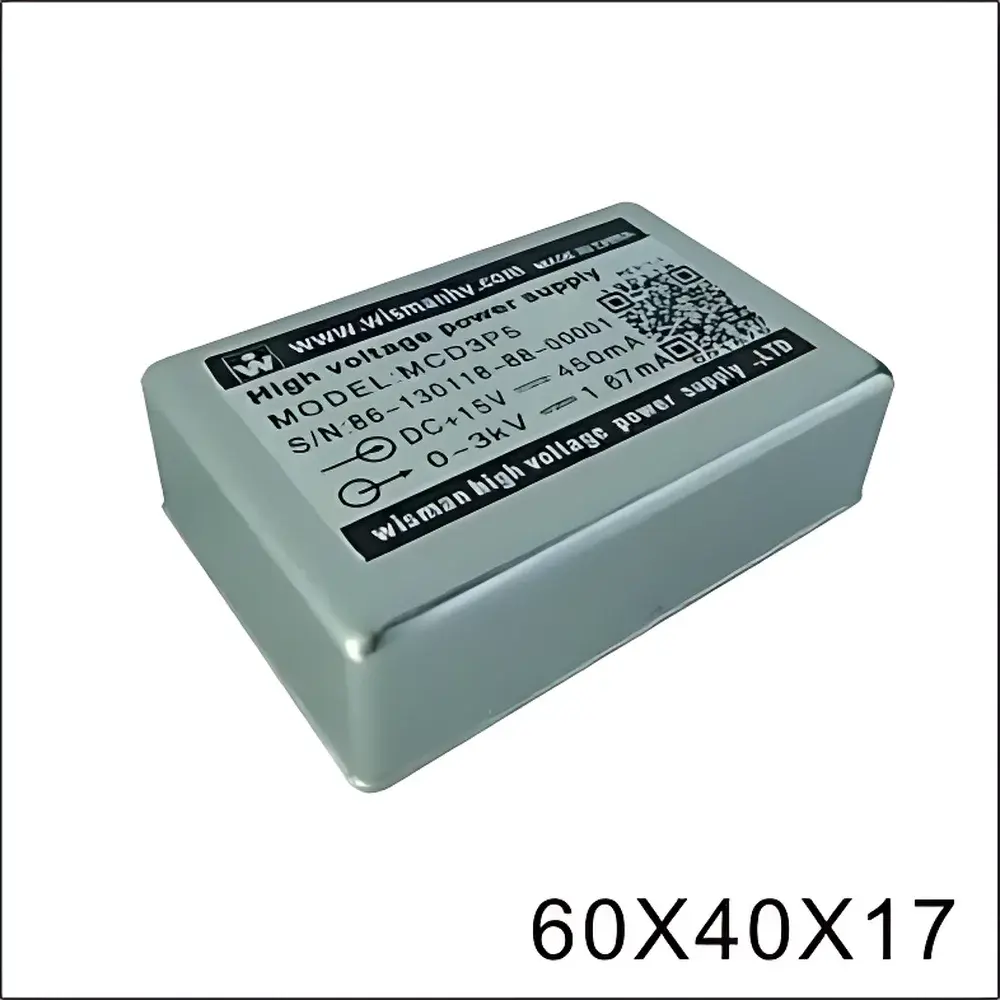

Wiseman MCD Series Positive-Polarity 3 kV / 5 W Low-Drift High-Voltage Power Supply Module for Electron Microscopy
| Brand | Wiseman |
|---|---|
| Origin | Shaanxi, China |
| Model | MCD |
| Output Polarity | Positive |
| Max Output Voltage | 3 kV |
| Max Output Power | 5 W |
| Output Ripple & Noise | <0.001% P-P |
| Stability (per hour) | 0.001% |
| Temp. Coefficient | 0.001%/°C |
| Input | 15 VDC ±1 V, 450 mA typ. |
| Dimensions | 60 mm × 40 mm × 17 mm |
| Weight | 120 g |
| Operating Temp. (Commercial Grade) | −10 °C to +50 °C (case) |
| Protection | Arc & Short-Circuit |
| Mounting | PCB-mount |
| Shielding | Full 6-Side EMI Shielding |
| Compliance | Designed for OEM integration in regulated scientific instrumentation environments |
Overview
The Wiseman MCD Series is a precision-engineered, positive-polarity high-voltage DC/DC power supply module specifically designed for demanding electron microscopy and analytical instrumentation applications requiring stable, low-noise bias voltage. Operating on a fixed 15 VDC input (±1 V), the module delivers up to 3 kV DC at 5 W continuous output power with exceptional long-term stability and thermal resilience. Its core architecture employs zero-current resonant switching and proprietary high-voltage insulation techniques to minimize electromagnetic interference, parasitic capacitance, and dielectric losses—critical attributes when powering sensitive electron-optical components such as electrostatic lenses, beam blankers, or detector bias circuits in SEM, TEM, and FIB systems. Unlike general-purpose HV supplies, the MCD is optimized for integration into compact, vibration-sensitive vacuum chambers where mechanical footprint, thermal drift, and signal integrity directly impact imaging resolution and quantitative measurement repeatability.
Key Features
- Output voltage range: 300 V to 3 kV (standard discrete taps: 300 V, 500 V, 1 kV, 1.25 kV, 1.5 kV, 2 kV, 2.5 kV, 3 kV)
- Programmable output via external potentiometer or 0–10 V analog control signal
- Ultra-low output ripple & noise: <0.001% peak-to-peak (measured across full load and temperature range)
- Short-term stability: ≤0.001% per hour; temperature coefficient: ≤0.001% / °C
- Full six-side conductive shielding for EMI/RFI suppression—essential near electron detectors and low-signal amplifiers
- Robust protection suite: auto-recovering short-circuit protection and arc detection with current limiting
- Compact PCB-mount form factor (60 mm × 40 mm × 17 mm) with minimal thermal mass for rapid thermal equilibrium
- Three operating grade options: Commercial (−10 °C to +50 °C case), Industrial (−25 °C to +65 °C), and Extended (−40 °C to +95 °C)
Sample Compatibility & Compliance
The MCD module is compatible with a broad spectrum of electron-optical and radiation-detection subsystems, including but not limited to electrostatic lens stacks, Faraday cup bias networks, channeltron and microchannel plate (MCP) detectors, secondary electron multipliers (SEMs), G-M tubes, proportional counters, and ion trap electrodes. Its low-drift performance meets the baseline stability requirements referenced in ASTM E1558 (Standard Guide for Electron Microscopy Specimen Preparation) and supports traceable calibration workflows under ISO/IEC 17025-accredited laboratory conditions. While the module itself carries no standalone regulatory certification (e.g., UL, CE), its design adheres to IEC 61010-1 safety principles for measurement/control equipment and incorporates creepage/clearance margins compliant with Pollution Degree 2 environments. OEM integrators are responsible for final system-level compliance validation—including EMC testing per CISPR 11 and safety assessment per IEC 62368-1—when embedded in end-user instruments.
Software & Data Management
The MCD operates as a hardware-integrated analog subsystem and does not feature embedded firmware, network interfaces, or digital communication protocols. Control and monitoring are implemented externally via analog interface: a 0–10 V input sets output voltage proportionally, while an optional feedback pin provides a scaled monitor signal (e.g., 1 V = 1 kV) for closed-loop regulation or data acquisition systems. For laboratories implementing GLP or GMP-compliant workflows, the module’s deterministic analog behavior—combined with its documented stability metrics and thermal coefficients—enables rigorous uncertainty budgeting in accordance with ISO/IEC Guide 98-3 (GUM). When integrated into automated microscope platforms, it interfaces seamlessly with LabVIEW, Python-based DAQ frameworks (e.g., PyVISA), or PLC-controlled bias sequencing routines without introducing timing jitter or protocol overhead.
Applications
- Electrostatic lens biasing in scanning/transmission electron microscopes
- High-voltage bias for secondary electron detectors (Everhart-Thornley, in-lens, STEM detectors)
- Beam blanking and stigmator control circuits
- Ion source extraction and acceleration stages in focused ion beam (FIB) columns
- Biasing of radiation detectors in electron probe microanalyzers (EPMA) and energy-dispersive X-ray spectroscopy (EDS) systems
- ESD simulation and controlled static charge generation in materials science test benches
- OEM integration into portable X-ray fluorescence (XRF) analyzers and handheld mass spectrometers
FAQ
Is the MCD module suitable for ultra-high vacuum (UHV) environments?
Yes—the module uses vacuum-compatible conformal coating and low-outgassing encapsulants. However, direct exposure to pressures below 10⁻⁶ mbar requires optional ceramic feedthrough integration and verification of outgassing rates per ASTM E595.
Can multiple MCD units be synchronized for phased-array bias control?
No native synchronization capability exists. Precise inter-unit timing requires external analog triggering or master-slave voltage referencing via shared control lines.
What is the recommended method for verifying long-term output stability in situ?
Use a calibrated high-impedance HV meter (e.g., Keithley 237 or equivalent) with 100 GΩ input resistance and record hourly readings over ≥72 hours under constant thermal load and ambient conditions.
Does Wiseman provide aging data or MTBF estimates for the MCD series?
Yes—accelerated life testing (ALT) per MIL-HDBK-217F indicates a B10 life >50,000 hours at 70% rated voltage and 40 °C case temperature, assuming derated operation and proper heatsinking.
Is custom output voltage or polarity available beyond standard offerings?
Yes—OEM customization includes non-standard voltage taps, dual-polarity variants, and modified thermal management layouts. Lead time and NRE apply.




