
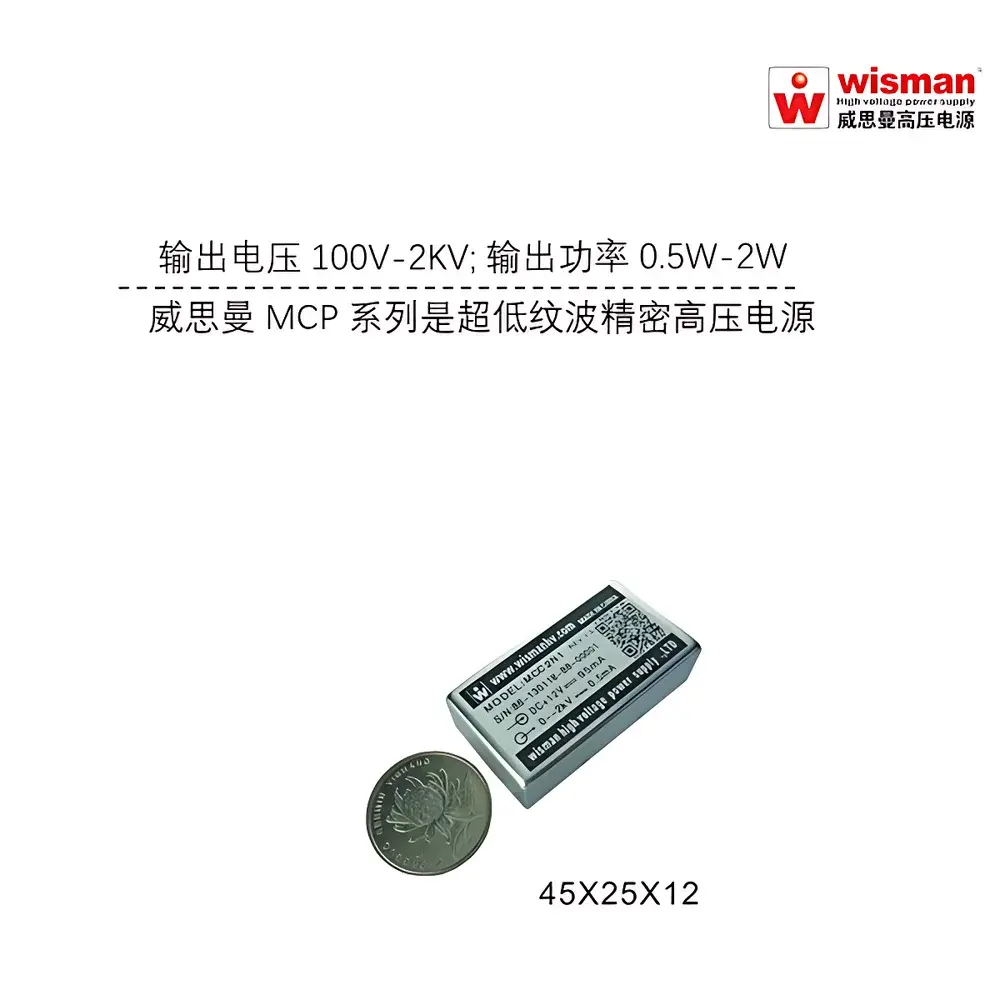

Wiseman MCP2kV/2W Instrument-Dedicated High-Voltage Power Supply Module
| Brand | Wiseman |
|---|---|
| Model | MCP2kV/2W |
| Output Voltage | ±0–2 kV (adjustable) |
| Output Power | 2 W |
| Output Ripple & Noise | <5 mV<sub>PP</sub> (<0.001% of full scale) |
| Stability | ±0.001% per hour |
| Temperature Coefficient | 15 ppm/°C |
| Input Voltage | +12 V ±0.5 V (optional: ±5 V, ±15 V, ±24 V) |
| Control Interface | 0–5 V analog or 20 kΩ potentiometer |
| Dimensions | 45.5 × 25 × 12 mm |
| Weight | 25 g |
| Shielding | Full 6-face mu-metal + conductive coating |
| Protection | Reverse polarity, overcurrent, short-circuit, arc suppression, overvoltage control |
| Compliance | Designed for GLP/GMP-aligned instrumentation environments |
Overview
The Wiseman MCP2kV/2W is a compact, PCB-mountable high-voltage power supply module engineered specifically for precision scientific instrumentation requiring stable, ultra-low-noise DC bias voltages. Based on zero-current resonant converter topology and proprietary high-voltage insulation design, the MCP2kV/2W delivers regulated output from 0 to ±2000 V with exceptional stability and minimal electromagnetic interference. Its core architecture integrates advanced dielectric materials, optimized PCB layout for field containment, and six-sided magnetic and electrostatic shielding—making it suitable for noise-sensitive applications such as photomultiplier tube (PMT) gain control, mass spectrometer ion optics biasing, electron multiplier voltage supply, and detector front-end amplification stages. Unlike general-purpose HV supplies, the MCP series prioritizes long-term drift performance and transient immunity under variable load conditions typical in analytical instruments.
Key Features
- DC/DC conversion architecture with isolated output, supporting both positive and negative polarity configurations
- Ultra-low output ripple: <5 mVPP (typical), corresponding to <0.001% of full-scale output at rated load
- High short-term stability: ±0.001% per hour under constant thermal and input conditions
- Low temperature coefficient: 15 ppm/°C — enabling reliable operation across 0–50°C ambient range without recalibration
- Robust protection suite: reverse-input-polarity safeguard, analog control voltage fault detection, continuous overcurrent limiting, auto-recovering short-circuit response, and arc quenching circuitry
- Flexible analog control interface: accepts 0–5 V external command signal (100 kΩ input impedance) or standard 20 kΩ potentiometer for manual adjustment
- Compact form factor (45.5 × 25 × 12 mm) optimized for embedded integration into OEM instrument chassis
- Efficient thermal design: operates at >75% efficiency across 10–100% load range; no forced-air cooling required
- OEM customization available for voltage range, control logic, mechanical mounting, and safety certification alignment (e.g., IEC 61010-1, UL 61010)
Sample Compatibility & Compliance
The MCP2kV/2W is routinely deployed in vacuum-compatible and EMI-sensitive subsystems where signal integrity and voltage fidelity directly impact measurement accuracy. It meets mechanical and electrical requirements for integration into mass spectrometers (e.g., quadrupole RF driver bias, TOF reflectron grids), PMT-based scintillation detectors (gamma spectroscopy, flow cytometry), electron microscopy column lens stacks, and electrophoresis systems requiring precise field gradients. While not individually certified to IEC 61010-1 or UL 61010, the module is designed to comply with essential safety and EMC principles—including reinforced insulation clearance (≥8 mm creepage for 2 kV), conducted emission suppression (<30 dBµV @ 150 kHz–30 MHz per CISPR 11 Class B), and transient surge immunity (IEC 61000-4-4 Level 3). When integrated into final equipment, it supports traceable calibration protocols and audit-ready documentation per ISO/IEC 17025 and FDA 21 CFR Part 11 requirements when paired with appropriate data logging and access controls.
Software & Data Management
As a hardware-level analog module, the MCP2kV/2W does not include onboard firmware or digital communication interfaces. However, its analog control input enables seamless integration into instrument control architectures using standard DAQ systems (e.g., National Instruments PXI, Beckhoff EtherCAT terminals) or microcontroller-based supervisors (ARM Cortex-M4/M7, STM32H7). Voltage setpoint logging, ramp profiling, and real-time fault status monitoring can be implemented externally via ADC sampling of the control line and auxiliary monitoring pins (available upon OEM request). For regulated environments, the module supports deterministic voltage ramping (50 ms 0–99% rise time) and repeatable turn-on sequencing—critical for GLP-compliant startup routines and automated QC workflows. Traceability is maintained through documented calibration curves (provided per batch) and optional factory-applied serial-numbered calibration certificates.
Applications
- Photomultiplier tube (PMT) dynode chain biasing in radiation detection and fluorescence spectroscopy
- Ion optic element biasing in quadrupole, time-of-flight (TOF), and orbitrap mass spectrometers
- Electron multiplier and channeltron voltage supply in surface analysis and residual gas analyzers
- Electrostatic lens and deflector bias in scanning electron microscopes (SEM) and transmission electron microscopes (TEM)
- High-voltage electrode drive in capillary electrophoresis (CE) and microfluidic separation platforms
- Detector bias for solid-state radiation sensors (Si-PIN, CdTe), proportional counters, and Geiger-Müller tubes
- OEM integration into portable X-ray fluorescence (XRF) analyzers and handheld radiation survey meters
- Research-grade electrostatic manipulation of charged aerosols, nanoparticles, and biomolecules
FAQ
What is the maximum continuous output current at 2 kV?
At 2 kV output, the 2 W rating corresponds to a maximum sustained current of 1 mA. Derating applies above 40°C ambient; consult the thermal derating curve in the datasheet.
Can the MCP2kV/2W be operated in constant-current mode?
No—it is a voltage-regulated source only. Current limiting is protective, not programmable. For CC operation, an external feedback loop with current-sense resistor and op-amp is required.
Is the output referenced to earth ground?
The output is fully floating. Ground reference must be defined externally per application requirements; common practice is to tie the return to instrument chassis or signal ground.
Does Wiseman provide calibration certificates with NIST-traceable standards?
Yes—traceable calibration reports (including voltage accuracy, ripple, and stability measurements) are available as an optional add-on for production batches or individual units.
What is the expected MTBF under continuous operation at 25°C?
Based on accelerated life testing and field data, MTBF exceeds 100,000 hours at rated load and nominal temperature, consistent with MIL-HDBK-217F predictions for Class R components.



