
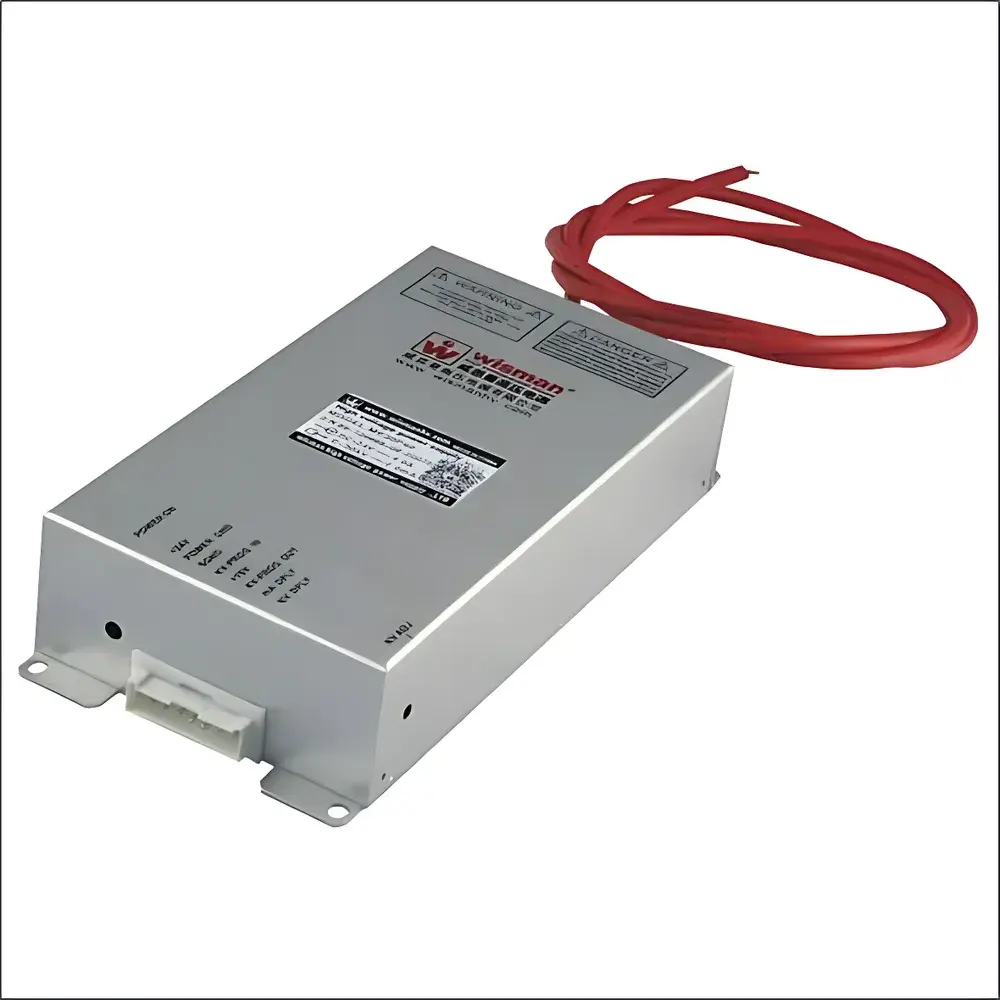
Wiseman ME Series High-Voltage DC Power Supply Module (30 kV / 100 W)
| Brand | Wiseman |
|---|---|
| Output Voltage | 30 kV |
| Output Power | 100 W |
| Output Polarity | Selectable Positive/Negative |
| Ripple & Noise | <0.1% p-p |
| Stability | ±0.01% over 8 hours |
| Temperature Coefficient | 25 ppm/°C |
| Input | DC 24 V |
| Communication Interface | RS-232 or RS-485 (addressable multi-unit networking) |
| Protection | Arc detection, short-circuit protection, overvoltage/overcurrent limiting |
| Efficiency | Up to 90% |
| Certifications | CE compliant |
| Operating Temperature | 0–40 °C |
| Dimensions (30 kV model) | 43.0 × 100.0 × 205.0 mm (H×W×D) |
| Application | Mass spectrometry, photomultiplier tubes, particle detectors, electrostatic systems, scientific instrumentation |
Overview
The Wiseman ME Series High-Voltage DC Power Supply Module is an engineered solution for precision high-voltage biasing in analytical and scientific instrumentation. Designed around a regulated DC/DC conversion architecture with zero-current resonant switching topology, the ME module delivers stable, low-noise output across a wide voltage range — up to 50 kV — while maintaining compact form factor and high electromagnetic compatibility. Its core design prioritizes metrological integrity: ultra-low output ripple (<0.1% peak-to-peak), exceptional long-term stability (±0.01% over 8 hours), and minimal thermal drift (25 ppm/°C). These characteristics make it particularly suitable for applications demanding strict voltage fidelity — such as mass spectrometer ion optics, photomultiplier tube (PMT) dynode chains, and charged-particle beam focusing systems — where even minor fluctuations can compromise signal-to-noise ratio or spectral resolution.
Key Features
- High-voltage DC output up to 50 kV with selectable polarity (positive or negative)
- Output power options up to 100 W, supporting diverse load profiles including capacitive charging and resistive bias networks
- Ultra-low output ripple and noise (<0.1% p-p), achieved through advanced filtering and resonant converter design
- Thermal and time-stable performance: ±0.01% voltage drift over 8-hour operation; 25 ppm/°C temperature coefficient
- Integrated arc and short-circuit protection with automatic recovery, minimizing downtime during transient events
- Flexible control interface: analog (0–10 V or external potentiometer) and digital (RS-232 or addressable RS-485) modes
- Multi-unit RS-485 network capability — each unit configurable with unique address for centralized monitoring and sequencing
- Six-sided conductive shielding and optimized PCB layout ensure robust EMI immunity in electromagnetically dense lab environments
- CE-marked for compliance with EU safety and EMC directives (2014/30/EU, 2014/35/EU)
- OEM-ready mechanical design with standardized footprint and mounting features for integration into instrument chassis
Sample Compatibility & Compliance
The ME series is routinely deployed in mass spectrometry systems requiring stable high-voltage bias for ion acceleration, quadrupole rods, and detector front-end electronics. It supports critical components including microchannel plate (MCP) detectors, channeltrons, and scintillation-based radiation sensors. The module meets essential requirements for laboratory-grade instrumentation under ISO/IEC 17025-aligned environments, and its CE certification confirms conformity with applicable Low Voltage Directive (LVD) and Electromagnetic Compatibility (EMC) standards. While not inherently 21 CFR Part 11 compliant (as a hardware-only module), the RS-485 interface enables integration into audit-trail-capable control systems used in GLP/GMP-regulated laboratories when paired with validated host software.
Software & Data Management
The ME module operates in open-protocol mode: RS-232 and RS-485 commands follow ASCII-based command sets (e.g., “VSET?”, “IOUT?”, “ON”, “OFF”) compatible with LabVIEW, Python (PySerial), MATLAB, and custom SCADA platforms. No proprietary drivers are required. When deployed in multi-unit configurations via RS-485, individual addressing allows daisy-chained topologies with deterministic polling latency. All setpoints and real-time output readings (voltage, current, status flags) are accessible programmatically. For traceability-critical workflows, timestamped telemetry logs can be generated at the host level — enabling correlation with instrument acquisition timelines during method validation or calibration audits.
Applications
- Mass spectrometry: Ion source biasing, collision cell voltages, detector gain control
- Radiation detection: PMT and MCP high-voltage supply in gamma spectroscopy and neutron detection systems
- Electrophoresis and bioanalytical tools: High-field gel electrophoresis, DNA sequencing platforms, electroporation devices
- Materials science: Electron beam and ion beam column biasing, electrostatic lens arrays
- Industrial metrology: ESD test equipment, corona discharge sources, static elimination systems
- Research infrastructure: Plasma physics experiments, vacuum chamber biasing, laser-triggered breakdown studies
FAQ
What is the maximum continuous output power at 30 kV?
At 30 kV, the ME-30kV/100W model delivers up to 100 W — corresponding to a maximum output current of 3.33 mA.
Can multiple ME modules be synchronized for phased voltage ramping?
While the ME does not support hardware synchronization (e.g., trigger inputs), precise coordinated ramping is achievable via host-controlled RS-485 command sequencing with sub-millisecond inter-command latency.
Is remote calibration supported?
No. Calibration is performed at the factory using NIST-traceable standards; field recalibration requires return to Wiseman or authorized service centers.
Does the module support analog modulation (e.g., for pulsed operation)?
Yes — the external analog control input accepts 0–10 V signals for proportional voltage programming, enabling externally gated or modulated output profiles.
What cooling method is recommended for sustained 100 W operation?
For continuous full-power operation above 25 °C ambient, forced-air cooling (≥1 CFM) across the heatsink surface is advised; derating curves are provided in the technical datasheet.
Related Products



