
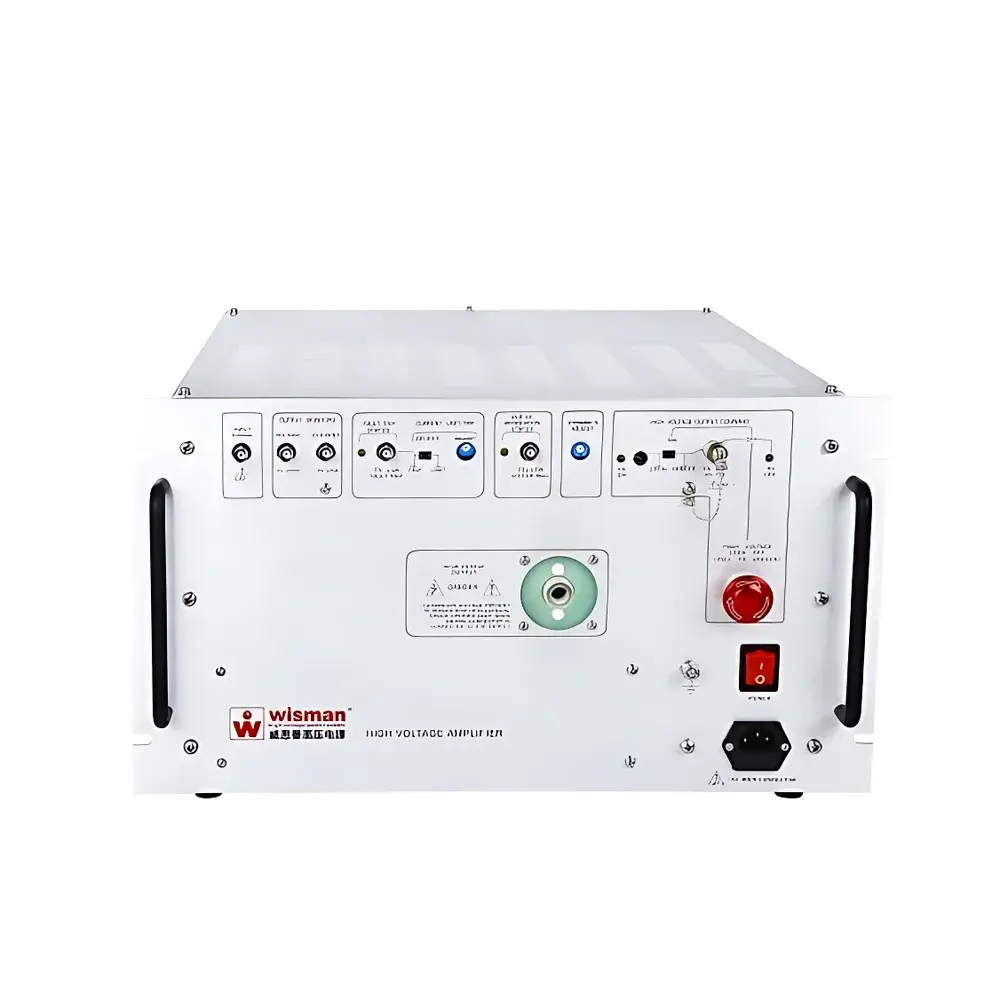
Wisman AMN ±2 kV / 400 W High-Voltage Power Amplifier
| Brand | Wisman |
|---|---|
| Origin | Shaanxi, China |
| Manufacturer Type | Authorized Distributor |
| Country of Origin | China |
| Model | AMN |
| Price Range | USD $13,500 – $40,800 (FOB) |
| Compatible Instruments | Mass Spectrometers, Piezoelectric Actuators, Electro-Optic Modulators, Ion Beam Systems |
| Output Voltage | ±2 kV DC or AC peak |
| Output Power | 400 W |
| Output Current | ±200 mA DC / ±400 mA AC peak (50% duty cycle, 2 ms pulse width) |
| Slew Rate | >750 V/µs (10%–90%) |
| Small-Signal Bandwidth | DC to >100 kHz (−3 dB) |
| Large-Signal Bandwidth | DC to >60 kHz (3% THD) |
| Voltage Gain | 200 V/V (DC), Accuracy: ±0.1% of full scale |
| Input Impedance | 25 kΩ |
| Output Noise | <0.5 V RMS (voltage), <10 mV RMS (monitor), <30 mV RMS (current monitor) |
| Stability | <50 ppm/hr (non-cumulative) |
| Tempco | <25 ppm/°C |
| Operating Temp | 0–40 °C |
| Humidity | ≤85% RH, non-condensing |
| Altitude | ≤2000 m |
| Dimensions | 264 × 483 × 635 mm (H×W×D) |
| Weight | 25 kg |
| Display Resolution | Voltage monitor ratio 200:1, current monitor 0.025 V/mA |
| Protection | Four-quadrant active output, short-circuit protection, thermal shutdown |
Overview
The Wisman AMN ±2 kV / 400 W High-Voltage Power Amplifier is a precision-engineered, fully solid-state instrumentation-grade amplifier designed for demanding scientific and industrial applications requiring stable, low-noise, high-slew-rate bipolar high-voltage excitation. Based on four-quadrant active output architecture, the AMN delivers true bidirectional current sourcing and sinking capability across its entire ±2 kV output range—enabling accurate dynamic control of reactive, capacitive, and resistive loads without signal distortion or phase lag. Its core topology employs high-voltage MOSFET-based switching stages with proprietary isolation and feedback compensation, ensuring exceptional linearity, thermal stability, and immunity to load-induced instability. Unlike transformer-coupled or piezoelectric-driver-specific modules, the AMN operates as a general-purpose, programmable high-voltage source compatible with analog control interfaces (0–10 V input), making it suitable for integration into automated test systems, closed-loop polarization setups, and time-resolved material characterization platforms.
Key Features
- Four-quadrant active output stage enabling simultaneous voltage sourcing/sinking and current sourcing/sinking—critical for driving high-capacitance piezoelectric actuators, electro-optic crystals, and electrophoretic cells without oscillation or overshoot.
- Ultra-high slew rate (>750 V/µs, 10%–90%) and wide small-signal bandwidth (DC to >100 kHz, −3 dB) support fast transient response in pulsed biasing, ion beam steering, and real-time ferroelectric hysteresis loop acquisition.
- Low output noise (<0.5 V RMS broadband, <10 mV RMS on voltage monitor) ensures signal integrity in sensitive applications such as mass spectrometer detector biasing and low-current atmospheric plasma diagnostics.
- Programmable analog input interface (25 kΩ impedance, ±10 V full-scale) with 200 V/V fixed gain and ±0.1% full-scale DC accuracy enables direct integration with DAQ systems, function generators, and PID controllers.
- Comprehensive protection suite including electronic short-circuit limiting, over-temperature shutdown, and auto-recoverable foldback current regulation—designed for unattended operation in GLP-compliant labs and 24/7 industrial environments.
- Front-panel voltage/current monitoring outputs (0.025 V/mA current scaling, 200:1 voltage scaling) with calibrated analog readouts support traceable in situ verification without external meters.
Sample Compatibility & Compliance
The AMN is routinely deployed in applications involving dielectric materials, ferroelectrics, electroactive polymers, and vacuum-based charged-particle systems. It meets IEC 61010-1:2010 safety requirements for measurement, control, and laboratory equipment, including reinforced insulation design for ±2 kV working voltage and creepage/clearance compliance per Pollution Degree 2. While not FDA 21 CFR Part 11 certified as a standalone unit, its analog control architecture supports audit-trail-capable integration with validated SCADA or LIMS platforms when used in regulated QC/QA workflows (e.g., USP analytical instrument qualification). The unit complies with CE marking directives (EMC Directive 2014/30/EU, Low Voltage Directive 2014/35/EU) and RoHS 2011/65/EU substance restrictions.
Software & Data Management
The AMN operates as an analog-controlled instrument and does not include embedded firmware, USB, or Ethernet connectivity. However, its standardized ±10 V input interface ensures seamless compatibility with third-party software ecosystems—including National Instruments LabVIEW, MATLAB Data Acquisition Toolbox, Python-based PyDAQmx drivers, and Keysight PathWave. Users may implement full data logging, parameter sweeps, and closed-loop feedback via external DAQ hardware with ≥16-bit resolution and ≥100 kS/s sampling. Voltage and current monitor outputs enable real-time synchronization with oscilloscopes or digitizers for waveform fidelity validation and harmonic distortion analysis (THD <3% up to 60 kHz). For GxP environments, calibration records (per ISO/IEC 17025) and metrological traceability documentation are available upon request from authorized distributors.
Applications
- Piezoelectric actuator drive and hysteresis characterization in atomic force microscopy (AFM) and nanopositioning stages.
- Biasing of microchannel plates (MCPs), electron multipliers, and Faraday cups in mass spectrometry detection chains.
- Electro-optic modulation in laser cavity Q-switching and beam steering systems using LiNbO₃ or KTP crystals.
- Ferroelectric polarization cycling (P–E loop measurement) under variable frequency and temperature conditions.
- Electrophoretic mobility and dielectrophoretic trapping of nanoparticles and biomolecules in microfluidic devices.
- Dielectric barrier discharge (DBD) and atmospheric pressure plasma jet (APPJ) electrode excitation with controlled AC/DC superposition.
- Ion beam focusing and deflection in compact accelerator test benches and space propulsion simulation chambers.
FAQ
Is the AMN compatible with mass spectrometers requiring ultra-stable high-voltage detector bias?
Yes—the AMN’s <50 ppm/h drift, <25 ppm/°C tempco, and sub-0.5 V RMS noise make it suitable for high-gain electron multiplier and channeltron biasing where baseline stability directly impacts signal-to-noise ratio and detection limit.
Can the AMN drive highly capacitive loads (e.g., >10 nF) without oscillation?
Yes—its four-quadrant output stage provides active current sink capability during rapid voltage transitions, preventing charge buildup and enabling stable operation with capacitive loads up to 100 nF at frequencies below 10 kHz.
Does the unit support remote programming via digital interface (e.g., GPIB, RS-232)?
No—the AMN is analog-only; digital control requires external DAC hardware interfacing to its ±10 V input. Optional OEM modules with integrated EtherCAT or CANopen are available through Wisman’s industrial OEM program.
What calibration standards apply to the AMN’s voltage and current monitors?
Voltage monitor accuracy is traceable to NIST-calibrated HV dividers (±0.1% FS); current monitor accuracy references Fluke 5720A calibrators (±0.5% FS). Full calibration certificates (ISO/IEC 17025 accredited) are provided with optional service contracts.
Is the AMN suitable for continuous DC operation at ±2 kV and ±200 mA?
Yes—rated continuous output power is 400 W (±2 kV × ±200 mA), with forced-air cooling and thermal derating curves supplied in the technical manual for ambient temperatures above 35 °C.



