
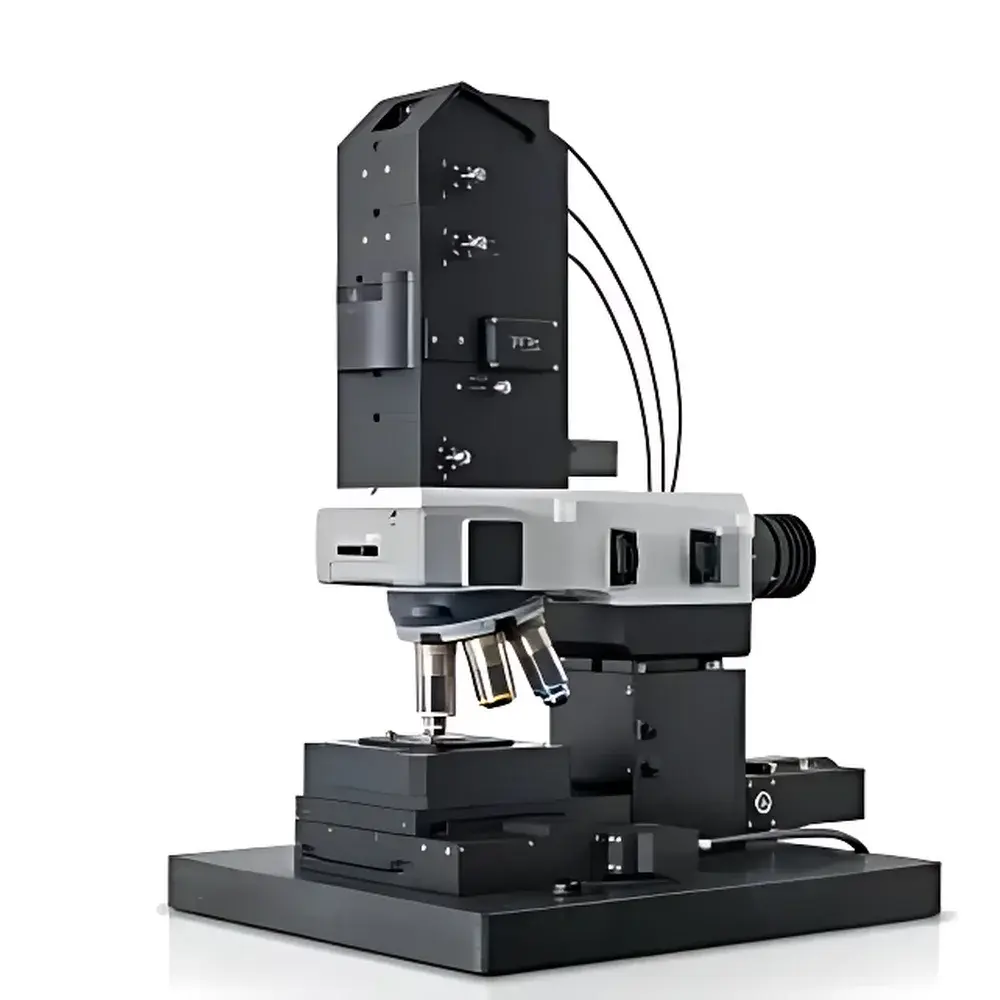
WITec Alpha300 R Confocal Raman Microscope
| Brand | WITec |
|---|---|
| Origin | Germany |
| Model | Alpha300 R |
| Instrument Type | Confocal Raman Microscope |
| Spectral Range | 500–700 cm⁻¹ |
| Spectral Resolution | 0.02 cm⁻¹ |
| Spatial Resolution | 1 µm (lateral), 1 µm (axial) |
| Minimum Wavenumber | 1 cm⁻¹ |
| Spectral Reproducibility | 0.15 cm⁻¹ |
Overview
The WITec Alpha300 R Confocal Raman Microscope is a high-precision, research-grade confocal Raman imaging system engineered for non-destructive, label-free chemical characterization at diffraction-limited spatial resolution. Based on the principle of confocal laser Raman spectroscopy—where monochromatic laser light excites molecular vibrations and the inelastically scattered photons are spectrally resolved—the Alpha300 R delivers quantitative vibrational fingerprinting with sub-micrometer spatial localization. Its true confocal optical architecture enables depth-resolved spectral acquisition, allowing 3D chemical mapping of transparent, layered, or heterogeneous samples without sectioning or vacuum requirements. Integrated with a Zeiss upright microscope platform, the system supports oil-immersion objectives and PZT-driven scanning stages to achieve ≤200 nm lateral and ~500 nm axial optical resolution (at 532 nm excitation), making it suitable for nanoscale material heterogeneity analysis, stress/strain evaluation in crystalline lattices, and phase distribution studies in multicomponent systems.
Key Features
- True confocal Raman microscopy with pinhole-based depth discrimination and single-point spectral acquisition
- FAST Raman Imaging® standard: spectrum acquisition as fast as 125 ms (back-illuminated CCD) or 38 ms (front-illuminated CCD)
- ULTRAFAST Raman Imaging® option with EMCCD: integration time down to 0.76 ms per spectrum
- PZT-scanning stage with 200 × 200 × 2 µm travel range, positional accuracy of 4 × 4 × 0.5 nm, and linearity better than 0.02%
- Multi-laser excitation compatibility: 355, 442, 488, 514, 532, 633, and 785 nm lasers (10–150 mW output, depending on wavelength)
- High-throughput spectrometer: 300 mm focal length, f/4 design, 70% throughput, dual grating turret (600 g/mm and 1800 g/mm)
- Automated focus stabilization and motorized sample positioning for reproducible coordinate-based navigation
- Native compatibility with AFM and near-field optical microscopy (NSOM) for correlative multimodal analysis
Sample Compatibility & Compliance
The Alpha300 R operates under ambient conditions and accommodates samples up to 150 mm in diameter. It supports bulk solids, thin films, biological tissues, pharmaceutical tablets, geological sections, and semiconductor wafers—without requiring conductive coating, vacuum, or cryogenic preparation. Its confocal geometry permits subsurface interrogation of optically transparent media (e.g., polymers, glasses, hydrogels) and depth profiling through layer stacks. The system meets essential laboratory compliance frameworks: spectral data acquisition adheres to GLP/GMP principles; timestamped metadata, user authentication, and audit-trail-enabled software support FDA 21 CFR Part 11 readiness. All optical components conform to ISO 10110 standards for surface quality and wavefront fidelity, and spectral calibration routines follow NIST-traceable reference materials (e.g., silicon, cyclohexane).
Software & Data Management
Controlled by WITec’s proprietary ProjectLE software, the Alpha300 R provides unified workflow management—from instrument alignment and laser power optimization to hyperspectral cube acquisition, real-time spectral preview, and multivariate analysis. ProjectLE supports automated batch processing, peak fitting (Voigt, Gaussian, Lorentzian), principal component analysis (PCA), cluster analysis, and false-color chemical mapping. Raw spectral datasets (.wdf format) are stored with embedded metadata (laser wavelength, objective NA, integration time, grating selection, stage coordinates), ensuring full traceability. Export options include ASCII, CSV, and HDF5 formats for interoperability with MATLAB, Python (SciPy/NumPy), and commercial chemometrics platforms. Software updates are delivered via secure HTTPS channels, and version-controlled release notes document validation status per ICH Q9 guidelines.
Applications
- Materials Science: Mapping crystallinity gradients, residual stress in ceramics/metal alloys, and defect distribution in 2D materials (e.g., graphene, MoS₂)
- Thin Films & Polymers: Quantifying phase separation in block copolymers, interfacial diffusion in multilayer coatings, and degradation kinetics under UV/thermal exposure
- Pharmaceuticals: Verifying active pharmaceutical ingredient (API) distribution in solid dispersions, detecting polymorphic transitions during tablet compression, and assessing excipient compatibility
- Semiconductor Industry: Identifying dopant-induced strain in SiGe heterostructures, characterizing gate oxide integrity, and localizing contaminants in fab-cleanroom environments
- Geosciences: In situ mineral identification in fluid inclusions, carbon speciation in metamorphic rocks, and microfossil organic content analysis
- Life Sciences: Label-free cellular component mapping (lipids, proteins, nucleic acids), drug uptake kinetics in 3D spheroids, and extracellular matrix remodeling in tissue engineering scaffolds
FAQ
What distinguishes the Alpha300 R from non-confocal Raman microscopes?
The Alpha300 R employs a physical pinhole in the detection path to reject out-of-focus signal, enabling true optical sectioning and unambiguous depth-resolved spectroscopy—unachievable with widefield or slit-based systems.
Can the system perform simultaneous Raman-AFM measurements?
Yes—via WITec’s integrated TrueSurface mode, which synchronizes topographic AFM feedback with Raman spectral acquisition at identical XY coordinates, preserving nanoscale correlation without stage repositioning.
Is spectral calibration traceable to international standards?
Yes—calibration uses NIST-certified reference standards (e.g., crystalline silicon at 520.7 cm⁻¹), with documented uncertainty budgets compliant with ISO/IEC 17025 requirements for accredited laboratories.
What file formats are supported for data export and third-party analysis?
ProjectLE exports spectra and hyperspectral cubes in ASCII, CSV, and HDF5 formats, all retaining full metadata for seamless import into Python, MATLAB, or commercial chemometric tools such as Unscrambler or Pirouette.
Does the system meet regulatory requirements for QC/QA in pharmaceutical manufacturing?
When deployed with validated protocols and 21 CFR Part 11-compliant software configuration (including electronic signatures and audit trails), the Alpha300 R supports GMP-compliant raw material verification, blend uniformity assessment, and stability-indicating method development.




