
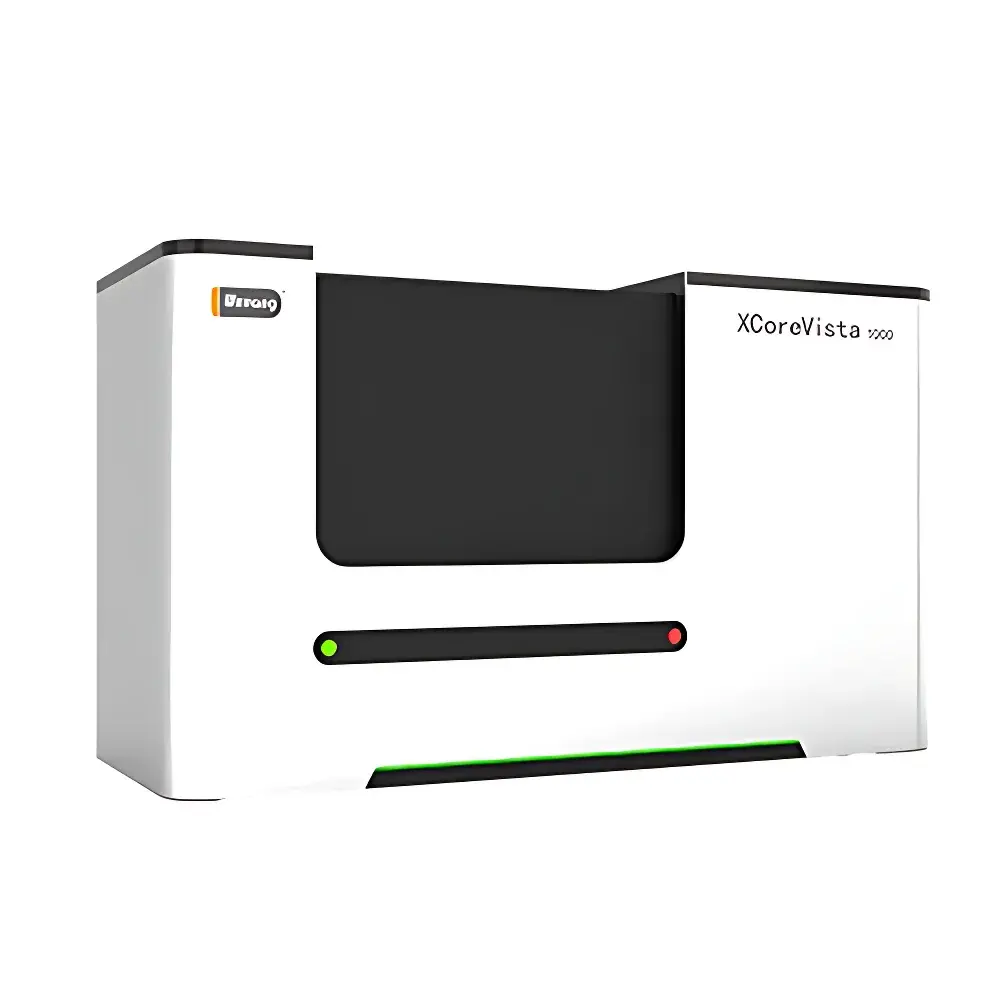
Wkuang XCoreVista 1000 4D Desktop In Situ Micro-CT System
| Brand | Wkuang |
|---|---|
| Origin | Jiangsu, China |
| Manufacturer Type | Authorized Distributor |
| Origin Category | Domestic (China) |
| Model | XCoreVista 1000 4D |
| Pricing | Upon Request |
| Spatial Resolution | ≥2 µm (Flat Panel Detector) / ≥500 nm (Optically Coupled Detector) |
| Maximum Sample Dimensions | 300 mm × 300 mm |
| Maximum Sample Weight | 20 kg |
| In Situ Stage Temperature Range | −80 °C to +150 °C |
| In Situ Mechanical Load Capacity | Up to 1 kN |
Overview
The Wkuang XCoreVista 1000 4D is a compact, high-performance desktop micro-computed tomography (micro-CT) system engineered for non-destructive, high-resolution 3D and time-resolved 4D structural characterization of materials under controlled physical stimuli. Utilizing cone-beam geometry with a sealed, maintenance-free microfocus X-ray source and dual-detection architecture—supporting both flat-panel detector (FPD) and optically coupled scintillator-based imaging—the system delivers spatial resolution down to 2 µm (FPD mode) and sub-500 nm (optically coupled mode) without requiring synchrotron infrastructure. Its integrated in situ 4D platform enables simultaneous acquisition of volumetric data during thermal cycling (−80 °C to +150 °C) and mechanical loading (up to 1 kN), making it suitable for dynamic process monitoring in metallurgy, battery electrode evolution, polymer deformation, ceramic sintering, and composite failure analysis.
Key Features
- Desktop footprint with fully shielded cabinet: Complies with IEC 61000-6-3 and GBZ 188–2014 radiation safety standards; requires only standard 230 V AC power supply.
- Dual imaging modalities: Absorption contrast imaging for density-based phase segmentation and propagation-based phase contrast imaging for enhanced edge detection in low-absorbing materials (e.g., polymers, biological tissues).
- Modular detector options: High-dynamic-range flat-panel detector (≥16-bit depth, 2048 × 2048 pixels) or optically coupled CCD/CMOS sensor with fiber-optic taper for ultra-high-resolution imaging.
- Integrated 4D in situ stage: Thermally stabilized chamber with Peltier and resistive heating elements; calibrated temperature uniformity ±1.5 °C across field of view; load frame with integrated load cell and displacement encoder compliant with ISO 7500-1 Class 1 accuracy.
- Real-time reconstruction engine: GPU-accelerated Feldkamp-Davis-Kress (FDK) algorithm enabling on-the-fly volume generation at up to 1 volume per minute (depending on projection count and voxel size).
Sample Compatibility & Compliance
The XCoreVista 1000 4D accommodates samples up to 300 mm in diameter and 300 mm in height, with maximum mass of 20 kg. Its open-stage design supports custom sample holders and third-party fixtures—including electrochemical cells, tensile jigs, and environmental chambers—enabling multimodal correlative workflows. The system meets electromagnetic compatibility (EMC) requirements per EN 61326-1 and radiation safety regulations per national Class II X-ray equipment licensing framework in China (NMPA registration pending). Data acquisition protocols are structured to support audit-ready documentation aligned with GLP principles, including metadata stamping (time, temperature, load, exposure parameters) embedded directly into DICOM and HDF5 output files.
Software & Data Management
Control and reconstruction are managed via Wkuang’s proprietary VistaCT Suite v4.x, a Windows-based application supporting full workflow automation from scan planning to quantitative morphometry. The software includes batch processing pipelines compliant with ASTM E1441 and ISO 15732 standards for CT metrology, as well as tools for porosity analysis, grain segmentation, crack tracking, and digital volume correlation (DVC). Raw projections and reconstructed volumes are stored in vendor-neutral formats (DICOM, TIFF stack, HDF5) with embedded EXIF-like metadata. Optional integration with LIMS platforms is available through RESTful API and supports 21 CFR Part 11–compliant electronic signatures and audit trails when deployed in regulated QA/QC environments.
Applications
- Materials science: Quantifying pore network evolution in Li-ion battery anodes/cathodes during charge–discharge cycling.
- Mechanical engineering: In situ observation of fatigue crack initiation and propagation in aluminum alloys under cyclic loading.
- Additive manufacturing: Validation of internal defect distribution (lack-of-fusion, porosity, residual stress-induced distortion) in Ti-6Al-4V laser powder bed fusion parts.
- Geoscience: Time-lapse imaging of fluid flow pathways and mineral dissolution kinetics in rock core plugs under reservoir-relevant pressure–temperature conditions.
- Electronics packaging: Non-destructive inspection of solder joint integrity, void fraction, and intermetallic growth in flip-chip assemblies subjected to thermal shock.
FAQ
Does the XCoreVista 1000 4D require external cooling or HVAC integration?
No — the sealed X-ray tube and detector modules are air-cooled; ambient lab temperature stability between 18 °C and 25 °C is recommended for optimal thermal drift control.
Can the system be used for dimensional metrology according to ISO 15732?
Yes — with calibrated reference artifacts and validated geometric correction models, measurement uncertainty ≤ (2.5 + L/100) µm (k = 2) is achievable for traceable length measurements within the central 60% of the FOV.
Is phase contrast imaging enabled by hardware or software post-processing?
Phase contrast is generated via propagation-based method using free-space Fresnel diffraction; no grating or analyzer crystal is required — contrast enhancement is intrinsic to optical path length differences and detector pixel pitch.
What level of technical support and service coverage is provided internationally?
Wkuang offers remote diagnostics, annual preventive maintenance contracts, and certified engineer dispatch for on-site calibration and qualification (IQ/OQ) — service agreements include ISO/IEC 17025-aligned performance verification reports.



