
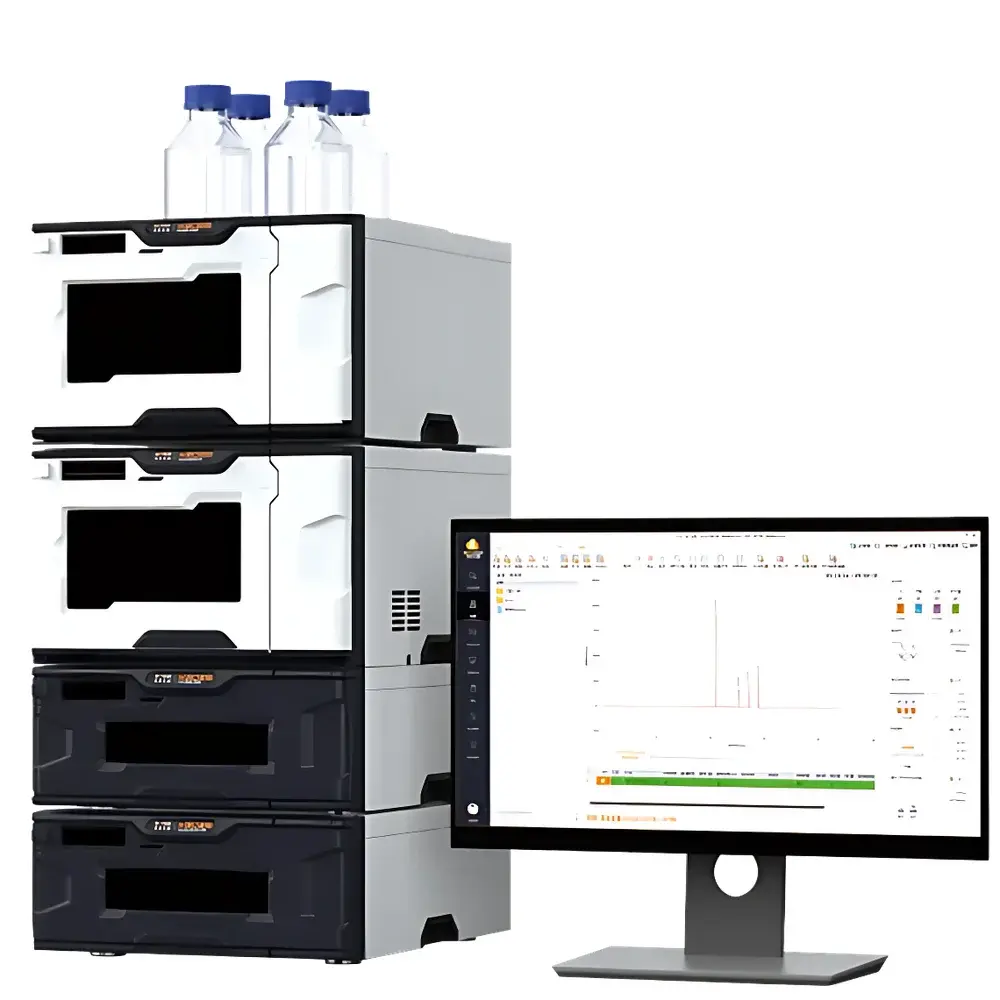
Wooking K2025 High-Performance Liquid Chromatograph
| Brand | Wooking |
|---|---|
| Origin | Shandong, China |
| Manufacturer Type | Authorized Distributor |
| Product Category | Domestic |
| Model | K2025 |
| Instrument Type | Conventional HPLC System |
| Application Scope | General-Purpose Analytical HPLC |
| Flow Rate Range | 0.001–10.000 mL/min |
| Maximum Pressure | 62 MPa |
| Flow Accuracy | RSD ≤ 0.1% |
| Sample Tray Capacity | 108 positions |
| Injection Volume Range | 0–100 µL |
| Column Oven Temperature Range | (Ambient −10)°C to 85°C |
| UV-Vis Wavelength Range | 190–900 nm |
| Data Acquisition Rate | Up to 100 Hz |
Overview
The Wooking K2025 High-Performance Liquid Chromatograph is a modular, CE-compliant analytical platform engineered for precision, robustness, and regulatory readiness in pharmaceutical, environmental, food safety, and academic laboratories. Built upon classical reversed-phase, normal-phase, and ion-exchange chromatographic principles, the system delivers high-resolution separations under isocratic or gradient elution conditions using either high-pressure binary gradient (P2) or low-pressure quaternary gradient (P4) solvent delivery architectures. Its core architecture integrates four independently controllable modules—pump, autosampler, column oven, and multi-detection capability—each designed to meet ISO/IEC 17025 method validation requirements and support GLP/GMP-aligned workflows. The system operates on a unified control and data acquisition framework compliant with FDA 21 CFR Part 11, ensuring traceability, electronic signature integrity, and audit-ready data handling.
Key Features
- P2 Binary High-Pressure Gradient Pump: Features patented suspended floating plunger design (ZL 2020 2 1896102.3), dynamic pressure suppression algorithm, and helical cross-counterflow mixing—achieving retention time reproducibility of RSD < 0.2% across 24-hour continuous operation.
- P4 Quaternary Low-Pressure Gradient Pump: Four independent solvent channels with real-time flow monitoring, individual channel diagnostics, and tool-free solvent line replacement—reducing downtime and consumable cost per analysis.
- K2025AS Autosampler: Equipped with monolithic constant-pressure sampling needle (ZL 2020 2 1159205.1), ultra-precise syringe drive, and pre-load injection technology (ZL 2020 2 2977790.2), enabling 5-second injection cycle time and carryover < 0.005% after dual internal/external needle wash.
- K2025CO Column Compartment: Employs fuzzy PID temperature control, dual 3D air circulation, and triple-layer thermal insulation—maintaining ±0.1°C stability across full operating range (−10°C to 85°C), with integrated leak detection, Peltier health monitoring, and overtemperature cut-off.
- Modular Detection Options: Supports interchangeable detectors—including UV-Vis (190–900 nm), DAD (12-channel spectral acquisition), FLD, RID, and ELSD—each calibrated to NIST-traceable standards and compatible with spectral library matching and peak purity assessment.
Sample Compatibility & Compliance
The K2025 accommodates standard 2.1–4.6 mm ID analytical columns (up to 250 mm length) and supports mobile phases ranging from aqueous buffers (pH 1.5–12) to aggressive organic solvents (e.g., THF, chloroform). All fluidic paths are constructed from biocompatible, low-metal-leaching materials (e.g., PEEK, sapphire, and ceramic components), minimizing analyte adsorption and column fouling. The system meets IEC 61000-4 electromagnetic compatibility standards and complies with ISO 9001 manufacturing protocols. Its software architecture satisfies FDA 21 CFR Part 11, EU Annex 11, and WHO TRS 992 requirements for electronic records, role-based access control, electronic signatures, and immutable audit trails—validated for use in QC release testing under USP , EP 2.2.46, and JP 17.
Software & Data Management
WookingLab Chromatography Workstation v3.2 provides a unified interface for method development, sequence definition, real-time monitoring, peak integration, and report generation. Its flat-design UI supports drag-and-drop method building and includes built-in pharmacopoeial method libraries (ChP 2020, CVMP 2020), reducing method transfer time by >40%. The integration engine offers 25 configurable integration events (e.g., baseline correction, peak splitting, shoulder detection) and three quantitative algorithms (external standard, internal standard, standard addition). Raw data is stored in a relational SQLite database with SHA-256 hashing; all user actions—including method edits, reprocessing, and report exports—are timestamped, signed, and logged in an uneditable audit trail. Backup and restore functions support automated offsite archival via SFTP or network share.
Applications
The K2025 is routinely deployed for small-molecule quantification in pharmaceutical stability studies (ICH Q1–Q5), residual solvent analysis per USP , pesticide screening in agricultural commodities (AOAC 2017.16), amino acid profiling in clinical diagnostics, and polymer additive identification in packaging migration testing. Its DAD module enables simultaneous multi-wavelength quantitation and spectral deconvolution of co-eluting peaks in herbal extract analysis, while the FLD option supports trace-level mycotoxin detection at sub-ppb levels. In environmental labs, the system pairs with C18 columns and gradient elution to resolve PAHs and PCB congeners per EPA Method 8330B and ISO 18856.
FAQ
Is the K2025 compatible with third-party column hardware and software interfaces?
Yes—the system uses industry-standard 1/16″ stainless-steel tubing, universal column fittings, and supports ASCII-based instrument control via RS-232 and Ethernet TCP/IP protocols. It exports .cdf and .csv files compatible with OpenLab CDS, Chromeleon, and Empower.
Does the autosampler support cold storage for thermolabile samples?
Yes—the K2025AS optional refrigerated tray maintains 4°C ±1°C with active dew-point control to prevent condensation-induced volume error.
Can the UV-Vis detector perform spectral scanning during gradient runs?
Yes—full-spectrum acquisition (190–900 nm) at up to 100 Hz is fully synchronized with gradient programming and retention time, enabling post-run peak identification without re-injection.
What validation documentation is provided with the system?
Each shipment includes Factory Acceptance Test (FAT) report, Installation Qualification (IQ) checklist, and Operational Qualification (OQ) protocol templates aligned with ASTM E2500 and GAMP5 guidelines.
Is remote monitoring and troubleshooting supported?
Yes—via secure TLS-encrypted web interface and optional VNC-based technician access with session logging and permission-limited control scopes.




