
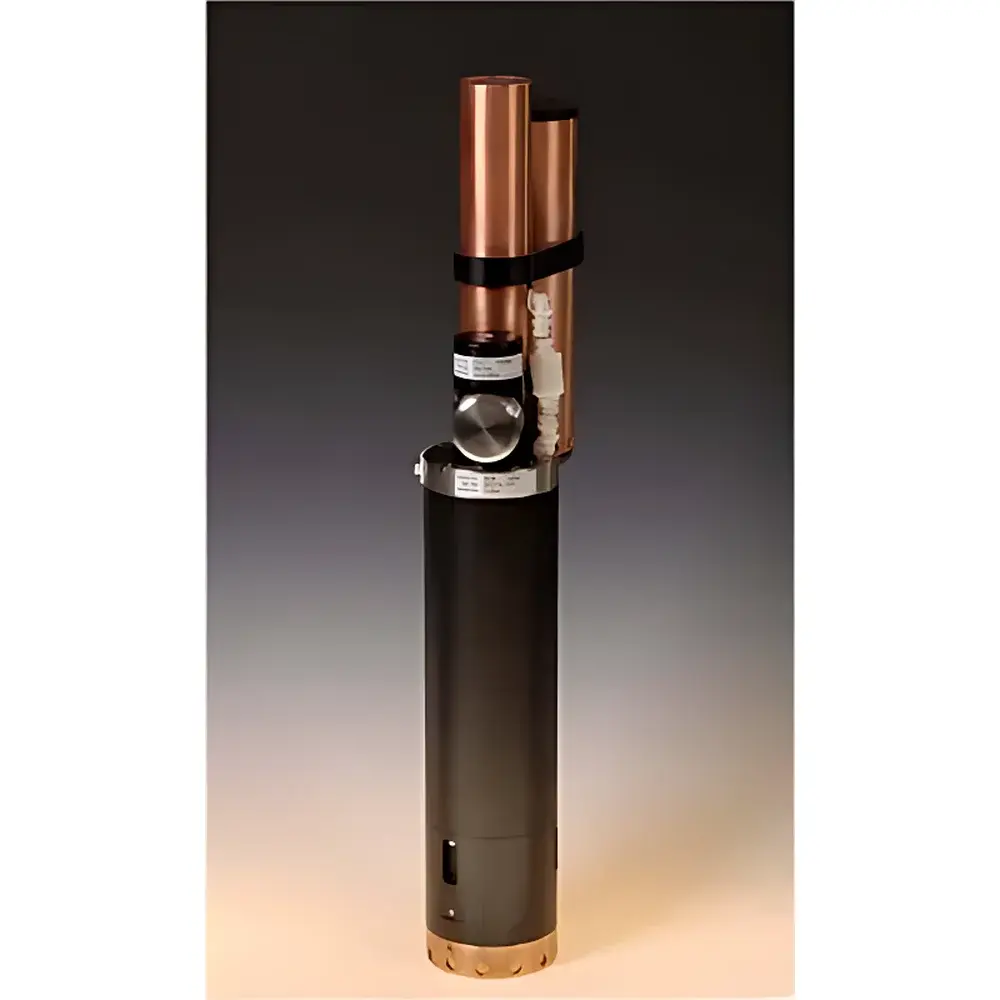
WQM Multi-Parameter Water Quality Monitor
| Origin | USA |
|---|---|
| Manufacturer Type | Authorized Distributor |
| Origin Category | Imported |
| Model | WQM |
| Pricing | Available Upon Request |
Overview
The WQM Multi-Parameter Water Quality Monitor is an integrated, submersible environmental sensing platform engineered for high-fidelity, long-term in situ monitoring of aquatic systems. It combines proprietary optical and electrochemical sensor technologies from two industry-leading manufacturers: WET Labs’ fluorescence-based turbidity and backscatter sensors, and Sea-Bird Scientific’s precision CTD (Conductivity-Temperature-Depth) modules. The instrument operates on the principle of multi-spectral optical excitation (for chlorophyll-a fluorescence), dual-wavelength nephelometry (for turbidity and backscatter), and four-electrode conductivity measurement—ensuring minimal polarization error and stable calibration across salinity gradients. Designed for deployment in both freshwater and marine environments, the WQM delivers synchronized, time-stamped measurements of seven core parameters—temperature, conductivity, pressure (depth), dissolved oxygen (optical, luminescence-based), chlorophyll-a fluorescence, turbidity, and optical backscatter—at 1 Hz sampling frequency. Its robust mechanical architecture and fouling-resistant optical windows enable uninterrupted operation in high-sediment, biofouling-prone waters—making it especially suitable for fixed-site observatories, moored buoys, autonomous underwater vehicles (AUVs), and towed body platforms.
Key Features
- Fouling-mitigating optical design with self-cleaning quartz windows and hydrophobic coatings to maintain signal integrity over extended deployments (≥6 months)
- Modular sensor integration: Interchangeable chlorophyll-a/turbidity ranges support application-specific configurations (e.g., 0–30 µg/L Chl-a / 0–10 NTU for oligotrophic lakes; 0–125 µg/L Chl-a / 0–1000 NTU for estuarine or coastal zones)
- High-resolution analog-to-digital conversion: 24-bit ADC for conductivity, temperature, and DO channels ensures low-noise data acquisition and trace-level detection limits
- Pressure-compensated dissolved oxygen measurement using phase-lifetime luminescence quenching—eliminating membrane drift and electrolyte depletion issues common in Clark-type sensors
- RS-232 serial interface compliant with NMEA 0183 framing for seamless integration into legacy telemetry systems and real-time data loggers
- IP68-rated housing rated to 200 m depth, constructed from marine-grade titanium alloy and corrosion-resistant Delrin® end caps
Sample Compatibility & Compliance
The WQM is validated for continuous immersion in natural water matrices—including freshwater lakes and rivers, brackish estuaries, and full-strength seawater (up to 45 PSU). Sensor calibrations adhere to ASTM D3370 (Standard Practices for Sampling Water), ISO 7888 (Electrical Conductivity of Water), and USP (Total Organic Carbon—where turbidity serves as a surrogate indicator). All firmware and data logging protocols support audit-trail functionality required under GLP and GMP frameworks. While not FDA-cleared as a medical device, its DO and conductivity modules are routinely referenced in EPA Method 360.1 and ISO 5815-1 for wastewater and surface water quality assessment.
Software & Data Management
Data acquisition is managed via Sea-Bird Scientific’s SBE Data Processing software suite (v7.25+), which supports automated calibration coefficient application, thermal inertia correction for fast-response temperature profiling, and linearized chlorophyll-a quantification using factory-derived quantum yield coefficients. Raw binary output (.hex) is convertible to netCDF-4 format with embedded CF-1.8 metadata conventions, enabling direct ingestion into IOOS, ERDDAP, and THREDDS data servers. The system supports optional SDI-12 or Modbus RTU expansion for integration with third-party environmental monitoring networks. All configuration changes, calibration events, and sensor diagnostics are timestamped and stored with user-defined annotation fields—meeting 21 CFR Part 11 requirements for electronic records and signatures when deployed in regulated research settings.
Applications
- Long-term, fixed-location water quality observatories in reservoirs, drinking water intakes, and protected wetlands
- Moored buoy arrays for coastal hypoxia monitoring and Harmful Algal Bloom (HAB) early warning systems
- Towed undulating platforms (e.g., SeaSoar, MOCNESS) for synoptic vertical profiling of phytoplankton biomass and particle load
- Regulatory compliance monitoring per EU Water Framework Directive (WFD) metrics—specifically for supporting “good ecological status” classification of phytoplankton and transparency indicators
- Calibration and validation of satellite-derived ocean color products (e.g., NASA OCx algorithms) through coincident in situ radiometric and fluorescence measurements
FAQ
What depth rating does the WQM support, and is pressure compensation applied to all sensors?
The WQM is rated to 200 m depth. Pressure compensation is applied to temperature, conductivity, and dissolved oxygen outputs using real-time pressure-derived corrections based on ITS-90 and TEOS-10 thermodynamic models.
Can the WQM be powered by solar-charged batteries in remote deployments?
Yes—the instrument operates within a 12–18 VDC input range and draws ≤150 mA at 12 V during active sampling, making it compatible with standard marine solar-battery systems equipped with voltage regulation and low-voltage disconnect safeguards.
How often does the chlorophyll-a sensor require recalibration in field use?
Factory calibration remains stable for ≥12 months in non-abrasive, low-fouling environments. In high-turbidity or high-biofouling conditions, biannual verification against certified reference standards (e.g., NIST-traceable fluorescein solutions) is recommended.
Is raw sensor data accessible without proprietary software?
Yes—ASCII-formatted output (via RS-232) includes header-tagged, space-delimited values for all channels. Protocol documentation and parsing scripts are publicly available under Sea-Bird Scientific’s Open Data License v2.0.
Related Products







