
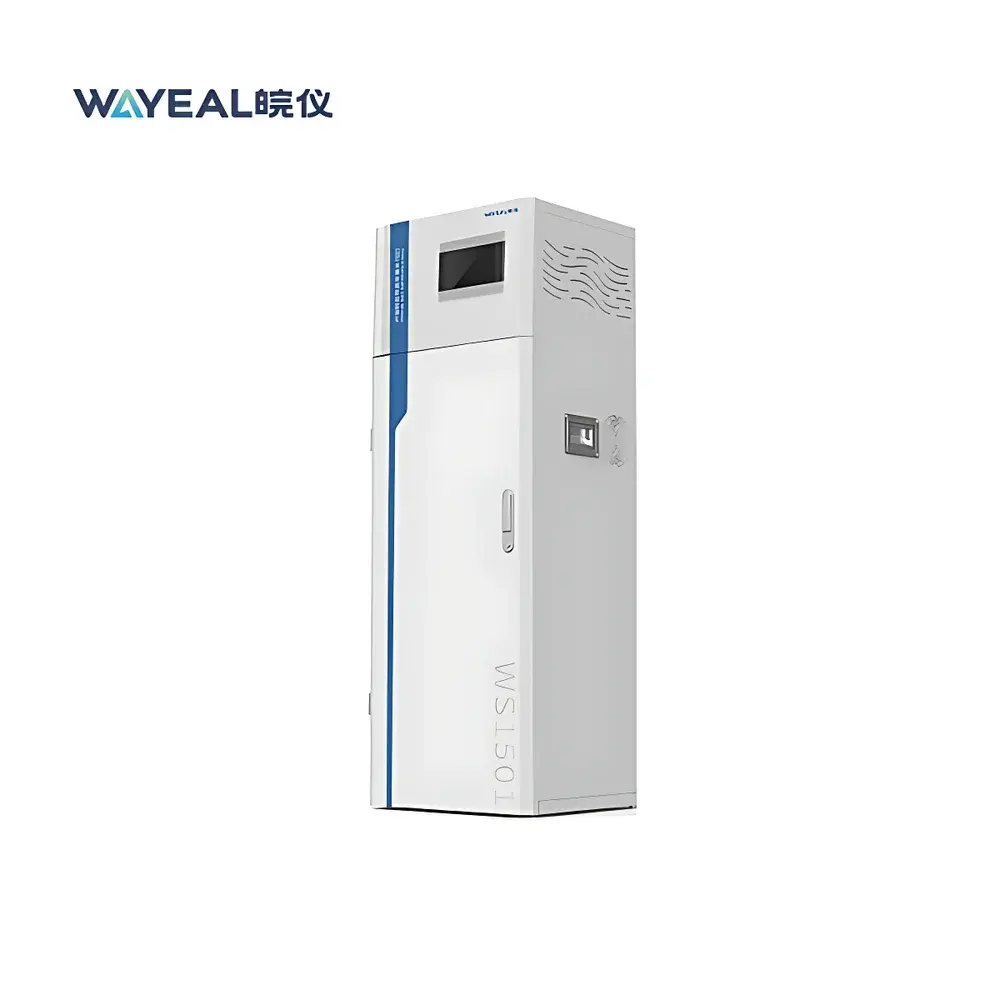
WS1501 CODCr Online Automatic Water Quality Monitor by WAYEAL
| Brand | WAYEAL |
|---|---|
| Origin | Anhui, China |
| Manufacturer Type | Direct Manufacturer |
| Product Origin | Domestic (China) |
| Model | WS1501 |
| Pricing | Available Upon Request |
Overview
The WAYEAL WS1501 CODCr Online Automatic Water Quality Monitor is a fully automated, laboratory-grade analyzer engineered for continuous, unattended measurement of Chemical Oxygen Demand (COD) in accordance with the standardized dichromate oxidation method (ISO 6060 / HJ 399–2017). It implements the classical open-reflux or high-pressure sealed digestion principle—specifically adapted for online operation—where water samples are reacted with a precisely dosed potassium dichromate (K₂Cr₂O₇) solution under strongly acidic conditions (concentrated H₂SO₄), catalyzed by silver sulfate (Ag₂SO₄) and masked for chloride interference using mercury sulfate (HgSO₄). Digestion occurs at 165 °C under controlled pressure within a sealed quartz or borosilicate glass reaction cell. The resulting reduction of Cr(VI) to Cr(III) induces a stoichiometric color change proportional to the oxidizable organic content. This absorbance shift is quantified via dual-wavelength photometry (typically 600 nm and 700 nm), enabling robust compensation for turbidity and matrix effects. Designed for deployment in municipal wastewater treatment plants, industrial effluent discharge points, and environmental monitoring stations, the WS1501 delivers regulatory-compliant COD data traceable to national standard reference materials.
Key Features
- Triple-stage precision optical fluidic metering system: Ensures sub-milliliter reagent dispensing accuracy and repeatability (<±0.5% RSD), minimizing volumetric drift caused by peristaltic tube fatigue or compression hysteresis.
- Real-time temperature compensation algorithm integrated with PT100-grade thermal sensors: Maintains calibration stability across ambient operating ranges from 5 °C to 40 °C without manual recalibration.
- Active ambient light rejection architecture: Combines synchronized LED pulsing, optical bandpass filtering, and dark-current subtraction to eliminate photometric error from fluctuating ambient illumination.
- Fail-safe digestion module: Includes redundant pressure transducers (0–2.0 MPa range), overtemperature cutoff (170 °C hard limit), and conductive leak detection electrodes embedded in the chassis baseplate.
- Field-editable maintenance sequence logic: Operators can customize cleaning cycles, calibration intervals, and diagnostic routines via the onboard HMI—no firmware update or PC connection required.
- Electromechanically interlocked safety door: Automatically de-energizes heating elements and high-voltage valves upon door opening; meets IEC 61000-6-2 EMC and IP54 enclosure rating requirements.
Sample Compatibility & Compliance
The WS1501 accepts raw influent, secondary effluent, and industrial discharge streams with suspended solids ≤ 100 mg/L and chloride concentrations up to 2,000 mg/L (with standard HgSO₄ masking). It complies with Chinese Environmental Protection Standards HJ 353–2019 (Technical Specifications for Installation and Acceptance of Online Monitoring Systems for Water Pollutants) and HJ 354–2019 (Technical Specifications for Operation and Maintenance). Data integrity conforms to GLP-aligned audit trail requirements, including timestamped event logging for sample injection, digestion start/stop, photometric reading, and fault recovery—supporting retrospective validation under local MEE (Ministry of Ecology and Environment) audits. While not certified to US EPA Method 410.4 or ISO 15705, its analytical principle and performance envelope align with those protocols for comparative monitoring applications.
Software & Data Management
The embedded Linux-based controller runs WAYEAL’s proprietary WQ-OS v3.2 firmware, supporting Modbus TCP, RS485/RTU, and optional 4–20 mA analog output (HART-enabled). All measurements, diagnostics, and maintenance logs are stored locally on encrypted microSD (≥32 GB) with configurable retention policies (default: 180 days). Remote access is enabled via TLS 1.2-secured web interface (HTTPS), permitting real-time parameter adjustment, historical trend review (up to 10 years aggregated), and export in CSV or PDF formats. Audit trails meet basic 21 CFR Part 11 readiness criteria—including user role-based authentication (admin/operator/observer), electronic signatures for calibration verification, and immutable log entries with SHA-256 hashing.
Applications
- Continuous compliance monitoring at municipal wastewater treatment plant (WWTP) discharge outfalls per GB 18918–2002 Class A/B limits.
- Real-time process control feedback for activated sludge, MBR, and SBR systems—enabling dynamic aeration optimization and chemical dosing adjustments.
- Industrial pretreatment verification at textile, pharmaceutical, food & beverage, and chemical manufacturing facilities prior to sewer discharge.
- Early-warning detection of accidental spills or process upsets through deviation analysis of 24-hour moving average COD trends.
- Integration into SCADA networks for centralized environmental data aggregation across multi-site operations.
FAQ
What digestion method does the WS1501 employ, and how does it differ from open-reflux benchtop procedures?
It uses a pressurized, sealed-tube digestion at 165 °C for 15 minutes—reducing total cycle time to ≤30 minutes while maintaining equivalence to ISO 6060. No manual cooling or titration is required.
Can the instrument handle high-chloride wastewater without dilution?
Yes—standard configuration includes 10:1 HgSO₄-to-Cl⁻ molar masking, supporting up to 2,000 mg/L Cl⁻. For >5,000 mg/L, optional chloride-resistant electrode modules are available.
Is remote firmware upgrade supported?
Yes—via secure HTTPS upload with checksum validation and rollback capability in case of interrupted update.
What maintenance intervals are recommended for routine operation?
Reagent replacement every 30 days; quartz digestion cell cleaning every 90 days; optical window wipe every 7 days; full system calibration verification quarterly.
Does the system support integration with third-party LIMS or cloud platforms?
Yes—through RESTful API (JSON over HTTPS) and OPC UA gateway options, enabling bidirectional data exchange with LabVantage, Thermo Fisher SampleManager, or AWS IoT Core.







