
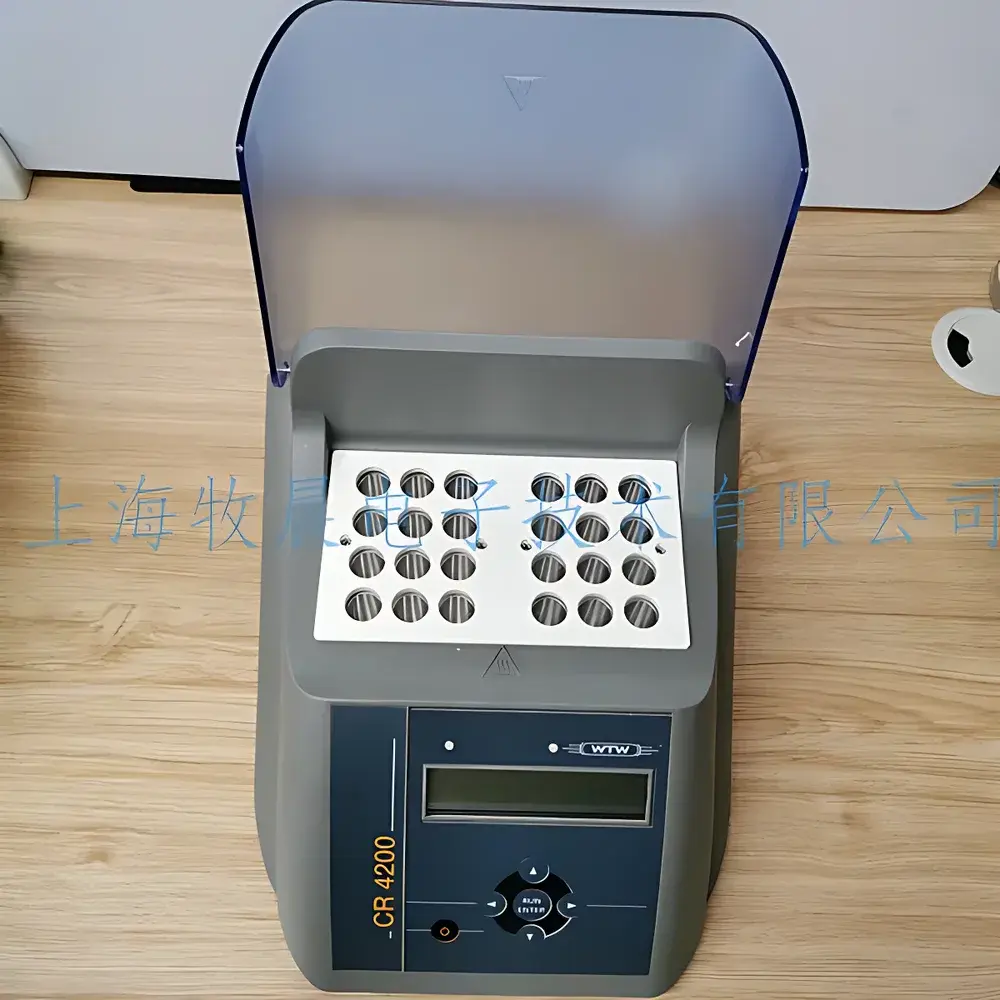
WTW CR 4200 Advanced Dual-Block COD Digestion System
| Brand | WTW |
|---|---|
| Origin | Germany |
| Model | CR 4200 |
| Digestion Method | Rapid Thermal Digestion |
| Heating Blocks | Dual independent 12-position blocks |
| Sample Capacity | 24 × 16 mm OD reaction tubes |
| Temperature Range | 25–170 °C |
| Time Range | 0–180 min |
| Temperature Accuracy | ±1 °C |
| Temperature Stability | ±0.5 K |
| Overtemperature Protection | 190 ±5 °C |
| Heating Rate | 25→100 °C in ≤5 min, 25→120 °C in ≤7 min, 25→148 °C in ≤10 min |
| Power Supply | 230 VAC/50 Hz or 115 VAC/60 Hz |
| Power Consumption | 560 W |
| Operating Temperature | +5 to +40 °C |
| Storage Temperature | –25 to +65 °C |
| Dimensions (W×D×H) | 292 × 245 × 180 mm |
| Weight | 3.6 kg |
| Communication Interface | RS-232 |
| Certified Compliance | GS, CE, cETLus |
| Optional Accessory | External temperature probe TFK CR (Art. No. 250100) |
Overview
The WTW CR 4200 Advanced Dual-Block COD Digestion System is a precision-engineered thermal digestion instrument designed for standardized, reproducible sample preparation in environmental water quality laboratories. It operates on the principle of controlled conductive heating via two independently regulated aluminum heating blocks, enabling simultaneous or staggered digestion of up to 24 samples in 16 mm OD borosilicate glass or PTFE-lined reaction tubes. The system is optimized for oxidation-based analytical methods including Chemical Oxygen Demand (COD) determination per ISO 6060 and DIN 38409-H41, as well as total nitrogen (TN) and total phosphorus (TP) digestion according to ISO 11908 and ISO 11885. Its thermally stable architecture ensures uniform heat distribution across all positions—critical for minimizing inter-sample variability and meeting the stringent repeatability requirements of accredited environmental testing labs.
Key Features
- Dual independent 12-position heating blocks with individual thermal control—enabling parallel processing of heterogeneous sample batches or method validation studies.
- Seven pre-programmed digestion protocols covering common regulatory methods: 148 °C / 120 min (standard COD), 120 °C / 30, 60, and 120 min (TN/TP variants), and 100 °C / 60 min (low-temperature hydrolysis).
- Eight user-definable temperature/time profiles stored in non-volatile memory—supporting method development, validation, and adaptation to emerging EPA or ISO draft protocols.
- Integrated safety hood with transparent polycarbonate shield—mechanically interlocked to disable heating when opened, complying with EN 61000-6-4 (EMC) and EN 61010-1 (safety) requirements.
- Overtemperature cut-off at 190 ±5 °C with audible and visual alarm—preventing thermal runaway during unattended operation or reagent failure events.
- Real-time digital temperature display with LED status indicators for power, heating, and completion—ensuring immediate operational awareness without software dependency.
- RS-232 serial interface for external data logging, remote start/stop, and integration into LIMS or ELN environments under GLP-compliant audit trails.
Sample Compatibility & Compliance
The CR 4200 accommodates standard 16 mm outer diameter digestion tubes used with Hach, Lovibond, and Merck test kits—including closed-tube high-pressure systems rated to 2 bar. Its thermal profile fidelity supports digestion of diverse matrices: municipal wastewater, industrial effluents, surface water, and sludge extracts. All factory-set programs align with the time–temperature envelopes specified in ISO 6060:2023 (COD), ISO 11908:2018 (TN), and ISO 11885:2018 (TP). Device certification includes GS (Geprüfte Sicherheit), CE (Low Voltage Directive 2014/35/EU and EMC Directive 2014/30/EU), and cETLus (UL 61010-1, CSA C22.2 No. 61010-1)—validating conformity with North American and European laboratory safety frameworks. When paired with the optional TFK CR external temperature probe (Art. No. 250100), the system enables traceable calibration verification per ISO/IEC 17025:2017 Clause 6.4.10.
Software & Data Management
While the CR 4200 operates autonomously via front-panel controls, its RS-232 port allows bidirectional communication with host PCs running terminal emulation or custom LabVIEW/Python scripts. Temperature setpoints, actual block temperatures, elapsed time, and end-of-cycle status are transmitted at 1-second intervals. Data output is ASCII-formatted and compatible with CSV import into Excel or statistical analysis platforms such as JMP or Minitab. For regulated environments, the system supports 21 CFR Part 11–compliant electronic records when interfaced with validated third-party data acquisition software that implements user authentication, audit trail generation, and electronic signature capture. Firmware updates are performed offline via USB-to-serial adapter—no cloud connectivity required.
Applications
- Routine COD analysis in municipal wastewater treatment plants per ISO 6060 or ASTM D1252–12 (Method B).
- Total nitrogen quantification in drinking water sources using alkaline persulfate digestion (ISO 11908).
- Total phosphorus determination in eutrophication monitoring programs (ISO 11885).
- Method validation and inter-laboratory comparison studies requiring identical thermal exposure conditions.
- QC/QA batch processing where temperature uniformity across 24 positions must remain within ±0.5 K over full runtime.
- Training laboratories requiring intuitive operation, physical safety redundancy, and regulatory documentation readiness.
FAQ
Does the CR 4200 support temperature calibration verification?
Yes—when used with the optional TFK CR external temperature probe (Art. No. 250100), the device outputs real-time comparison data between setpoint and measured block temperature, enabling periodic calibration checks traceable to NIST-certified references.
Can both heating blocks operate at different temperatures simultaneously?
No—the CR 4200 features dual blocks but shares a single temperature control loop; both blocks maintain identical setpoints. For differential thermal protocols, sequential operation is recommended.
Is the RS-232 interface compatible with modern Windows/macOS systems?
Yes—via standard USB-to-RS-232 adapters (e.g., FTDI-based), with no proprietary drivers required. Baud rate is fixed at 9600, 8-N-1 configuration.
What maintenance is required to ensure long-term thermal accuracy?
Annual verification using a calibrated reference thermometer inserted into a dummy tube is recommended. Cleaning of heating block grooves with isopropanol and lint-free swabs prevents residue buildup affecting thermal contact.
Does the unit comply with GLP documentation requirements?
The hardware itself does not generate electronic signatures, but its RS-232 output—when captured by validated LIMS or ELN software—fully satisfies GLP data integrity clauses for raw instrument data recording and retention.
Related Products







