
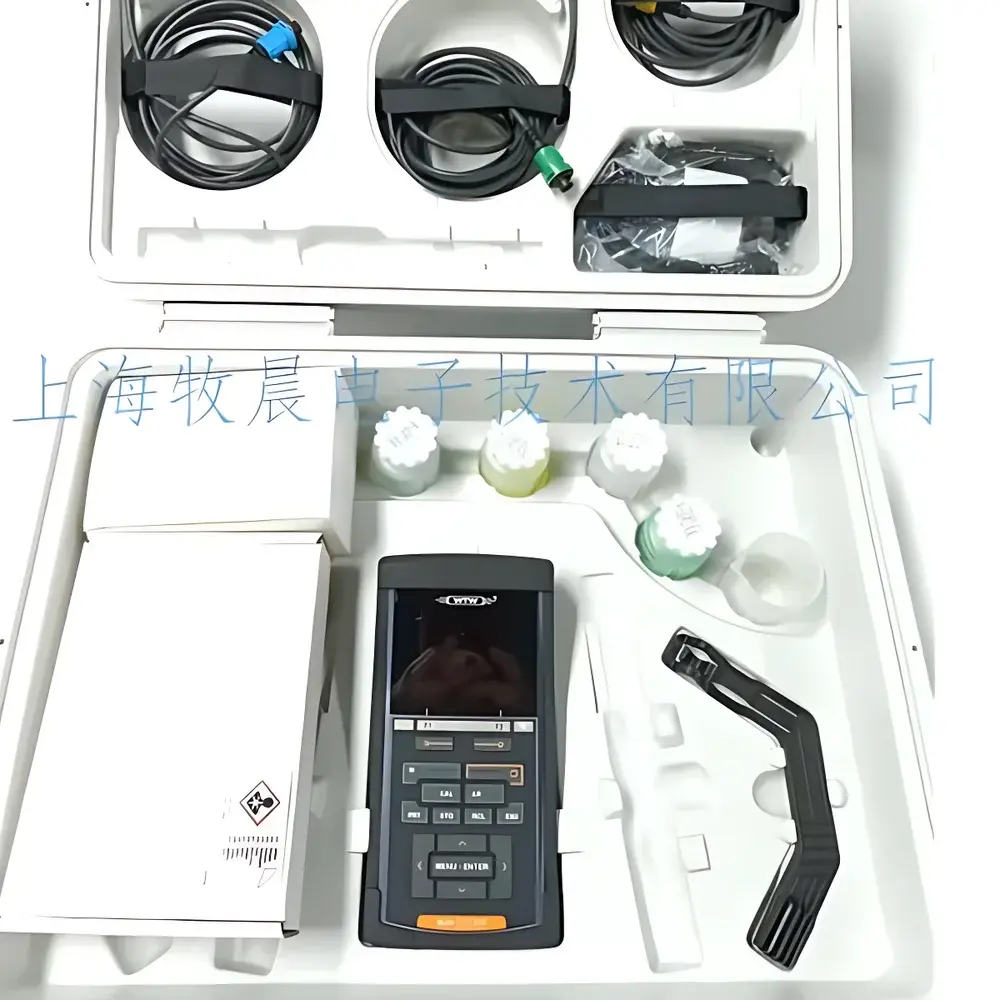
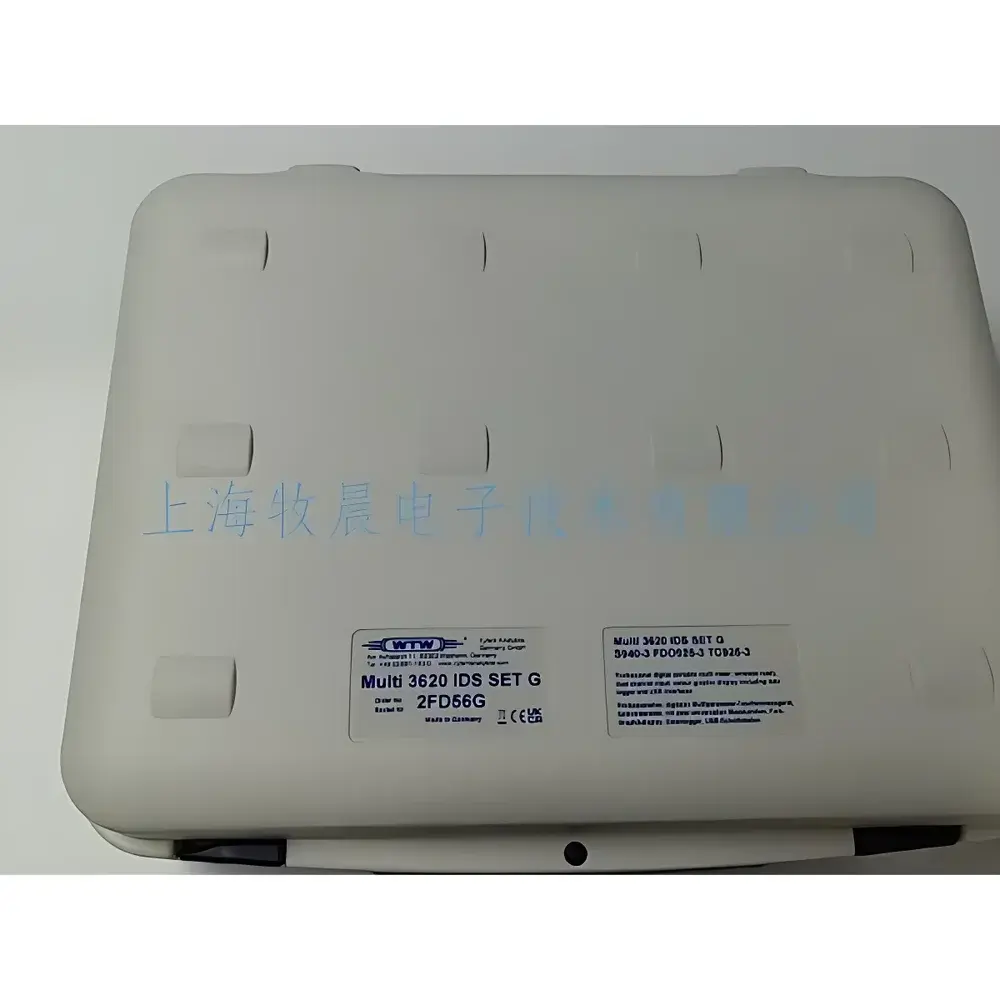
WTW Multi 3620 Portable Multi-Parameter Water Quality Analyzer
| Brand | WTW |
|---|---|
| Origin | Germany |
| Model | Multi 3620 |
| Instrument Type | Portable/Handheld Water Quality Analyzer |
| Detection Principle | Electrochemical Sensing (pH, ORP, Conductivity, DO) & Nephelometric Turbidity Measurement |
| Measured Parameters | pH, ORP, Dissolved Oxygen (DO), Conductivity, Turbidity (NTU/FNU) |
| Display | Color Graphic LCD |
| Data Storage | Up to 10,000 datasets (manual + auto logging) |
| Measurement Channels | 2 simultaneous digital IDS probe inputs |
| Communication | USB-B, optional wireless module (Bluetooth® Class 1, up to 10 m range) |
| Protection Rating | IP67 |
| Power Supply | 4 × AA alkaline or 4 × NiMH rechargeable batteries (1.2 V), or USB bus power |
| Compliance | CE-marked, designed per IEC 61000-6-2/-4 for electromagnetic immunity in field environments |
Overview
The WTW Multi 3620 is a high-precision, field-deployable multi-parameter water quality analyzer engineered for rigorous environmental monitoring and process control applications. Built upon WTW’s Intelligent Digital Sensor (IDS) platform, it employs digital signal transmission to eliminate analog noise, ensure long-term calibration stability, and enable plug-and-play recognition of certified IDS probes. The instrument operates on electrochemical principles for pH, ORP, conductivity, and dissolved oxygen measurements—utilizing temperature-compensated potentiometric, conductometric, and optical luminescence (FDO) methodologies—and applies 90° nephelometry at 860 nm for turbidity quantification per ISO 7027-1:2016. Its dual-channel architecture supports concurrent measurement of two independent parameters (e.g., pH + DO or conductivity + turbidity), while its IP67-rated housing ensures reliable operation in rain, dust, submerged splashing, and wastewater treatment plant environments.
Key Features
- Dual digital IDS probe interface with automatic sensor identification and embedded calibration history storage
- Optical dissolved oxygen sensing via fluorescence quenching (FDO 925), eliminating membrane replacement and electrolyte maintenance
- Integrated temperature compensation across all parameters using built-in or probe-mounted Pt1000 sensors (±0.2 °C accuracy)
- Color graphic LCD with intuitive icon-based navigation and real-time trend plotting
- Onboard data logger storing up to 10,000 measurement sets with time/date stamp, GPS tagging (when paired with external Bluetooth GNSS receiver), and user-defined sampling intervals
- USB-B port for direct PC connectivity; supports mass-storage mode for firmware updates and raw CSV export without proprietary software
- Wireless capability via optional Bluetooth 4.2 module (Class 1), enabling remote probe deployment and real-time telemetry to mobile tablets or ruggedized field laptops
- Comprehensive electrode diagnostics including pH slope monitoring, response time evaluation, and reference junction status reporting
Sample Compatibility & Compliance
The Multi 3620 is validated for use with natural waters (rivers, lakes, groundwater), effluents, activated sludge, drinking water distribution systems, and industrial process streams. It accommodates WTW’s full suite of IDS probes—including SenTix 980 (high-accuracy pH), FDO 925 (optical DO), TetraCon 925 (4-electrode conductivity), and VisoTurb 900-P (ISO-compliant turbidity)—all traceable to national metrology institutes. The system adheres to key regulatory frameworks: measurement uncertainty budgets align with ISO/IEC 17025 requirements for accredited labs; data integrity meets ALCOA+ principles; and audit trails support GLP and GMP-aligned workflows. While not FDA 21 CFR Part 11–certified out-of-the-box, its secure USB data export and timestamped logs facilitate integration into validated electronic lab notebook (ELN) or LIMS environments.
Software & Data Management
Data acquisition and post-processing are supported via WTW’s free LabX® Lite software (Windows/macOS), which imports .csv and .wtw files for statistical analysis, report generation (PDF/Excel), and compliance-ready documentation. All calibration curves—including multi-point pH and conductivity calibrations—are stored within each IDS probe’s memory chip, ensuring full traceability across instruments and operators. The analyzer maintains a local event log capturing calibration events, battery status changes, probe swaps, and error codes—accessible directly on-device or exported. No cloud dependency or subscription service is required; all firmware updates are distributed as signed binaries via WTW’s public support portal.
Applications
- Regulatory surface water and wastewater monitoring per EU WFD, US EPA Method 180.1 (turbidity), and ASTM D8082 (conductivity)
- In-situ profiling of stratified reservoirs and sediment porewater using the MPP 930 IDS deep-water probe (rated to 10 bar / 100 m depth)
- QA/QC verification during drinking water disinfection processes (e.g., chlorine contact tank DO/pH correlation studies)
- Industrial pretreatment compliance checks for textile, food & beverage, and pharmaceutical facilities
- Educational fieldwork and student-led environmental science projects requiring robust, low-maintenance instrumentation
FAQ
Does the Multi 3620 support simultaneous 3-parameter measurement?
No—the instrument has two physical IDS input channels and can acquire data from two probes concurrently. For three or more parameters, sequential measurement or use of integrated multi-sensor probes (e.g., MPP 930 IDS) is required.
Can calibration data be transferred between instruments?
Yes—calibration coefficients and history are stored in the probe’s internal memory, not the meter. Any WTW IDS-compatible analyzer will recognize and apply the stored calibration upon connection.
Is the VisoTurb 900-P turbidity sensor compliant with ISO 7027-1?
Yes—it uses an 860 nm LED light source and 90° detection geometry, meeting the spectral and angular specifications defined in ISO 7027-1:2016 for formazin-equivalent turbidity units (FNU).
What is the maximum operational depth for deep-water measurements?
When equipped with the MPP 930 IDS probe and appropriate pressure-rated cable, the system is rated for continuous operation at 10 bar (equivalent to 100 m freshwater depth), with pressure compensation applied in real time.
How is data security ensured during USB transfer?
All exported files include embedded metadata (operator ID, location tag if available, instrument serial number, and cryptographic checksum), and no executable code or macros are embedded—ensuring compatibility with air-gapped laboratory networks.
Related Products







